
The best towns with a World Heritage site within 90 minutes of Brescia
The country between Brescia and the Po is flat, misty and worked, planted with rice and maize, and the towns that rise out of it are built of brick the colour of dried apricot. East of the city the land lifts into moraine hills and then drops to Lake Garda, where the water carries olive terraces and lemon houses on its shoulders. Autumn is the season here: pumpkin tortelli with amaretti crushed into the filling, freshwater pike under salsa, Franciacorta poured cold, chestnuts on the foothill roads. Winter brings fog that flattens the arcades into charcoal drawings, which is its own reason to come.
Most visitors treat Brescia as a stopover on the way to Verona or Milan, and both cities absorb the crowds accordingly. Verona in particular fills its arena and its Piazza delle Erbe from spring through the opera season, coach parties moving in the same loop between the balcony and the river. It is a magnificent city and it has earned its listing, but a summer afternoon there is largely spent queueing.
The World Heritage listings do not stop at the big two. They continue across the plain and along the lake in the form of a purpose-built ducal town laid out on paper, a company village of workers' houses beside a hydroelectric channel, a stretch of Venetian bastions guarding a river mouth on Garda, arcades, courtyards and villas. These are the smaller places holding those sites, all inside a reasonable radius of Brescia, and fewer people go.
Of the 49 communes we have mapped in a 90-minute drive of Brescia, 6 qualify as towns with a World Heritage site: each holds a site UNESCO has listed. The smallest, Sabbioneta, has 4,096 residents.
If you are still choosing, we have also written The best towns with a World Heritage site within 90 minutes of Verona and The best towns with a World Heritage site within two hours of Parma.
Sabbioneta
Why visit Sabbioneta
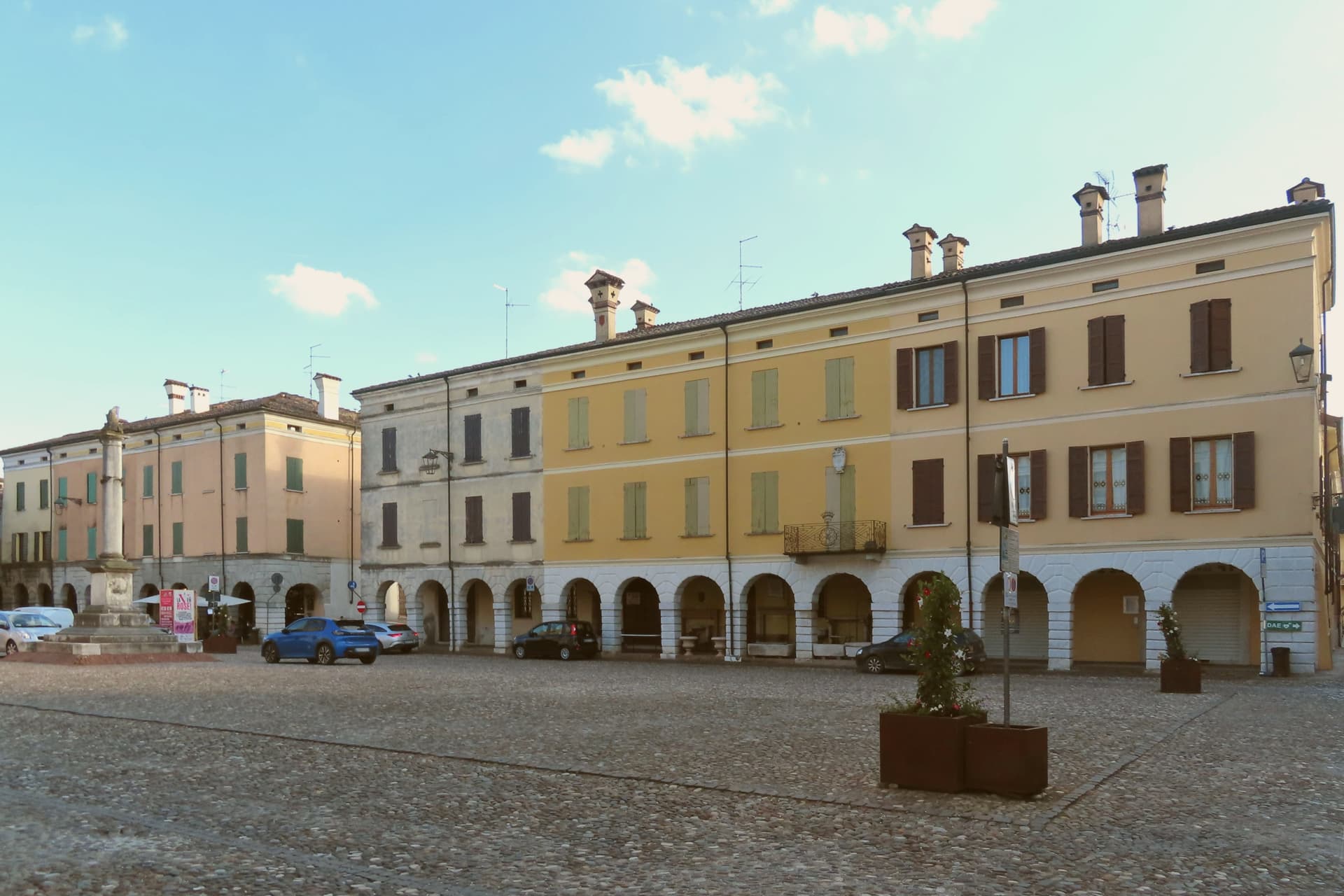
Sabbioneta sits at about 25 meters on a sandy bank of the Po, north of Parma and southwest of Mantova. Vespasiano I Gonzaga, a cadet of the Mantuan line, founded it in the late sixteenth century along the Roman Via Vitelliana as his personal fortress and ducal seat, built almost in one campaign between 1554 and 1591.
The town is organized around two main axes and two squares, with the star walls set at a fixed distance from that grid so the fortification and the street plan read as a single design rather than a wall added to an existing settlement. Vespasiano commissioned the theatre, the gallery, and the two palaces in sequence, each filling a distinct role in the ducal seat: a residence, a pleasure palace, a display case for his marbles, a place for performance.
The church holds his tomb, closing the set with a mausoleum built to the same scale as everything else he raised. What results is a town where every set piece was planned as part of one court rather than accumulated over generations, which is the quality that put it alongside Mantua as the planned counterpart to the organic city.
What to see in Sabbioneta
- Teatro all'Antica. Designed by Vincenzo Scamozzi with a raked wooden cavea and a painted false loggia opening onto a sky that never changes. It still stands as it was built for the Gonzaga court.
- Galleria degli Antichi. 97-meter arcaded gallery built to display Vespasiano's collection of ancient marbles, the longest such gallery of its period. The arcade runs in a single unbroken line, a corridor meant to be walked past statues rather than stood in.
- Palazzo Ducale. Vespasiano's main residence on Piazza Ducale, with frescoed rooms, wooden equestrian statues of the Gonzaga ancestors and gilded ceilings.
How to get to Sabbioneta
Parma is roughly 40 minutes away by road.
Our tip
April through June and September into October are the months Sabbioneta opens up. The Teatro all'Antica and the Galleria degli Antichi keep regular hours, the Po plain is green or gold depending on the half, and the bike path along the Oglio is rideable. July and August are humid and still: shade on the Piazza Ducale stays in short supply, and afternoons empty the centro storico.
Capriate San Gervasio
Why visit Capriate San Gervasio
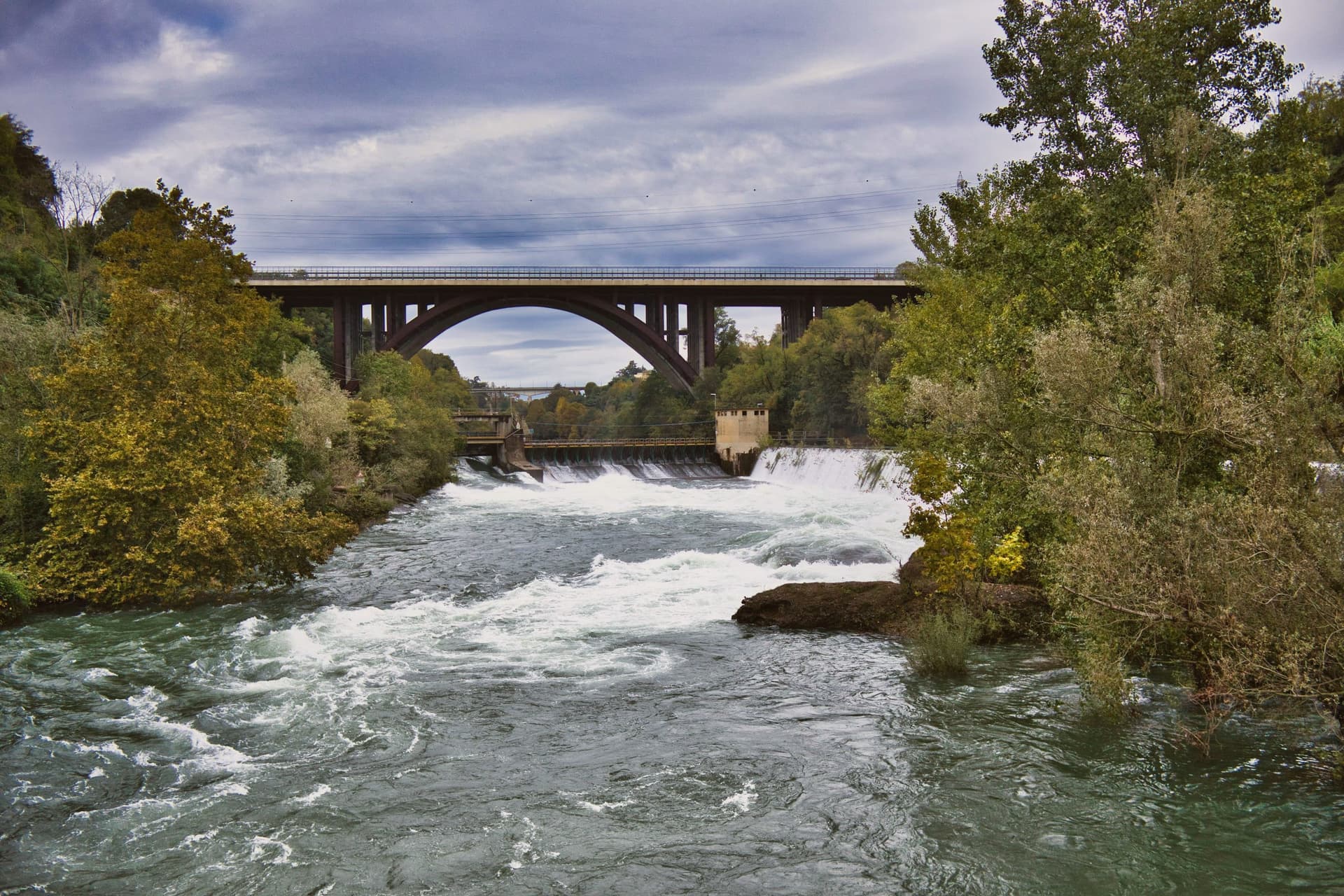
Capriate San Gervasio sits at the southern tip of the Isola Bergamasca, the wedge of plain between the Adda and Brembo, thirty kilometers northeast of Milano. The comune holds three historic settlements on three terraces: San Gervasio d'Adda to the north, Capriate d'Adda in the middle, and Crespi d'Adda at the southern point, where the two rivers nearly meet.
Crespi d'Adda was founded in the 1870s by the textile industrialist Cristoforo Benigno Crespi to house workers in his cotton mill, and completed by his son Silvio after study tours of German and English company towns. The plan is geometrically regular: the mill and offices on the left bank, workers' housing across the road on a grid.
Each family had a multi-family house with a garden. The village added a clinic, school, theatre, cooperative, hydroelectric station, sports field, priest's house, doctor's house and a Crespi mausoleum on the hill above.
UNESCO inscribed it in 1995 as one of the most intact European company towns. The mill closed in 2003.
What to see in Capriate San Gervasio
- Villaggio Operaio di Crespi d'Adda. UNESCO-listed industrial village founded 1870s by Cristoforo Benigno Crespi, completed by his son Silvio after studying German and English company towns.
- Mausoleo Crespi. Family mausoleum on the hill above the village, in an Indo-Cambodian inspired style, the most photographed building of the Crespi complex.
- Cotonificio Benigno Crespi. The cotton mill across the road from the workers' housing, the centerpiece of the company town, in redevelopment as a cultural hub from 2025.
How to get to Capriate San Gervasio
Bergamo is roughly 19 minutes away by road.
Our tip
April through June and September into October are the workable months on the Po Valley plain. The riverbanks of the Adda are dry and walkable, the cycle path through the Parco Adda Nord is in shade, the Crespi village stands cleanly in mid-season light. July and August bring humid heat above thirty degrees, with mosquitoes along the rivers.
Peschiera del Garda
Why visit Peschiera del Garda
Peschiera sits at 68 meters on the Mincio at the point where the river leaves Lake Garda, twenty-five kilometers west of Verona. The Romans called it Ardelica.
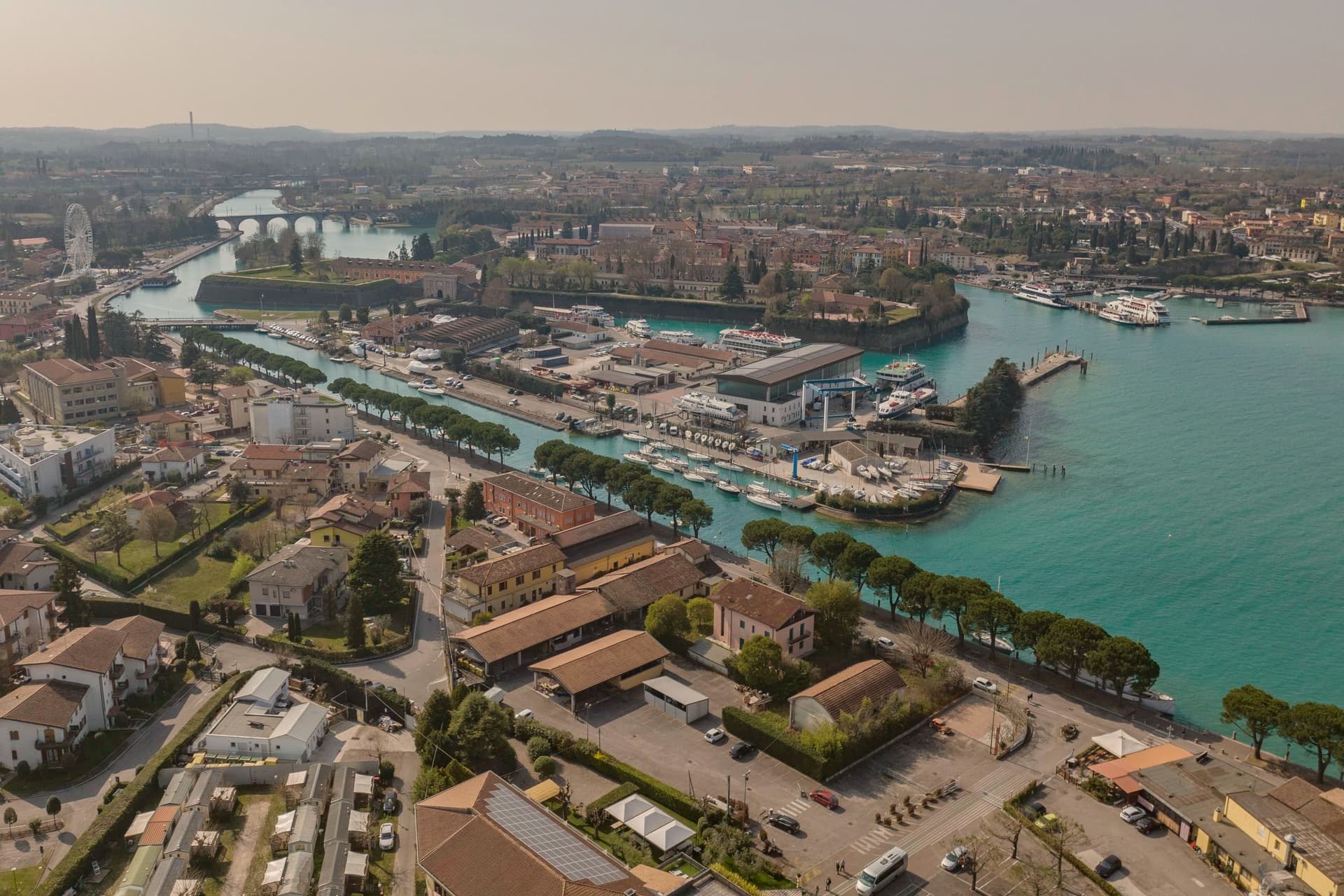
The town the Republic of Venice rebuilt in 1549 was set on the medieval walls' corners, with a moat fed by the river, and the design came from Guidobaldo della Rovere before its execution on site. Austria took the town in 1815 and folded it into a wider system with Verona, Mantua and Legnago, the four together holding Lombardy-Venetia until 1866; Peschiera held the northwest corner of that arrangement, the point closest to the lake.
The fortress and the marsh settlement belong to different periods and different UNESCO listings, one Bronze Age and lakeside, one sixteenth-century and defensive, but both sit on the same stretch of water where the Mincio gathers itself before running south. The river itself is the town's organizing fact: it leaves the lake, splits into three canals to cross the walls, and rejoins below the railway bridge.
What Peschiera adds up to is a place built twice on the same threshold, where a lake becomes a river and a river becomes a border worth fortifying.
What to see in Peschiera del Garda
- Mura veneziane. Pentagonal fortress designed by Michele Sanmicheli for Venice from 1549, with five bastions, a moat fed by the Mincio and three water gates.
- Canali del Mincio. Three canals cross the fortress and rejoin below the railway bridge; the central one runs through the main square inside the walls.
- Piazza Ferdinando di Savoia. Main square inside the walls, bordered by the Palazzo del Comando, the Voltoni arches over the Mincio and the Caserma Catterin.
How to get to Peschiera del Garda
There is a railway station in the town, so you can arrive without a car and never need one while you are here. Verona is roughly 30 minutes away by road.
Our tip
April through June and September through October are the strongest months in Peschiera. The fortress walls, the moat and the Mincio canals are at their clearest in spring and autumn, and the lakefront south of the walls fills with sailing and ferry traffic. July and August push past thirty degrees and the southern Garda concentrates much of the lake's day-trip volume; the parking lots around the railway station queue from midmorning.
Mantova
Why visit Mantova
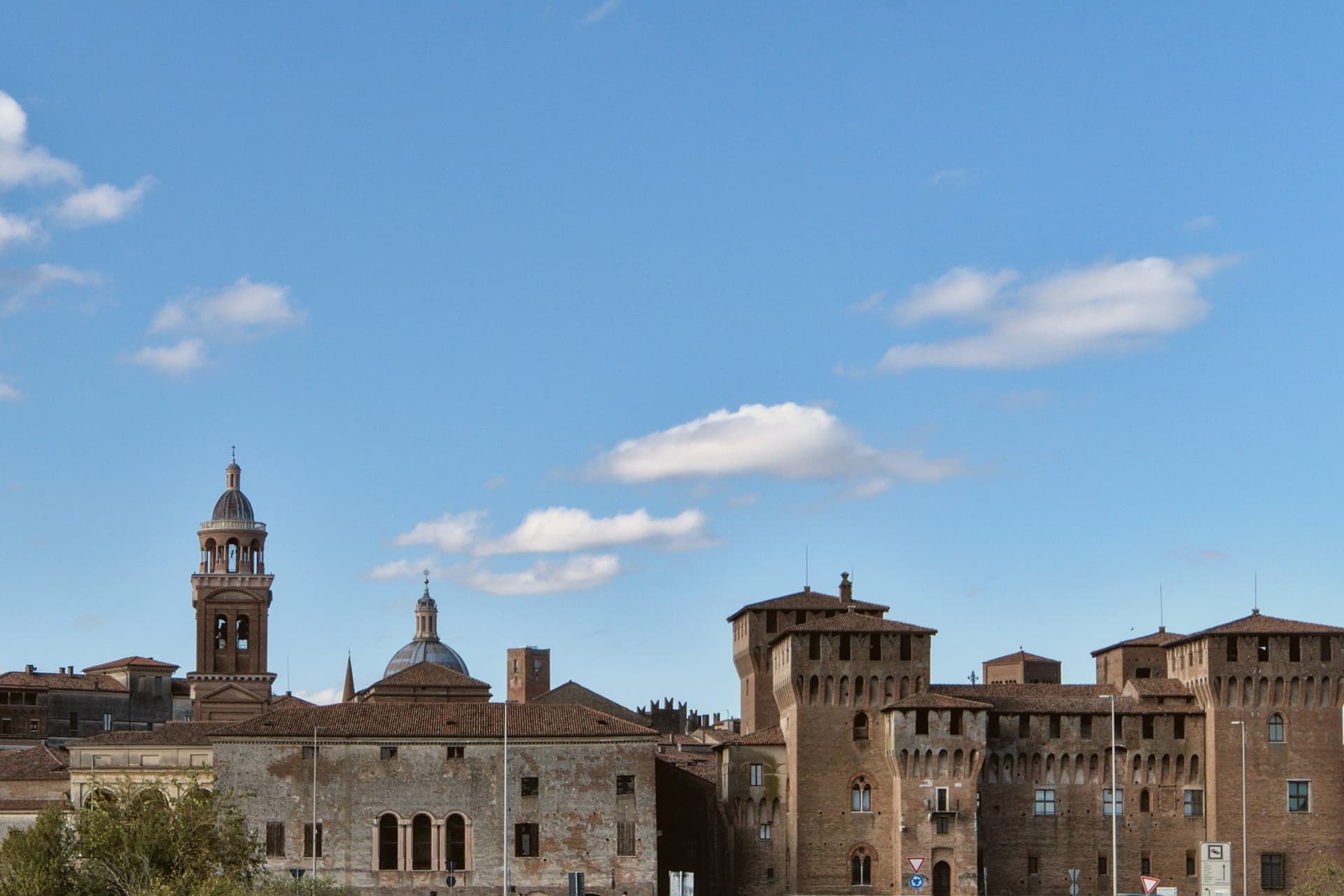
Mantova sits at 19 meters on a peninsula in the Mincio, halfway between Milan and Venice. In the twelfth century the river was dammed into three artificial lakes, Superiore, di Mezzo and Inferiore, which still ring the city on three sides and worked as its defence for six centuries.
From 1328 to 1707 it was the seat of the Gonzaga. The Palazzo Ducale they assembled across that span covers 34,000 square meters between Piazza Sordello and Lago di Mezzo, with over a thousand rooms; the Camera degli Sposi, frescoed by Andrea Mantegna between 1465 and 1474, is the heart of that complex.
Outside the walls, Federico II Gonzaga commissioned Giulio Romano to build Palazzo Te between 1525 and 1535: a pleasure villa with the Sala dei Giganti, whose painted Olympus collapses on the viewer from every wall. Mantua and Sabbioneta were jointly inscribed by UNESCO in 2008.
The city was Italian Capital of Culture in 2016.
What to see in Mantova
- Palazzo Ducale. Gonzaga ducal complex of 34,000 square meters between Piazza Sordello and Lago di Mezzo, with over a thousand rooms across four centuries of additions.
- Camera degli Sposi. Frescoed chamber by Andrea Mantegna inside the Palazzo Ducale, painted between 1465 and 1474, with an illusionistic oculus on the ceiling.
- Palazzo Te. Suburban pleasure villa built between 1525 and 1535 by Giulio Romano for Federico II Gonzaga, with the Sala dei Giganti and Sala di Amore e Psiche.
How to get to Mantova
There is a railway station in the town, so you can arrive without a car and never need one while you are here. Verona is roughly 39 minutes away by road.
Our tip
April through June and September into October are the months Mantova works best. The lakes hold light all day, the Palazzo Ducale is walkable without summer queues, and the surrounding bike paths to Peschiera del Garda run sixty kilometers along the Mincio. July and August get humid and still on the plain, with mosquitoes off the lakes and afternoons that empty the centro storico. Festival della sbrisolona e dei dolci italiani falls in October.
Vicenza
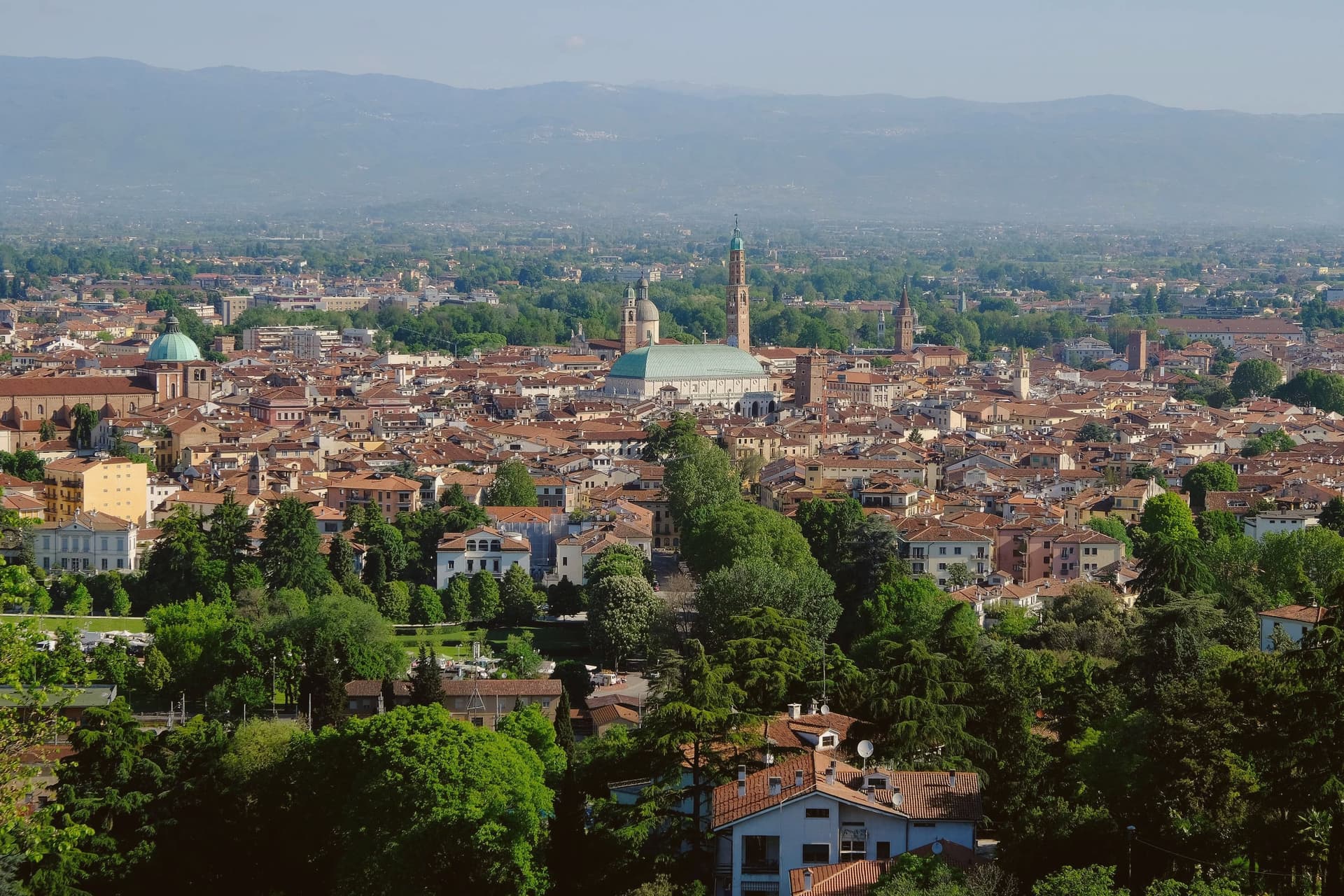
Why visit Vicenza
Vicenza is the city that made Palladio and that Palladio made. Andrea della Gondola — better known as Palladio — was a stonemason's apprentice in Vicenza in the 1520s, was renamed by his patron Trissino after the Greek goddess Pallas Athena, and spent the next 50 years building villas, palazzi and churches for the local Venetian-territory aristocracy.
The result: a 16th-century city of unprecedented architectural coherence, UNESCO-inscribed in 1994 as 'The City of Vicenza and the Palladian Villas of the Veneto'. The greatest hits cluster inside the walls: the Basilica Palladiana on Piazza dei Signori (his first major commission, 1549 — a Gothic medieval town hall wrapped in a white loggia of perfectly proportioned arches), Palazzo Chiericati (now the Pinacoteca), Loggia del Capitaniato, Palazzo Thiene, and the Teatro Olimpico — his final building (1580–1585), the world's oldest surviving indoor theatre, with a permanent trompe-l'œil stage set by Scamozzi depicting 'the seven streets of Thebes' in forced perspective.
A 20-minute walk south of the centro: Villa La Rotonda (1567), the symmetrical perfect-square villa that every American state capitol and Monticello copied. Vicenza also has Venice's gold and silver — half the gold sold in Italy passes through here annually (it's Europe's largest gold-jewellery district), and Vicenzaoro is the world's biggest gold trade fair.
Plus the Veneto kitchen: baccalà alla vicentina (salt cod with milk, anchovies and onions, served over polenta), bigoli with duck ragù, the local Lessini Durello sparkling wine, and Vicenza's own asparago bianco DOP in May.
What to see in Vicenza
- Basilica Palladiana + Piazza dei Signori. Palladio's 1549 wrap of perfect-proportioned white arches around the medieval Palazzo della Ragione — his first major commission, the building that made his name. The rooftop terrace is open and free.
- Teatro Olimpico. Palladio's final work (1580–85) and the world's oldest surviving indoor theatre. Scamozzi's permanent stage set shows 'the seven streets of Thebes' in trompe-l'œil forced perspective — they still perform here.
- Villa Capra 'La Rotonda'. The perfectly symmetrical 1567 villa on a hilltop 2 km south — a square plan with four identical pedimented porticoes, copied by Jefferson at Monticello and every state capitol in America.
How to get to Vicenza
There is a railway station in the town, so you can arrive without a car and never need one while you are here. Vicenza is roughly 3 minutes away by road.
Our tip
Vicenza is best from April through June and September through October — the Veneto plain gets hot and sticky in July and August, and the Palladian villas (especially the Rotonda) are most photogenic in low-angle spring or autumn light. May is asparago bianco season and the gardens are full. Winter is foggy and quiet but the indoor sights — Teatro Olimpico, the Pinacoteca, the basilica's interior — are at their most atmospheric. Festa dei Oto a Vicenza falls in August.
Bergamo
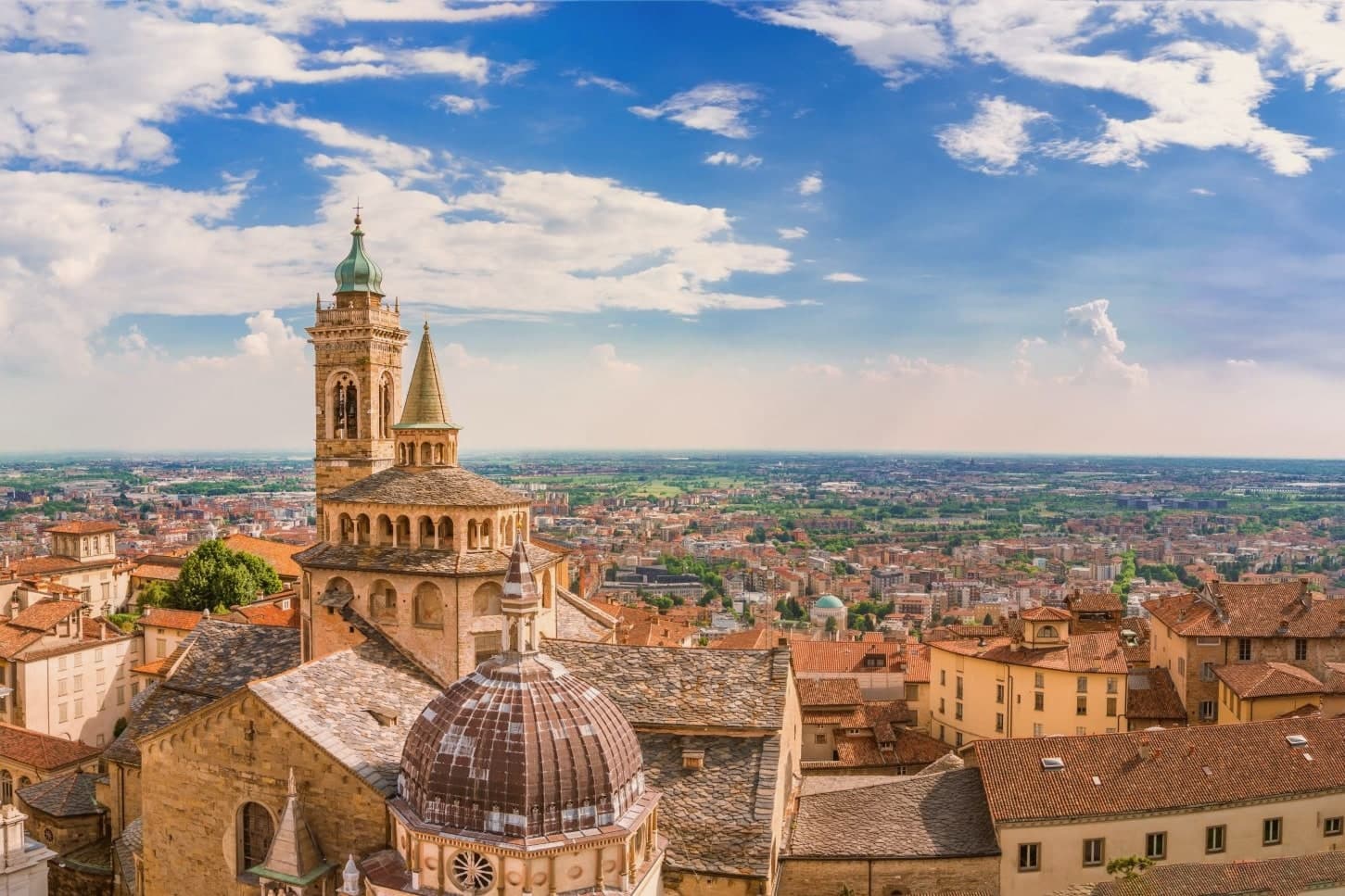
Why visit Bergamo
Bergamo's upper town occupies a spur of the Bergamasque foothills, and the lower town spreads onto the plain that runs southwest toward Milan. The walls that ring the hilltop cost the old town more than 250 buildings, including the original cathedral of Sant'Alessandro, demolished to clear ground for the defenses.
The circuit was built as part of a much larger Venetian project, inscribed together with the fortifications at Peschiera, Palmanova and sites on the Dalmatian coast: one defensive system spread across the Republic's frontier, of which this hilltop was the western anchor. The two halves of the city keep their own centuries.
The walled hilltop holds its medieval and Renaissance fabric inside the fortifications, reached by a funicular that has run the same route since the nineteenth century. The lower city is the newer half, built up through the nineteenth and twentieth centuries on the flat ground below.
Bergamo works as a place because that separation stayed intact instead of being built over: a fortified hill town and a modern city sharing one name but occupying two distinct centuries.
What to see in Bergamo
- Mura Venete. Eight bastions and four gates carry the circuit around the ridge of Città Alta, the walkway open along most of its length with views down over the lower town and the plain.
- Piazza Vecchia. Ringed by the Palazzo della Ragione, the Campanone tower, the Contarini fountain and the Biblioteca Mai, this is the square at the top of the funicular climb, the meeting point of Città Alta's streets.
- Basilica di Santa Maria Maggiore. The Romanesque exterior gives no hint of the Baroque interior inside, gilded and heavy with stucco, where the composer's tomb sits among the furnishings.
How to get to Bergamo
There is a railway station in the town, so you can arrive without a car and never need one while you are here. Bergamo is roughly 3 minutes away by road.
Our tip
April through June and September into October are the months Bergamo works best. Città Alta is walkable, the walls open at dawn, and the Accademia Carrara is uncrowded on weekday mornings. July and August are hot on the plain and full on the hill; the funicular waits stretch on weekends.
More from Anywhere Italy
- The best towns with a World Heritage site within 90 minutes of Verona
- The best towns with a World Heritage site within two hours of Parma
 The best towns with a World Heritage site within two hours of Trento
 The best towns with a World Heritage site in Lombardia
 The best towns with a World Heritage site that eat well in Veneto
 The best towns with a World Heritage site within 90 minutes of Milan