
The best towns with a World Heritage site that eat well in Veneto
Veneto eats seriously outside its famous restaurants. In the hills north of Treviso the vineyards are cut into slopes so steep the rows have to be worked by hand, and the villages between them are built in pale stone and stucco with porticoes deep enough to sit under in August. Autumn brings radicchio tardivo, forced in spring water and grilled with a little oil, alongside soppressa, sopa coada and polenta ground coarse. The wine is Prosecco made by people who resent what the word has come to mean, poured cold in bars that open early for the pickers.
Almost everyone arriving in the region goes to Venice, and the pressure on the lagoon city is now measured, taxed and argued over in the local press. It absorbs the cruise traffic, the day trips and the coach parties, and its restaurants have priced themselves for people who will eat there once. The World Heritage listing that draws those crowds is only one of several the region holds.
The others are inland and uphill. The Prosecco hills of Conegliano and Valdobbiadene carry the same designation, as do the Palladian villas scattered across the plain and the astronomical and artistic monuments of the university cities. Fewer people go to the towns in this list, and each of them has a table a dining guide has named, which in Veneto usually means an osteria that has been feeding the same families for a long time.
Of the 41 communes we have mapped in Veneto, 9 qualify as towns with a World Heritage site that eat well: each holds or sits inside a UNESCO World Heritage site, and a dining guide has named a table in each. The smallest, Cison di Valmarino, has 2,463 residents.
Two more lists worth reading alongside this one: The best towns with a World Heritage site within two hours of Trento and The 7 best hidden towns with a World Heritage site in Veneto.
Cison di Valmarino
Why visit Cison di Valmarino
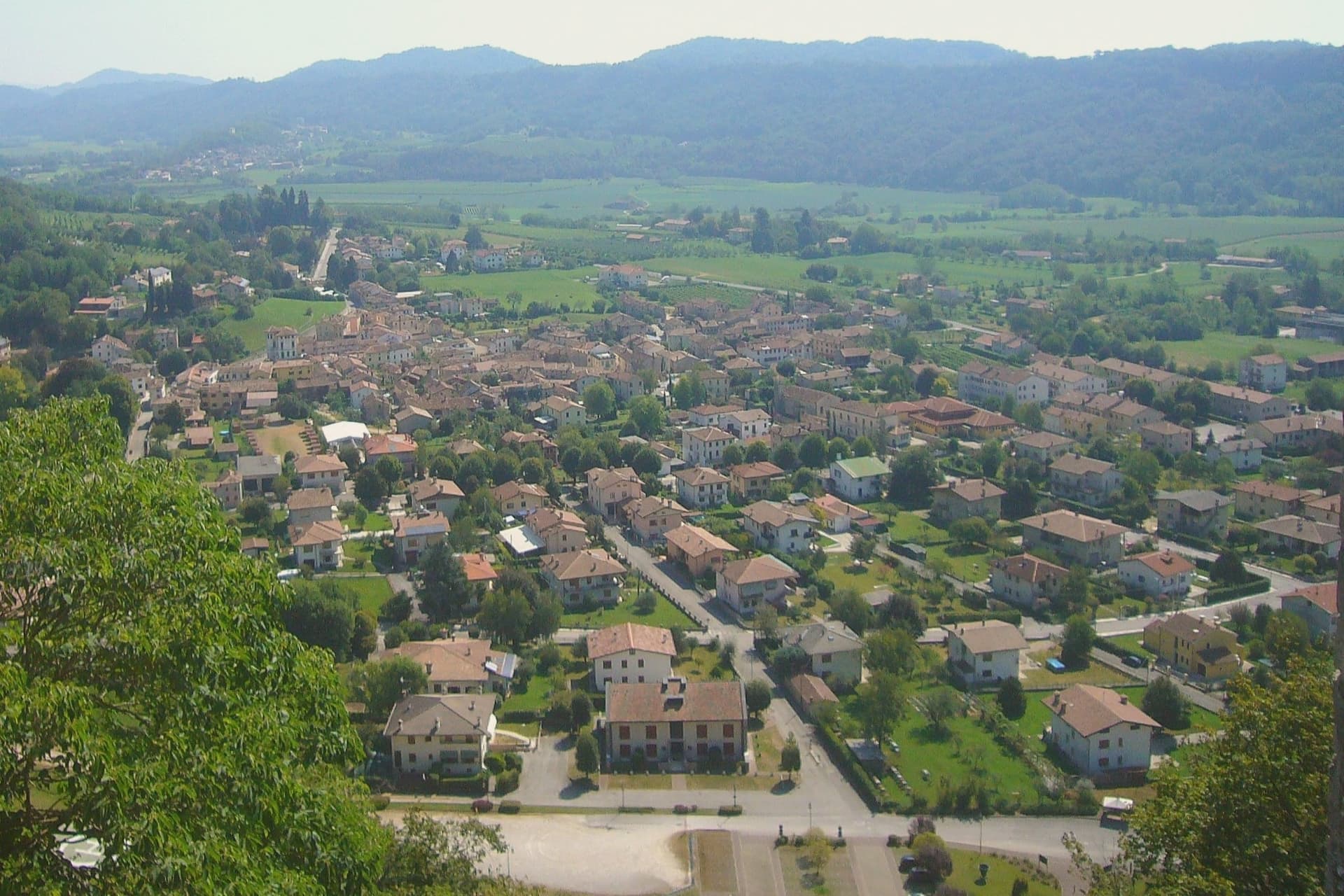
Cison di Valmarino sits at 261 meters at the foot of CastelBrando, the medieval fortress that rises 370 meters above the village on a dolomite spur. The castle is one of the largest in Europe, with origins as a Roman watch post on the Via Claudia Augusta and an unbroken occupation that runs through the Da Camino, the Brandolini, and into the present-day hotel and conference complex that opened in the 1990s.
The borgo below kept the layout the Brandolini gave it after they took the fief from Venice in 1436. Via XXIV Maggio runs through stone houses with arched portals; Piazza Roma holds the eighteenth-century Loggia.
The municipal territory carries four institutional signals at once, the maximum cluster in the eastern Prosecco hills, and the parish church of Santa Maria Assunta anchors the upper village. The Artigianato Vivo fair fills the streets for ten days each August, with around three hundred craft stalls drawing fifty thousand visitors and ranking among the largest artisanal events in Veneto.
La Muda di San Boldo have been named by a guide.
What to see in Cison di Valmarino
- CastelBrando. Medieval fortress on a dolomite rock at 370 meters above the village, with Roman foundations and continuous occupation, now hotel and conference center.
- Piazza Roma. Main square of the borgo with the eighteenth-century Loggia and the Palazzo Barbi, the historic seat of municipal administration.
- Chiesa di Santa Maria Assunta. Parish church in the upper village, rebuilt in the eighteenth century on an earlier medieval structure, with frescoes from the Tiepolo school.
How to get to Cison di Valmarino
Venezia is roughly 79 minutes away by road.
Our tip
April through October is the working window. April and May fill the hills with green and the Prosecco vineyards with flowering vines; September and October bring harvest and the gold light the Rive di Rolle hamlet has built its reputation on. The Artigianato Vivo runs the second and third weeks of August, with around 300 stalls along Via XXIV Maggio and parking for the surrounding villages used to capacity.
Follina
Why visit Follina
Follina sits at 191 meters where a stream cuts out of the Treviso Prealps into the upper Prosecco hills, sixty-five kilometers northwest of Padova. The name comes from follare, to full wool, and the Sanavalle stream powered fulling mills here from antiquity through the nineteenth century.
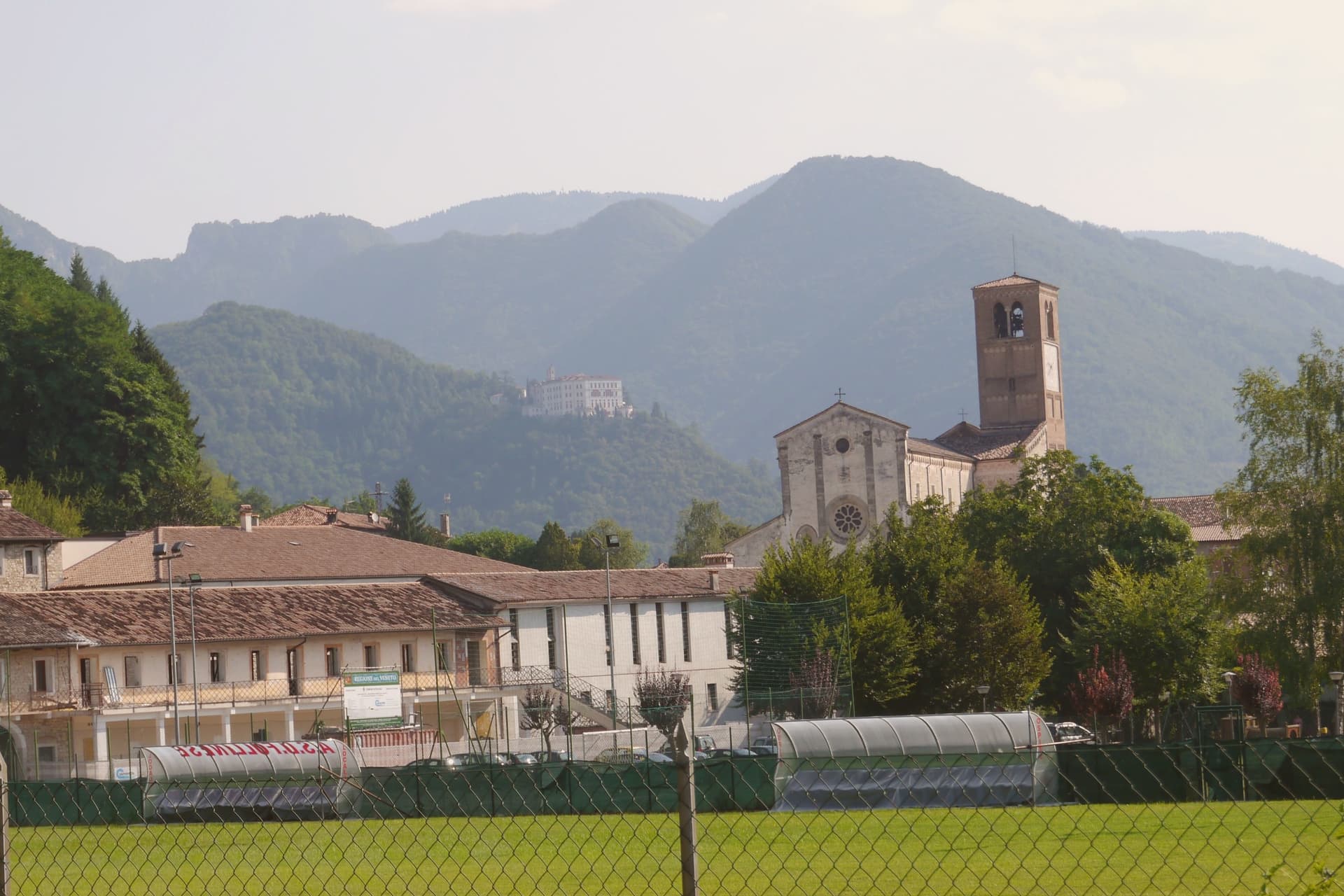
A monastic complex existed before the Cistercians arrived in the mid-twelfth century, likely a Benedictine house dependent on San Fermo di Verona. The Cistercians built the Abbey of Santa Maria from 1170; the cloister was completed in 1268.
The abbey is now a minor basilica and parish seat, a national monument since 1921, with frescoes of the Veneto-Byzantine school in the chapter house and a thirteenth-century stone Madonna inside the church. The Brandolini family, lords of nearby Cison di Valmarino, used Follina as a textile center through the Venetian period.
The borgo carries five institutional signals at once. The frazione of Pedeguarda holds the older parish church; the centro of Follina runs along the abbey wall and the stream that powered the mills.
La Corte, Osteria dai Mazzeri, Al Castelletto have been named by a guide.
What to see in Follina
- Abbazia di Santa Maria. Cistercian abbey built from 1170, with the cloister completed in 1268, raised to minor basilica and a national monument since 1921.
- Chiostro dell'Abbazia. Cistercian cloister of 1268, with twin colonnettes, sculpted capitals and a central well, intact in its medieval form.
- Sala del Capitolo. Abbey chapter house with frescoes of the Veneto-Byzantine school from the late thirteenth and early fourteenth centuries.
How to get to Follina
Venezia is roughly 73 minutes away by road.
Our tip
April through October is the working season. April and May bring the abbey gardens into bloom and the Prosecco hills into green; September and October bring harvest and the gold light the Rive belt is built on. July and August push into the low thirties and the centro empties in the afternoon, though the cloister stays cool.
Farra di Soligo
Why visit Farra di Soligo
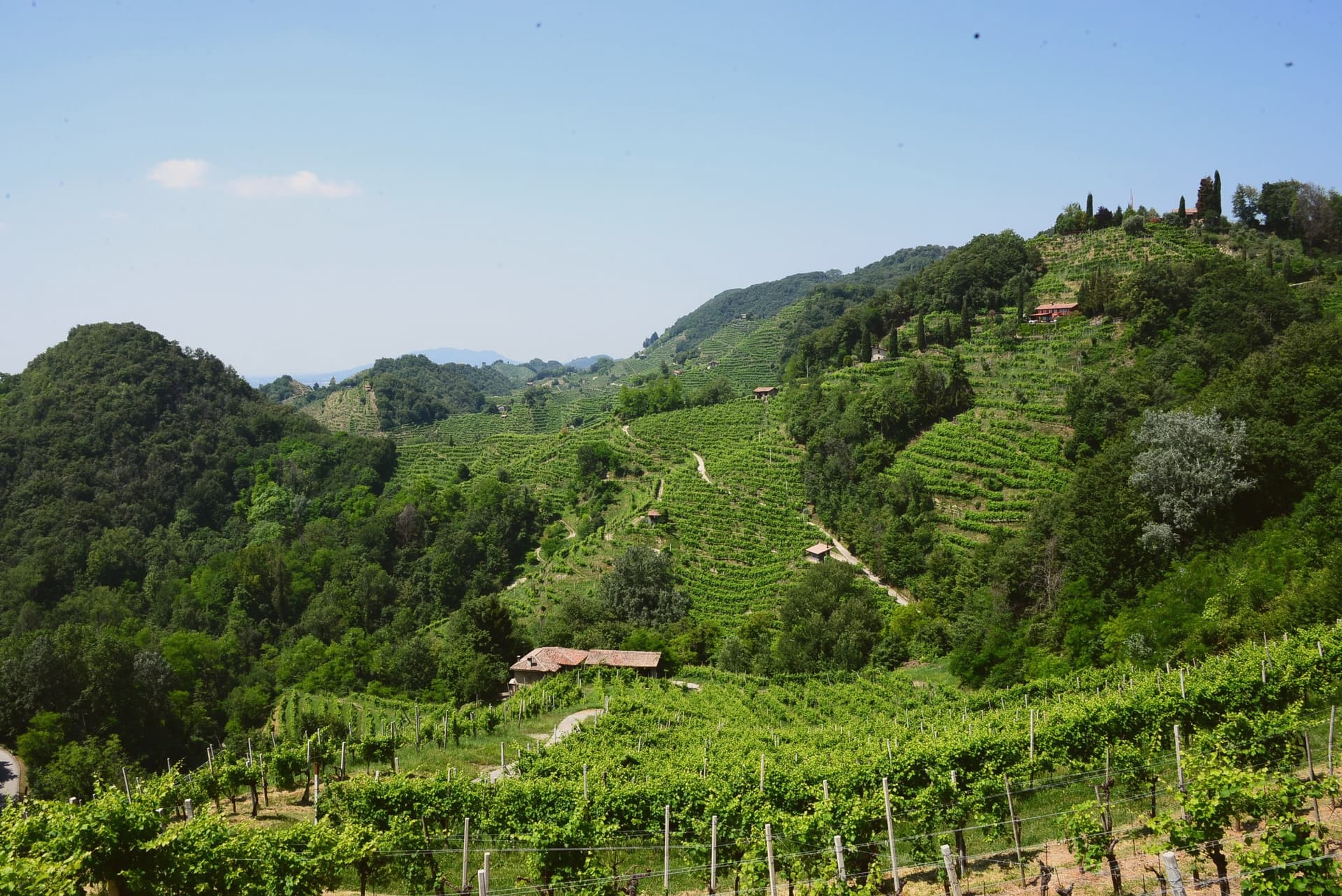
The Conegliano-Valdobbiadene Prosecco Hills take their local name, rive, from the steep hogback ridges that corrugate the landscape, terraced by hand over more than a thousand years and planted almost entirely to Glera. The whole landscape was inscribed as 'Le Colline del Prosecco di Conegliano e Valdobbiadene' in 2019, recognizing both the vineyard cultivation system and the long history of hillside terracing behind it.
Farra di Soligo sits at the literal centre of this territory, one of 15 comuni inside the inscribed area, an 8,477-resident commune at 161m altitude positioned between Conegliano (10 km east) and Valdobbiadene (5 km west), with the most-photographed stretch of the rive running through its own ground. Soligo, the frazione that gives the comune its name, holds the hilltop site of the triple watchtower ensemble above it, reached by marked paths climbing directly from the village rather than by road.
Beyond the towers and the vineyards, the territory holds two Romanesque parish churches, one in Farra itself with its campanile standing detached from the main body, another at Col San Martino with later frescoes added to its 12th-century fabric, and a working wooden watermill on the Lierza river, its wheel still turning, the photogenic centrepiece of a Sunday walking circuit that closes vineyard roads to cars between April and October. The Cistercian abbey at Follina extends the same religious-medieval layer 4 km to the southeast, ranking among the more important monastic ensembles in the Veneto.
The comune also carries the Cittaslow and Città del Vino marks alongside the UNESCO inscription, a rare triple signal for a town this size. Wine production runs through all of it: over 200 producers work the DOCG zone across the comune and its immediate neighbours, making the extra-dry Prosecco Superiore, the dry Cartizze grand-cru, and the rarer col fondo, unfiltered and naturally cloudy, the traditional version before the modern method took over.
Food follows the same prealpine register: spaghetti with duck ragù, baccalà alla vicentina, formaggio di Malga, tiramisù, invented 30 km south at Treviso. The Festa del Vino in May and the Sagra dell'Uva in October mark the calendar's two fixed points.
What holds the place together is the terracing itself: a landscape shaped by a single, continuous agricultural practice long enough that the medieval towers, the parish churches, and the working mill all read as features of one worked hillside rather than separate monuments set into it.
Locanda da Condo, Seda, Tino Gourmet dell'Hotel Villa Soligo have been named by a guide.
What to see in Farra di Soligo
- Conegliano-Valdobbiadene Prosecco Hills (UNESCO). The corrugated rive landscape of steep hogback ridges with Glera vineyards, inscribed as UNESCO World Heritage in 2019. Farra sits centrally in the inscribed area, with the most-photographed stretch running through its territory.
- Torri di Credazzo. The towers stand above Soligo, a frazione of Farra, reached by marked paths climbing from the village itself rather than by road.
- Molinetto della Croda. The mill's wheel still turns on the Lierza river, its wooden works exposed to view. It anchors the Rive Vive walking route, when vineyard roads nearby close to cars.
How to get to Farra di Soligo
Venezia is roughly 68 minutes away by road.
Our tip
Farra di Soligo is best April–June and September–October. The Rive Vive Sunday walks (April-October) close vineyard roads to cars and open them to cellar-hopping walkers — the signature local activity. October is harvest; the air smells of fermentation across the whole comune.
Valdobbiadene
Why visit Valdobbiadene
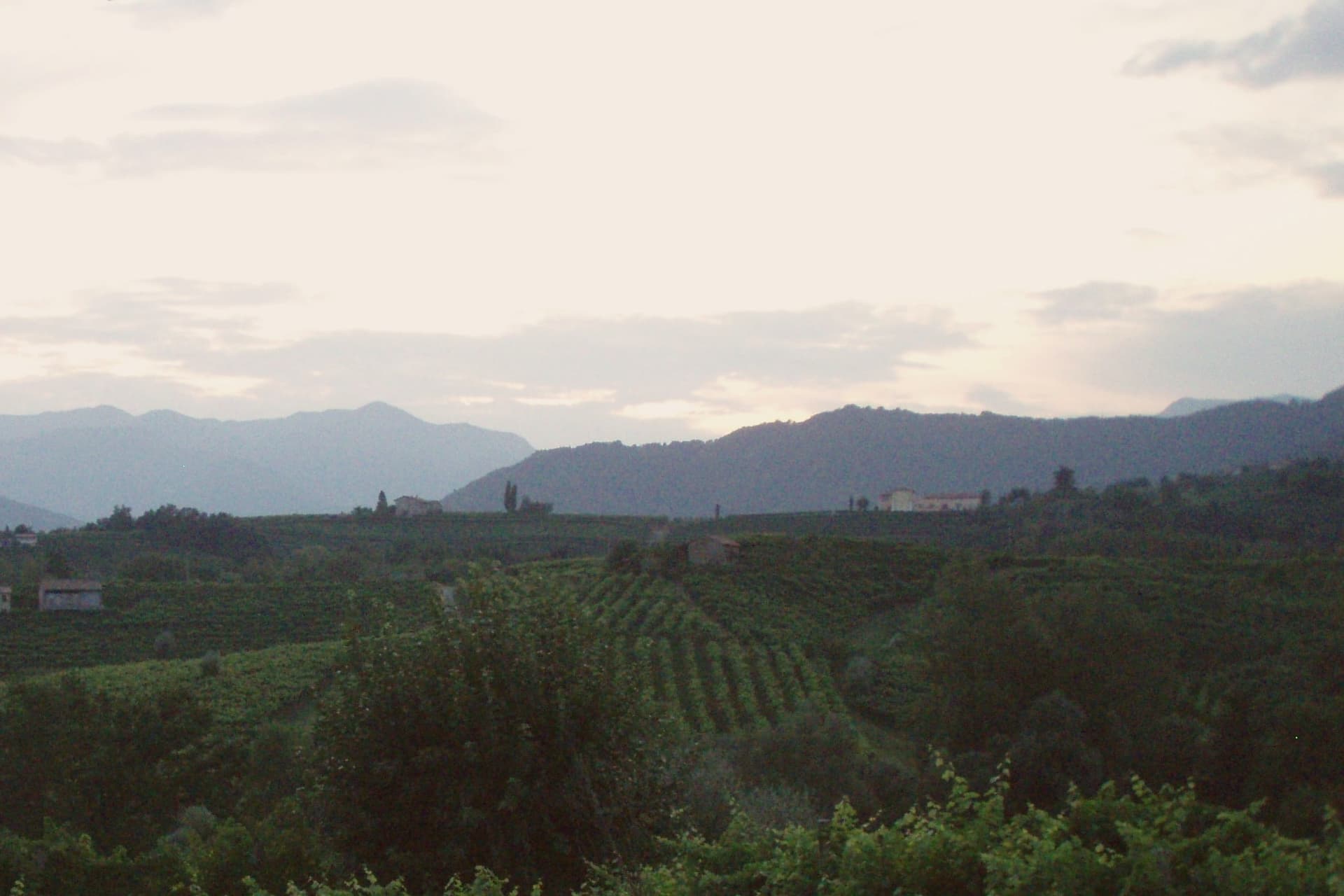
Valdobbiadene sits at 253 meters in the Treviso Prealps, fifty-five kilometers northwest of Venice, on the western edge of the Conegliano-Valdobbiadene UNESCO landscape inscribed in 2019. The town gives its name to the Conegliano Valdobbiadene Prosecco Superiore DOCG, and its own centro storico sits above a cluster of frazioni, among them the hilltop parcel that ranks as the zone's peak cru and the hamlet of Colderove with its sixteenth-century church.
Producers work these slopes on a shared calendar: the Antica Fiera di San Gregorio opens the working year on the second Monday of March, Villa dei Cedri hosts its own DOCG exhibition each spring, and cellar doors along the signed wine route stay open through the warm months as the harvest advances. The rhythm of the town follows the vine from one edge of the appellation to the other, with the hilltop parcel standing as the point the whole zone is measured against.
Tre Noghere, Alla Cima, Locanda Sandi have been named by a guide.
What to see in Valdobbiadene
- Cartizze. Rocky, south-facing hilltop with vineyards from 200 to 350 meters, worked in classified parcels above San Pietro di Barbozza.
- Duomo di Santa Maria Assunta. Neoclassical cathedral on Piazza Marconi, the civic anchor of the centro storico.
- Villa dei Cedri. Nineteenth-century villa and park at the foot of the centro storico, host of the Mostra del Cartizze e Valdobbiadene DOCG each spring.
How to get to Valdobbiadene
Venezia is roughly 85 minutes away by road.
Our tip
April through October is the working season. April and May bring vine flowering on the Cartizze and the Rive parcels and the Mostra del Cartizze opens at Villa dei Cedri in late April. June through August pushes into the low thirties on the lower slopes; the hilltop parcels stay cooler with the breeze off the Prealps. Mostra del Vin col Fondo a Valdobbiadone falls in July.
Peschiera del Garda
Why visit Peschiera del Garda
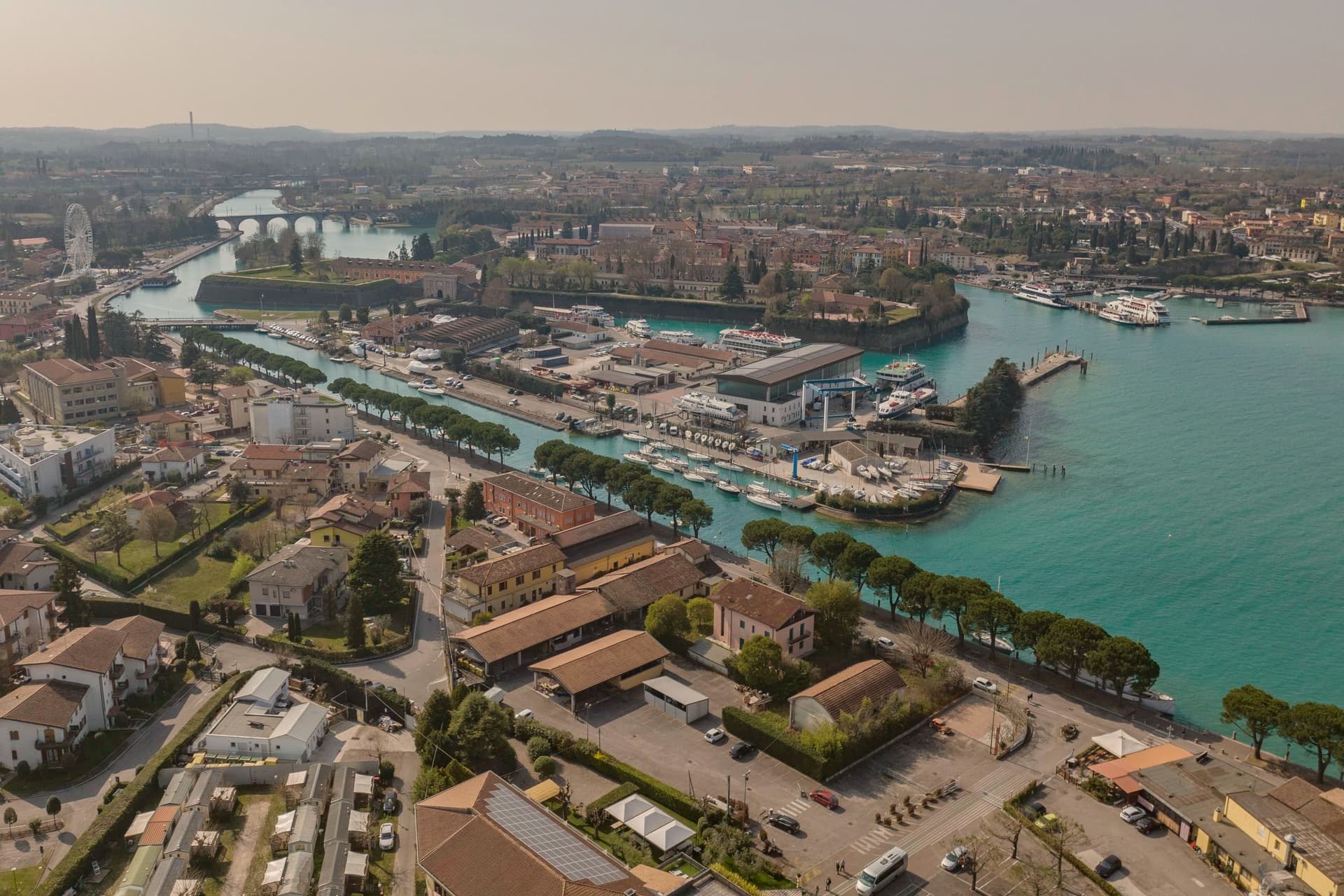
Peschiera sits at 68 meters on the Mincio at the point where the river leaves Lake Garda, twenty-five kilometers west of Verona. The Romans called it Ardelica.
The town the Republic of Venice rebuilt in 1549 was set on the medieval walls' corners, with a moat fed by the river, and the design came from Guidobaldo della Rovere before its execution on site. Austria took the town in 1815 and folded it into a wider system with Verona, Mantua and Legnago, the four together holding Lombardy-Venetia until 1866; Peschiera held the northwest corner of that arrangement, the point closest to the lake.
The fortress and the marsh settlement belong to different periods and different UNESCO listings, one Bronze Age and lakeside, one sixteenth-century and defensive, but both sit on the same stretch of water where the Mincio gathers itself before running south. The river itself is the town's organizing fact: it leaves the lake, splits into three canals to cross the walls, and rejoins below the railway bridge.
What Peschiera adds up to is a place built twice on the same threshold, where a lake becomes a river and a river becomes a border worth fortifying.
Osteria Bakarè have been named by a guide.
What to see in Peschiera del Garda
- Mura veneziane. Pentagonal fortress designed by Michele Sanmicheli for Venice from 1549, with five bastions, a moat fed by the Mincio and three water gates.
- Canali del Mincio. Three canals cross the fortress and rejoin below the railway bridge; the central one runs through the main square inside the walls.
- Piazza Ferdinando di Savoia. Main square inside the walls, bordered by the Palazzo del Comando, the Voltoni arches over the Mincio and the Caserma Catterin.
How to get to Peschiera del Garda
There is a railway station in the town, so you can arrive without a car and never need one while you are here. Verona is roughly 30 minutes away by road.
Our tip
April through June and September through October are the strongest months in Peschiera. The fortress walls, the moat and the Mincio canals are at their clearest in spring and autumn, and the lakefront south of the walls fills with sailing and ferry traffic. July and August push past thirty degrees and the southern Garda concentrates much of the lake's day-trip volume; the parking lots around the railway station queue from midmorning.
Pieve di Soligo
Why visit Pieve di Soligo
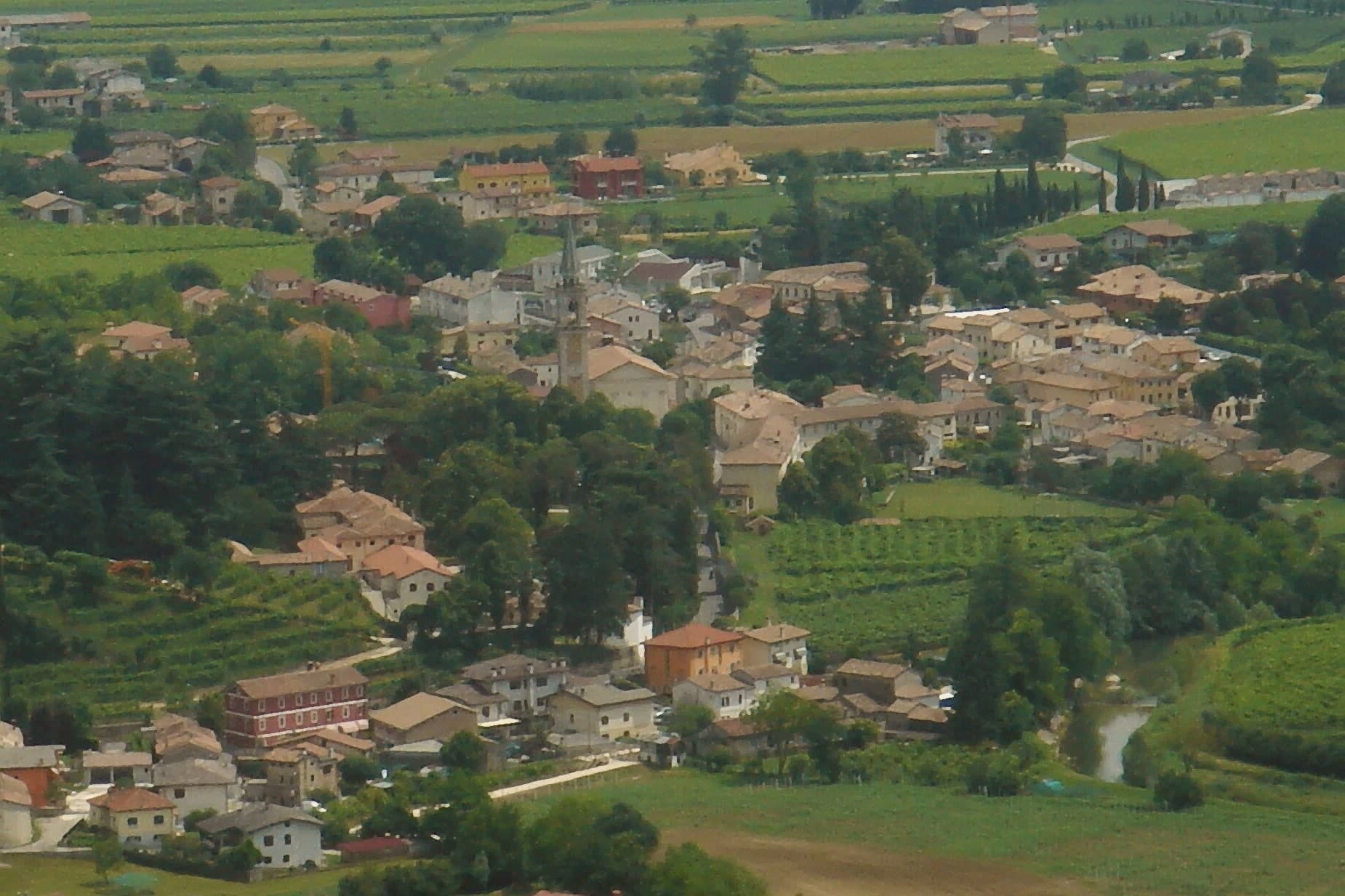
Pieve di Soligo sits at 132 meters, fifty-five kilometers north of Venice, where the Soligo and Lierza rivers meet on the commune's flat valley floor. The territory splits roughly two-thirds level ground to one-third hillside, the lower edge of a hogback landscape that rises toward the vineyard slopes to the north.
The market town occupies the flat stretch between the two watercourses; the upper village, where the old paved street of Cal Santa runs, sits apart from the newer centro that has grown around the cathedral and its campanile. An eighteenth-century country estate on the edge of town, with Venetian stuccoes and a private chapel, now serves an administrative function tied to the wine that covers the northern hills, while the Solighetto frazione keeps its own smaller eighteenth-century parish church, campanile detached from the nave, with a garden that shares the Brandolini name.
The poet born and later died in the town gave his late work a mapped version of the upper village, renaming its street in verse. Between the rivers below and the vineyard hills above, the commune reads as a working valley floor with a market town at its center, its administrative reach over regional wine production and its literary claim both rooted in the same small geography.
Da Lino have been named by a guide.
What to see in Pieve di Soligo
- Villa Brandolini. Eighteenth-century country estate with Venetian stucco interiors and a private chapel, now headquarters of the Consorzio di Tutela del Prosecco Superiore DOCG.
- Duomo di Santa Maria Assunta. Neo-Romanesque cathedral with neo-Gothic elements designed by Domenico Rupolo, consecrated in 1924, with a 75-meter campanile over the centro.
- Colline del Prosecco. UNESCO World Heritage hogback hills on the northern edge of the commune, inscribed in 2019, with Prosecco Superiore DOCG vineyards between 150 and 300 meters.
How to get to Pieve di Soligo
Venezia is roughly 64 minutes away by road.
Our tip
April through June and September through October are the working months for Pieve di Soligo. The vineyards open in spring with the Primavera del Prosecco events from March through June, and the harvest from late August into October keeps the town busy. The Premio Pieve Zanzotto poetry prize runs in October. Pieve di Sera falls in July.
Vittorio Veneto
Why visit Vittorio Veneto
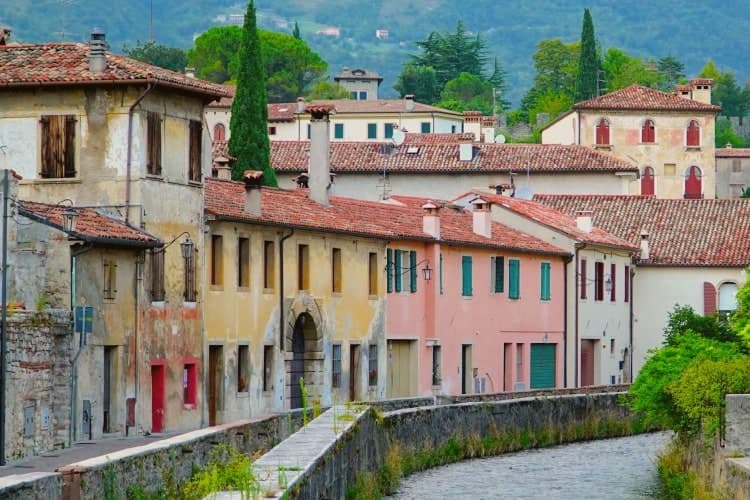
Vittorio Veneto sits at 138 meters at the foot of the Cansiglio plateau, seventy-five kilometers north of Padova. The commune was formed in 1866 by merging Ceneda, on the plain, with Serravalle, in the narrow valley above, and named for King Vittorio Emanuele II.
The two centers kept their own identities rather than blending into one. Serravalle is the older, walled district, set higher in the valley, with its cathedral holding the altarpiece of the Virgin with two saints.
Ceneda lies lower down on the plain, holding the Loggia of the Comunità and an eighteenth-century cathedral of its own alongside the castle ruins on the hill above it. In July 1923 the town took the name it carries now, after the battle that had taken its name from it three years earlier: the offensive of 24 October 1918 broke the Austro-Hungarian line, and the Armistice of Villa Giusti, effective 4 November, closed the war on this front.
The renaming fixed a wartime event permanently onto a place that had, until then, been two separate medieval settlements sharing a valley. What stands today is that same double structure, upper town and lower town, walled district and plain, still legible as two places joined by one name.
Le Macine have been named by a guide.
What to see in Vittorio Veneto
- Duomo di Serravalle. Rebuilt cathedral in the upper walled centro storico, holding the altarpiece of the Virgin with Saints Peter and Andrew in continuous liturgical use since it was painted.
- Museo della Battaglia. In the Loggia of the Comunità di Ceneda, built 1534-1538, with relics and documents of the offensive that ended the war on this front.
- Serravalle. Northern walled district above Ceneda, with sixteenth-century arcaded houses along the Meschio and the 1462 Loggia Serravallese.
How to get to Vittorio Veneto
There is a railway station in the town, so you can arrive without a car and never need one while you are here. Venezia is roughly 59 minutes away by road.
Our tip
April through October is the working season. April and May bring the Cansiglio plateau into play with walking weather and the upper Meschio at full flow. June through August stays cooler than the plain, with the narrow Serravalle valley holding shade through midday; the lower part around Ceneda pushes into the low thirties. Festa della Val Lapisina falls in July.
Vicenza
Why visit Vicenza
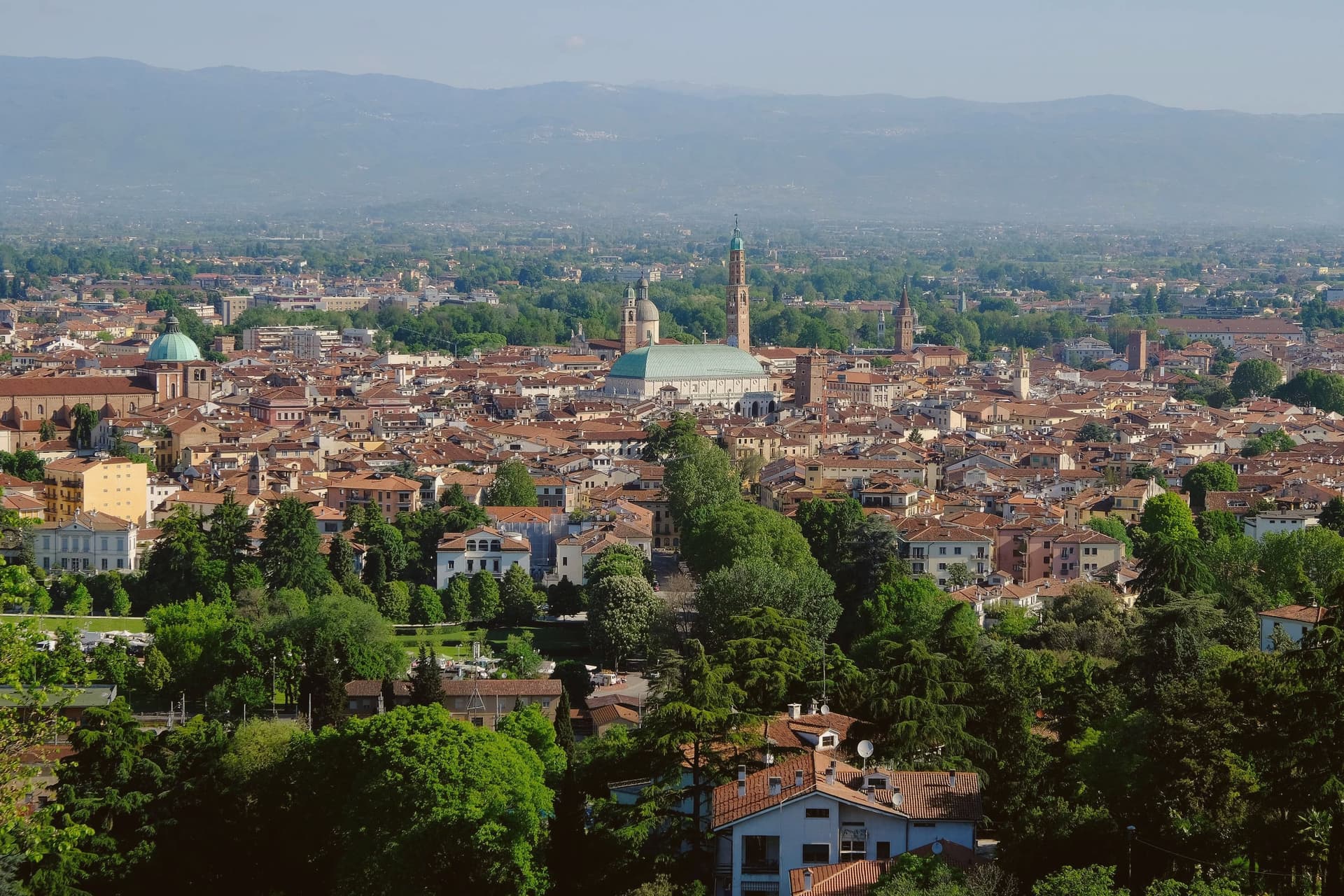
Vicenza is the city that made Palladio and that Palladio made. Andrea della Gondola — better known as Palladio — was a stonemason's apprentice in Vicenza in the 1520s, was renamed by his patron Trissino after the Greek goddess Pallas Athena, and spent the next 50 years building villas, palazzi and churches for the local Venetian-territory aristocracy.
The result: a 16th-century city of unprecedented architectural coherence, UNESCO-inscribed in 1994 as 'The City of Vicenza and the Palladian Villas of the Veneto'. The greatest hits cluster inside the walls: the Basilica Palladiana on Piazza dei Signori (his first major commission, 1549 — a Gothic medieval town hall wrapped in a white loggia of perfectly proportioned arches), Palazzo Chiericati (now the Pinacoteca), Loggia del Capitaniato, Palazzo Thiene, and the Teatro Olimpico — his final building (1580–1585), the world's oldest surviving indoor theatre, with a permanent trompe-l'œil stage set by Scamozzi depicting 'the seven streets of Thebes' in forced perspective.
A 20-minute walk south of the centro: Villa La Rotonda (1567), the symmetrical perfect-square villa that every American state capitol and Monticello copied. Vicenza also has Venice's gold and silver — half the gold sold in Italy passes through here annually (it's Europe's largest gold-jewellery district), and Vicenzaoro is the world's biggest gold trade fair.
Plus the Veneto kitchen: baccalà alla vicentina (salt cod with milk, anchovies and onions, served over polenta), bigoli with duck ragù, the local Lessini Durello sparkling wine, and Vicenza's own asparago bianco DOP in May.
Osteria Bertoliana, Matteo Grandi in Basilica, FuoriModena - Cucina km 200 and 1 more have been named by a guide.
What to see in Vicenza
- Basilica Palladiana + Piazza dei Signori. Palladio's 1549 wrap of perfect-proportioned white arches around the medieval Palazzo della Ragione — his first major commission, the building that made his name. The rooftop terrace is open and free.
- Teatro Olimpico. Palladio's final work (1580–85) and the world's oldest surviving indoor theatre. Scamozzi's permanent stage set shows 'the seven streets of Thebes' in trompe-l'œil forced perspective — they still perform here.
- Villa Capra 'La Rotonda'. The perfectly symmetrical 1567 villa on a hilltop 2 km south — a square plan with four identical pedimented porticoes, copied by Jefferson at Monticello and every state capitol in America.
How to get to Vicenza
There is a railway station in the town, so you can arrive without a car and never need one while you are here. Vicenza is roughly 3 minutes away by road.
Our tip
Vicenza is best from April through June and September through October — the Veneto plain gets hot and sticky in July and August, and the Palladian villas (especially the Rotonda) are most photogenic in low-angle spring or autumn light. May is asparago bianco season and the gardens are full. Winter is foggy and quiet but the indoor sights — Teatro Olimpico, the Pinacoteca, the basilica's interior — are at their most atmospheric. Festa dei Oto a Vicenza falls in August.
Padova
Why visit Padova
The Università degli Studi di Padova was founded in 1222 by scholars who had left Bologna in search of academic freedom, and for half a millennium it supplied the Veneto with its doctors and lawyers. Galileo lectured on physics here between 1592 and 1610.
Copernicus studied here. Elena Cornaro Piscopia became, in 1678, the first woman anywhere to receive a university doctorate.
The teaching happened in the same rooms tourists now walk through, which is part of what makes the university feel less like a monument and more like a machine that has never stopped running. The city's older story predates the university by centuries in spirit if not in stone: in 1303 Enrico Scrovegni commissioned a fresco cycle for his family chapel, an act of atonement for his father's usury, and the result changed what painting could do.
Separately, and for entirely different reasons, the city's botanical garden preserves a walled circular plan laid down in the sixteenth century, the layout that made it the template for every university garden that followed. Away from these two, the Basilica di Sant'Antonio draws pilgrims to a reliquary and a bronze outside its doors, the Palazzo della Ragione holds an astrological fresco hall and a two-hundred-year-old wooden horse, and a historic caffè has served coffee since 1831 in a neoclassical room that once served as Risorgimento headquarters.
The kitchen runs to bigoli with duck ragù, baccalà mantecato, risi e bisi in spring, and white asparagus from the Piazza delle Erbe market in May. What holds the city together is the university's habit of making its past into working infrastructure: a lecture hall still gives lectures, a dissection theatre still stands where it was built, a garden still grows on its original beds.
Caffè Pedrocchi, Stefano Mocellin al Padovanino, Belle Parti and 9 more have been named by a guide.
What to see in Padova
- Cappella degli Scrovegni (Giotto, 1303–1305). 38 scenes from the life of Christ and Mary, painted directly onto the plaster of a single chapel. The air-handling required to keep the pigment stable is why entry is capped at 15 minutes and 25 people at a time.
- Orto Botanico (1545, UNESCO). A walled circular garden, laid out on its founding plan and unchanged in shape since. Goethe stood among its beds. A modern biodiversity greenhouse has been added alongside the historic plot.
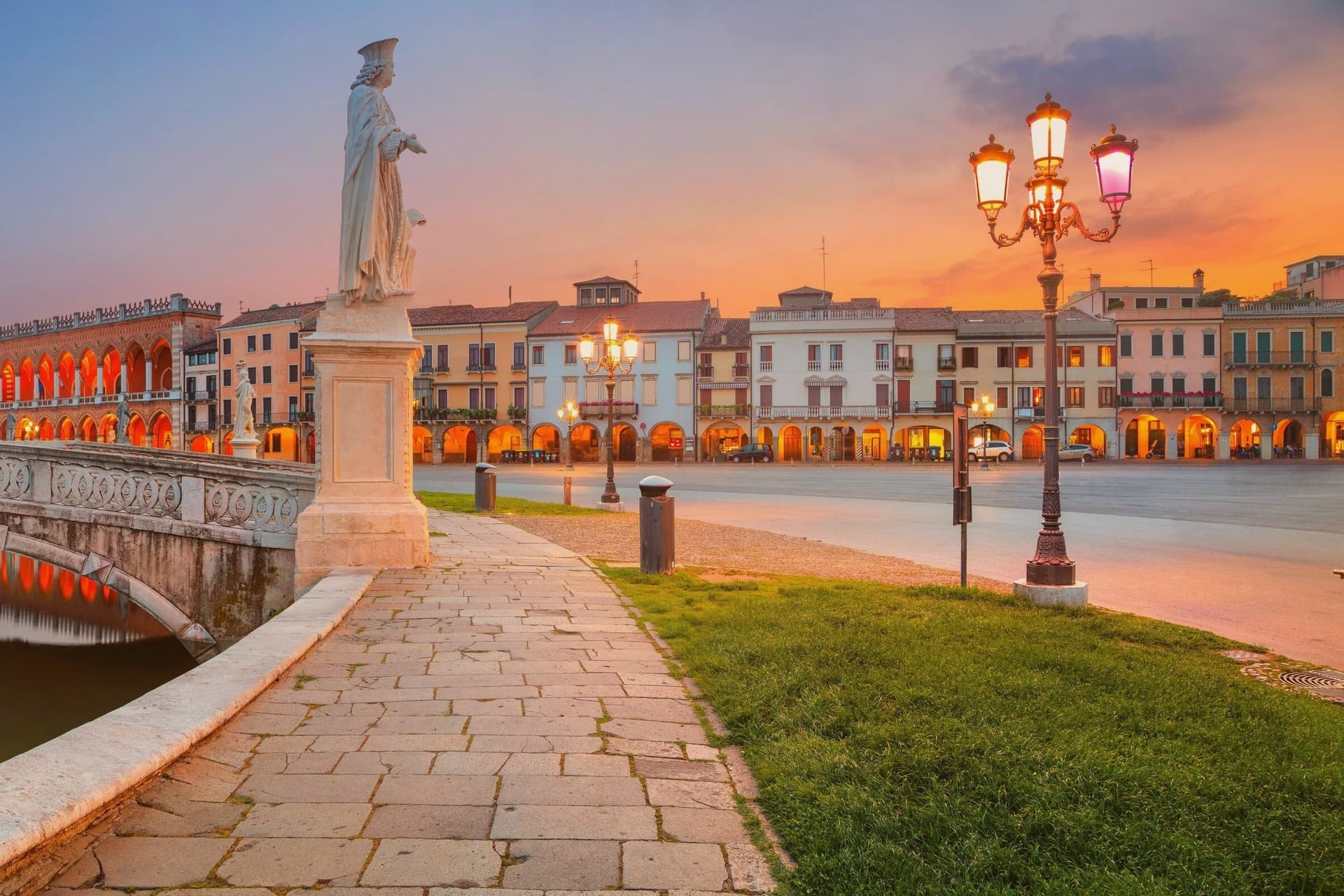
- Prato della Valle. An elliptical canal ringed by 78 statues of Padovan worthies, enclosing a central island and facing the Basilica of Santa Giustina. At 88,000 square metres it is the largest piazza in Italy.
How to get to Padova
There is a railway station in the town, so you can arrive without a car and never need one while you are here. Padova is roughly 3 minutes away by road.
Our tip
Padova is best April–June and September–October. May is the Padovan asparago bianco IGP at the Piazza delle Erbe market and the gardens at the Orto Botanico in full bloom. June 13 is the feast of Sant'Antonio — a quarter-million pilgrims, hotels full for 50 km.
More from Anywhere Italy
- The best towns with a World Heritage site within two hours of Trento
- The 7 best hidden towns with a World Heritage site in Veneto
- The best towns with a World Heritage site in the province of Treviso
- The best towns with a World Heritage site within 75 minutes of Venice
- The best towns with a World Heritage site within two hours of Udine
- The best hill towns in the province of Treviso