
The best towns inside a nature park that have a serious restaurant in Lazio
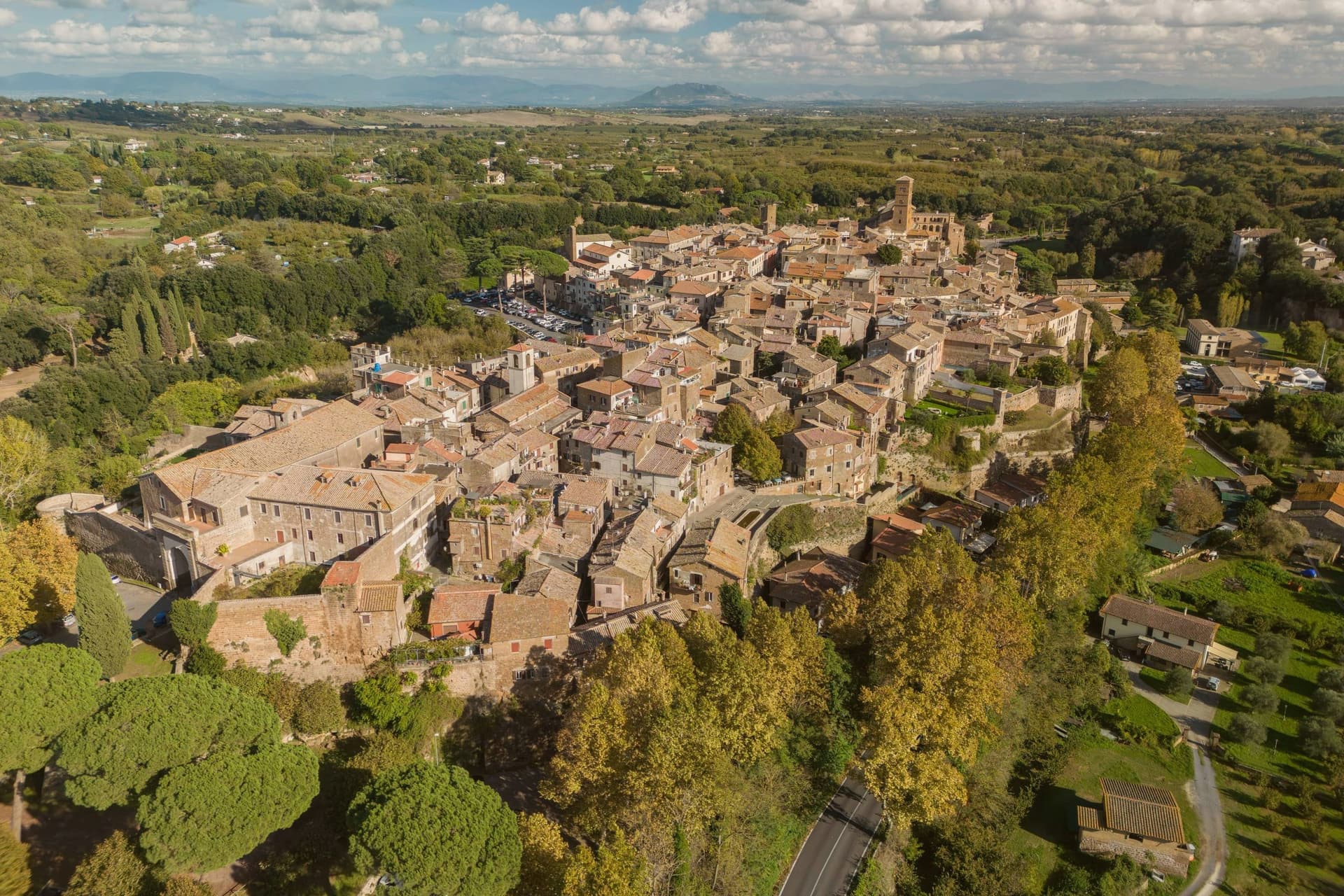
Lazio outside Rome is built on tufa, the soft volcanic stone that cuts easily and weathers to grey and ochre, and it is protected more widely than most visitors realise. Regional parks cover the crater lakes of the Colli Albani, the coastal dunes and marshes south of the capital, the promontories where mountain drops straight into the Tyrrhenian, and the wooded gorges of the north. The food follows the geography closely: porchetta carved warm in the Castelli, coregone and eel from the lakes, buffalo mozzarella from the Fondi plain, red prawns and Gaeta olives on the coast. Spring brings artichokes and wild asparagus, autumn brings chestnuts, mushrooms and the first pressing of oil. And in several of these places there is a serious kitchen, the kind the most demanding guides put in print.
The default day trip out of Rome runs to Tivoli, where Villa d'Este and Hadrian's Villa absorb coach parties from morning until closing, and lunch is whatever is nearest the ticket office. It is a fair reason to go, the fountains and the ruins are worth the train, but the crowd is dense and the eating around it is generally poor. Rome's own restaurant scene pulls in the same direction, keeping visitors inside the ring road for dinner. So the parks get treated as scenery glimpsed from a coach window rather than places you could plan a meal around.
The same volcanic hills, the same coast, the same protected wetlands carry on well past the famous stop, and the towns in this list sit inside the park boundaries rather than beside them. Some look over a crater lake, some over a beach or a lagoon, one over an Etruscan amphitheatre carved into rock. What they share is a protected landscape at the edge of town and a restaurant worth booking in the middle of it. Fewer people make the trip, and a table is easier to get.
Of the 60 communes we have mapped in Lazio, 6 qualify as towns inside a nature park with a serious restaurant: each sits inside a regional nature park, and each holds a restaurant listed by the most demanding of the guides. The smallest, Sutri, has 6,663 residents.
Elsewhere in the catalogue: The best towns you can reach by train that have a serious restaurant in Lazio and The best towns with a serious restaurant that sit on a walking route in Lazio.
Sutri
Why visit Sutri
Sutri sits at 291 meters on a narrow tuff spur, fifty kilometers north of Rome on the old road linking the two. The Etruscans held it before the Romans took it in the fourth century BC, and it was among the colonies that refused further military contributions to Rome during the Second Punic War in 209 BC.
The rock-cut monuments that define the town, the arena, the temple turned sanctuary, the chamber tombs, all come from the same tuff spur the town is built on, so the stone that gives Sutri its ground is also what its Etruscan and Roman residents carved into. The high ground above, where the eighteenth-century villa and its gardens sit, looks down over that older excavated town rather than sitting apart from it.
Local tradition ties the town's beans to Charlemagne, who passed through and was supposedly relieved of an attack of gout by Sutri's variety. What the place adds up to is a settlement where the town and its excavation are the same rock: nothing was built so much as removed.
N'uovo Vino e Cucina have been named by a guide.
What to see in Sutri
- Anfiteatro Romano. Elliptical amphitheater about forty-nine by forty meters, carved directly out of the tuff rock rather than built on it.
- Mithraeum / Madonna del Parto. Roman temple to Mithras hewn into the tuff and reused as a Marian sanctuary, accessed through the medieval rock-cut church.
- Necropoli rupestre. Etruscan necropolis with dozens of rock-cut chamber tombs in the cliff face along the Via Cassia.
How to get to Sutri
Roma is roughly 57 minutes away by road.
Our tip
April through June and September into October are the best months in the tuff country, when the amphitheater grass is green and the gardens of Villa Savorelli are open. July and August push afternoons into the mid-thirties; the rock-cut Mithraeum and tomb chambers stay cool and become the part of the visit that doesn't need to be timed. November through March is quiet. Sagra del Fagiolo falls in August.
Castel Gandolfo
Why visit Castel Gandolfo
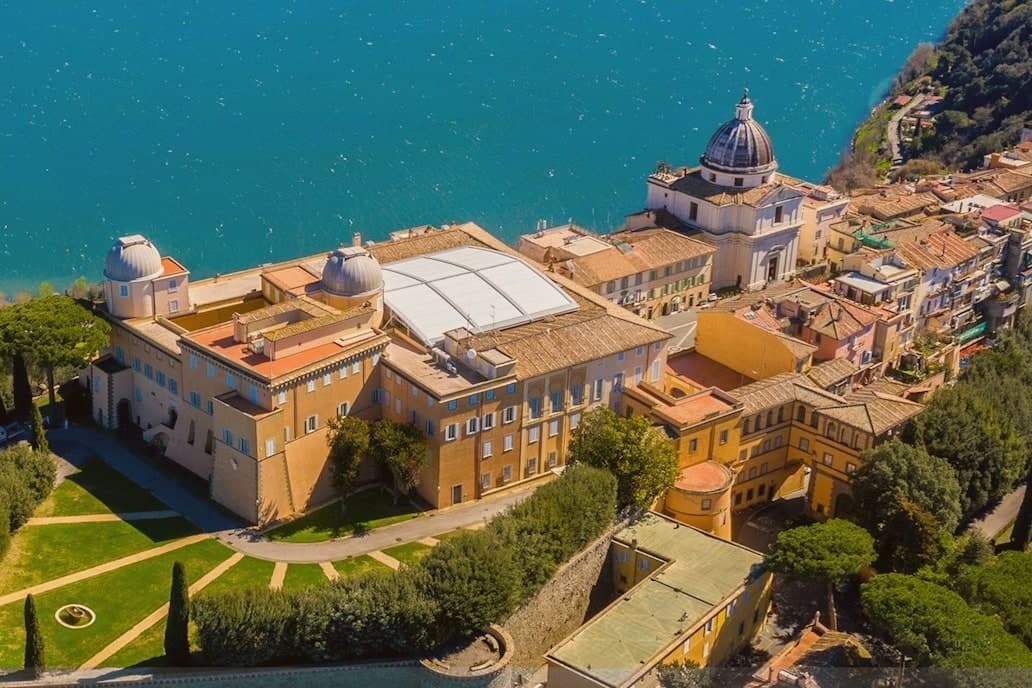
The town sits at 426 meters on the rim of the Lake Albano crater, twenty-five kilometers southeast of Rome among the Castelli Romani. It stands on the site of Alba Longa, the city Aeneas's son Ascanius is said to have founded.
The lake below was formed by the fusion of two volcanic craters and reaches 170 meters deep. The Villa Barberini stands adjacent to the palace, acquired by Taddeo Barberini in 1631, its gardens running down toward the water.
Pope Francis kept the palace as a museum after 2016; Leo XIV restored it to residential use in June 2025 and resides in the Villa Barberini next door, while the Borgo Laudato Si', created by Francis in 2023, carries ecological education across 55 hectares of the same estate. A town built on legend, given over for a time to public viewing, and returned to private residence: three uses of the same ground, laid one on top of the other without erasing what came before.
Tinello Bistrot, Antico Ristorante Pagnanelli have been named by a guide.
What to see in Castel Gandolfo
- Palazzo Apostolico. The palace Carlo Maderno raised between 1623 and 1626 stood open as a museum from 2016, its rooms given over to display cases and visitors. In June 2025 it returned to residential use, the museum arrangement dismantled to make way for a household again.
- Ville Pontificie e Giardini Barberini. Fifty-five hectares of papal villas and gardens running down to Lake Albano, with the seventeenth-century Villa Barberini at their center.
- Lago Albano. The crater lake sits at 293 meters above sea level and covers five square kilometers, its rim shared between this town and Albano Laziale.
How to get to Castel Gandolfo
There is a railway station in the town, so you can arrive without a car and never need one while you are here. Roma is roughly 35 minutes away by road.
Our tip
April through October is the open season for Castel Gandolfo, with the gardens open and the lake at swimming temperature from June. June and September are the calmer months and the historic papal-residence weeks. July and August fill with Roman day-trippers and Vatican tourists; the lake shore is busy.
Ariccia
Why visit Ariccia
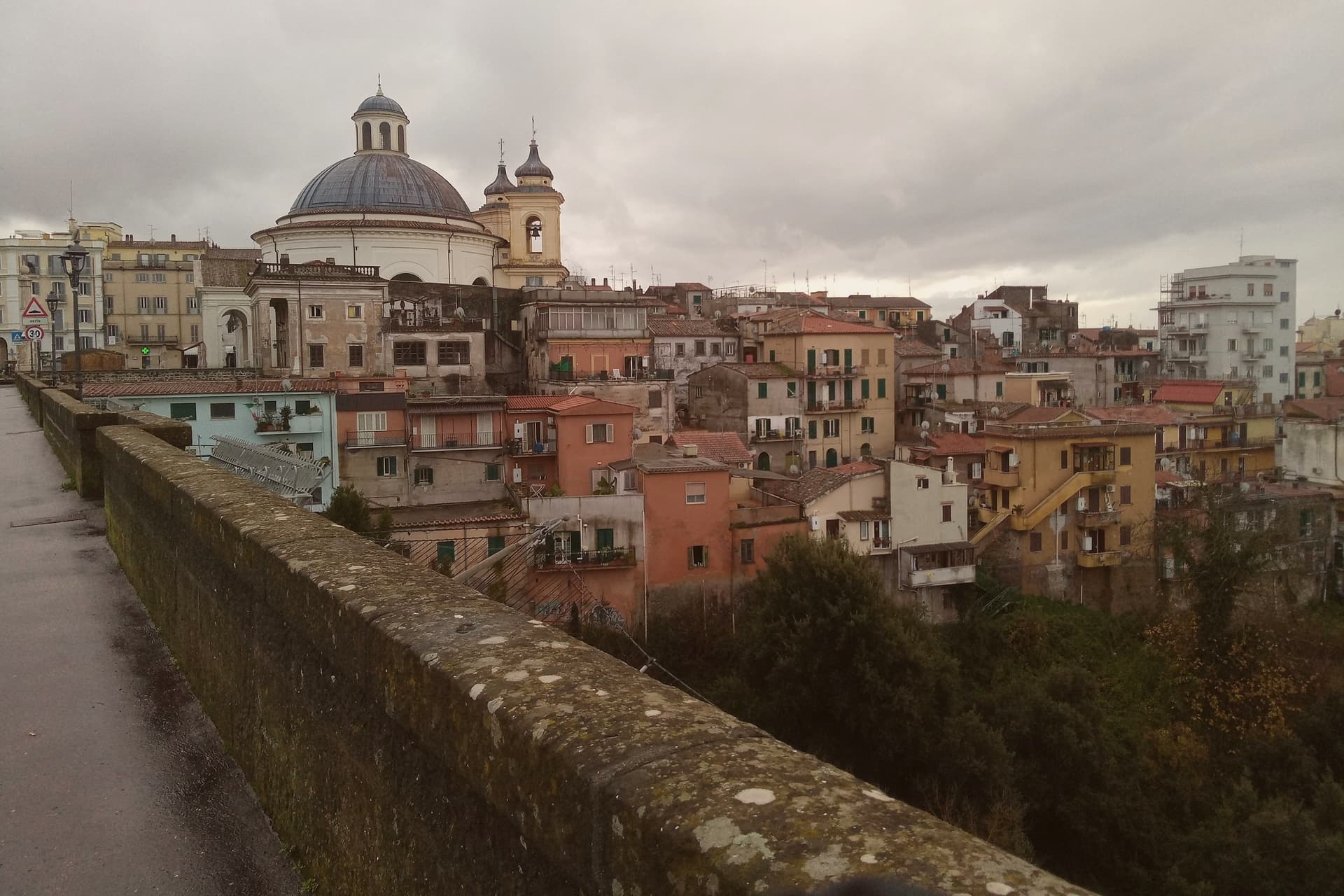
Ariccia sits on the rim of the Alban Hills volcanic complex, and the crater geography organizes everything about the place. The town centre occupies the ridge; below it on the eastern side the ground drops into the deep crater valley of Vallericcia, crossed by the viaduct linking the town to the next ridge.
The gorge itself became notorious after a series of suicides in the 1990s, now blocked with high railings. Further east and below, the volcanic lakes and the papal estate sit in a cluster within a few kilometres of the town centre, part of the same crater system that shaped Ariccia's position in the first place.
The Roman past predates the Baroque town by centuries: Aricia was the southern terminus of the original Via Appia, laid out in 312 BC, and the neighbouring lake was the site of the Latin League's federal sanctuary of Diana Aricina. The porchetta tradition is separate again: whole pork loin, deboned and seasoned with rosemary, garlic, pepper and wild fennel, slow-roasted on rotating spits in wood-fired ovens and served at room temperature in panini or by the etto.
The fraschette that serve it were originally outdoor wine vendors, marked with frasche, branches, as signs, and the town's status as a Città del Vino within the Frascati zone explains why the wine on the table is local rather than incidental. What makes Ariccia distinct among the Castelli towns is that these layers, Roman road terminus, crater rim settlement, unified Baroque set piece, and porchetta town, sit on top of each other in one small place rather than being scattered across the region.
Sintesi have been named by a guide.
What to see in Ariccia
- Palazzo Chigi + Piazza di Corte (Bernini). The Chigi family's Baroque summer residence. The palazzo, the piazza and the church facing it were designed as one ensemble. The palazzo is preserved as a 17th-c interior museum.
- Santa Maria dell'Assunzione (Bernini). Bernini's circular church, domed and modelled on the Pantheon: small, perfect, often empty.
- Ponte Monumentale. 1854 triple-tier brick viaduct spanning the 312m-deep Vallericcia crater. Walk across for the panoramic view; the gorge below is wooded and undeveloped.
How to get to Ariccia
There is a railway station in the town, so you can arrive without a car and never need one while you are here. Roma is roughly 41 minutes away by road.
Our tip
Ariccia is year-round — the Castelli Romani are Rome's cooler escape in summer (400m altitude buys 5-7 degrees off the city heat) and the porchetta is cold-served so it works in any weather. October–November is the Sagra dell'Uva and the Sagra della Porchetta (first weekend in September) — fraschette spill into the streets. Saturday lunch in any season is the locals' main event.
Gaeta
Why visit Gaeta
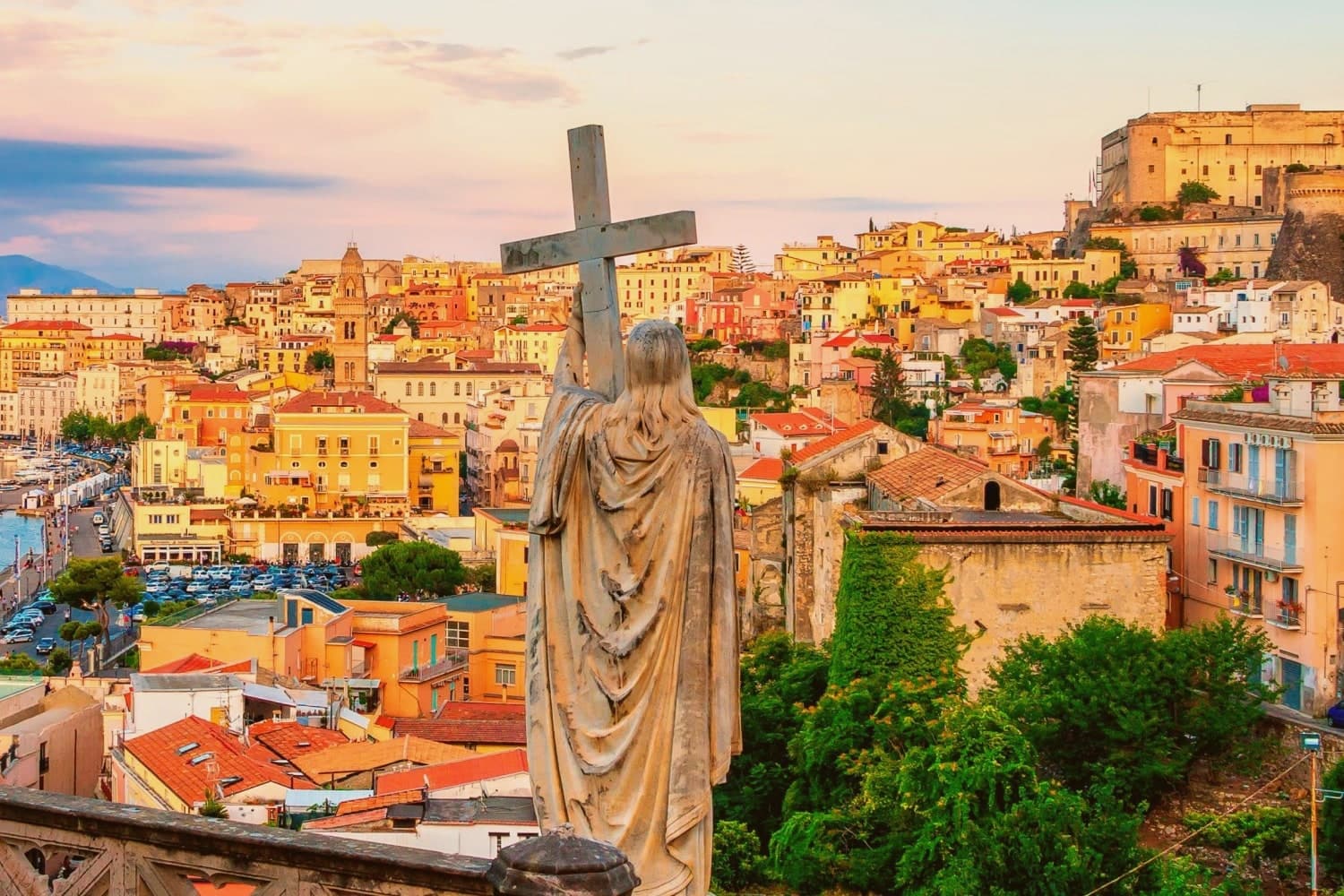
Gaeta sits on a promontory on the Tyrrhenian coast halfway between Rome and Naples, a shape that made it a port and a fortress before it was anything else. The wooded headland above the harbor is the hinge: it rises straight from the water, carries a Roman consul's tomb on its summit and a cliffside sanctuary on its flank, with the medieval quarter of Sant'Erasmo occupying the flatter ground at its base where the cathedral and the old churches stand behind the Bourbon-era walls.
The last chapter belongs to the Two Sicilies. Francis II and Maria Sofia held the town from November 1860 against the Sardinian army of Cialdini, and when the siege ended in February 1861 it ended the Bourbon kingdom in the south.
The tiella, the stuffed double-crust pie the town still makes, is what the defenders ate while it lasted. A fortified headland guarding a harbor, worn down by a Roman tomb, a medieval pilgrimage site, and a modern siege in turn: Gaeta's layers read less as separate monuments than as one defensible piece of coastline put to the same use again and again.
Dolia Gaeta, Magie dei Sapori all'Hotel Torre San Vito have been named by a guide.
What to see in Gaeta
- Santuario della Montagna Spaccata. The sanctuary of the Santissima Trinità is wedged into the fissure itself, the rock walls closing overhead on the walk up to it. Pope Pius IX retreated here in 1848.
- Cattedrale di Santa Maria Assunta. Cathedral in Sant'Erasmo with a 57-meter Norman-Gothic campanile, decorated with marble fragments from earlier Roman buildings.
- Mausoleo di Lucio Munazio Planco. Roman circular tomb of the consul who founded Lyon, on the summit of Monte Orlando, dating to the late 1st century BC. The climb through the headland's woods to reach it is part of the point.
How to get to Gaeta
There is a railway station in the town, so you can arrive without a car and never need one while you are here. Latina is roughly 82 minutes away by road.
Our tip
May through September is the Tyrrhenian beach season, with Serapo and the other coves running at full capacity in July and August. June and September are the strong months: warm sea, manageable crowds, the headland walks on Monte Orlando still pleasant in the middle of the day. October and April are good for the old town and the sanctuary, when day temperatures stay in the low twenties and the cliffs hold the light.
Fondi
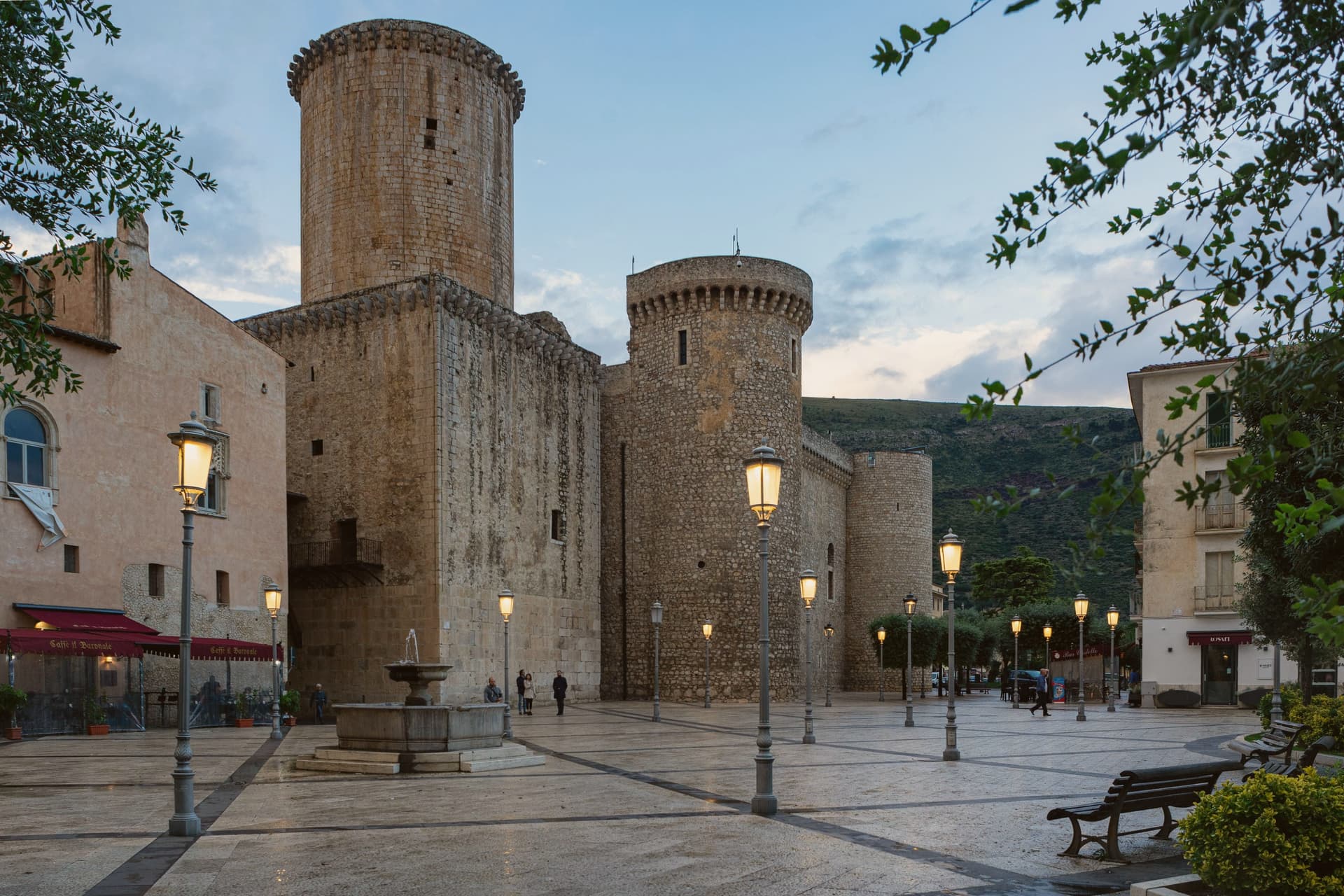
Why visit Fondi
Fondi sits in the middle of its own plain, the Piana di Fondi, a fertile basin between the Ausoni and Aurunci mountains halfway between Rome and Naples, with the Tyrrhenian only a few kilometers south. The Via Appia ran straight through it, and the town has been here since 338 BC, when its inhabitants gained limited Roman citizenship after the Latin War.
The old walls that once ringed the settlement still show at the base of the castle in the center, and inside those same walls sits the Giudea, the former Jewish quarter, so the medieval town and the Roman one occupy the same footprint rather than sitting apart. South of the built-up center the plain gives way to the Lago di Fondi, a brackish lake cut off from the sea by a sand bar and worked for fishing rather than farming.
The fields that surround all of this now feed the Mercato Ortofrutticolo, moving millions of tons of produce a year out of a basin whose flatness once made it easy to defend and now makes it easy to farm.
Da Fausto, Riso Amaro have been named by a guide.
What to see in Fondi
- Castello Baronale Caetani. Round towers over 30 meters high in the centro storico, raised on Roman walls that still form part of the base.
- Palazzo Caetani-Colonna. Adjoining noble residence built into the castle complex, the seat of Giulia Gonzaga's court between 1526 and 1534.
- Cattedrale di San Pietro Apostolo. Romanesque-Gothic cathedral with a 13th-century pulpit and the throne where the antipope Clement VII was elected.
How to get to Fondi
There is a railway station in the town, so you can arrive without a car and never need one while you are here. Latina is roughly 68 minutes away by road.
Our tip
May through September is when the plain works best for visitors: the lake, the sea, and the centro storico all reachable in a single day, evenings warm enough for late dinners on the piazzas. July and August push past thirty-two degrees and the plain has no relief from heat until the sea breeze comes in. April, October and early November are dry and quiet, the citrus groves heavy, the wholesale market running at full pace. Mercato Settimanale Di Fondi falls in October.
Terracina
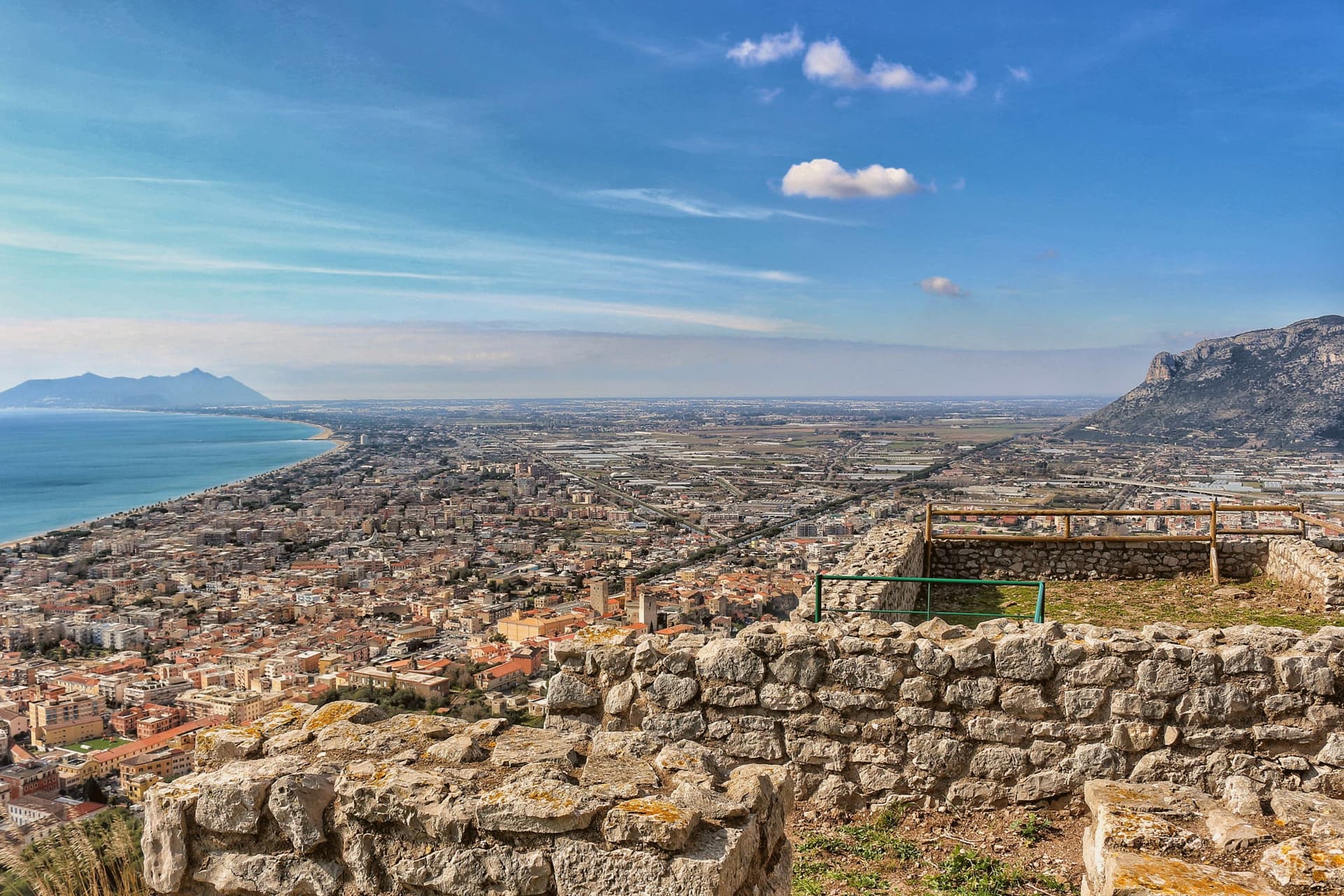
Why visit Terracina
Terracina sits where the Lepini mountains meet the Tyrrhenian Sea, a hundred kilometers south of Rome. The Volsci called it Anxur, the name of the youthful Jupiter who was its tutelary god, and the temple crowning the summit above the port carries that name still.
Below it the Roman town spread out along the coast road, its forum paved by a magistrate whose inscription remains underfoot, its capitolium later built over by the co-cathedral. Where the road met a headland it could not go around, the rock itself was cut away to let it pass, a shelf sliced through stone rather than a path found around it.
The upper town, on the mountain, and the lower town, on the plain and shore, read as two different solutions to the same site: one held the god and looked down, the other held the forum, the road, and eventually the harbor. What survives today, the beach, the working fishing port, the olive groves signed for their oil, is the plain continuing to do what it always did, at sea level, while the temple keeps its distance above.
Locanda Altobelli, Il Granchio, Locanda Ruggieri have been named by a guide.
What to see in Terracina
- Tempio di Giove Anxur. The temple on Monte Sant'Angelo stands on a vaulted substructure, thirty-five by twenty meters, the arcading still visible from below and, on clear days, the view running out past the port to the sea.
- Foro Emiliano. Original limestone-paved Roman forum, bronze-letter inscription of Aulus Aemilius still legible, eleventh forum along the Via Appia from Rome.
- Cattedrale di San Cesareo. Co-cathedral consecrated 1074 on the ancient capitolium, Cosmatesque pulpit and pavement, twelfth-century bell tower and portico.
How to get to Terracina
Latina is roughly 41 minutes away by road.
Our tip
May through September brings the beach and the port to full life: Bandiera Blu water, ferries to Ponza and Ventotene, fishermen unloading at the eastern mole. June and September are the calmer months. July and August fill with Roman day-trippers and touch thirty-five degrees on the seaward slopes.
More from Anywhere Italy
 The best towns you can reach by train that have a serious restaurant in Lazio
 The best towns with a serious restaurant that sit on a walking route in Lazio
 The best hill towns inside a nature park in Lazio
 The best towns with a serious restaurant that eat well within 90 minutes of Roma
 The best towns that eat well in the province of Latina
 The best beach towns in the province of Latina