
The prettiest villages in the province of Avellino
The province of Avellino sits inland from the Bay of Naples, high enough that autumn arrives early and the chestnut harvest matters more than the beach season. Villages here are built from local grey stone and limestone, stacked along ridges with the Apennines behind them, and most are crowned by a Norman or Lombard castle in some state of repair. This is Aglianico country, the Taurasi vineyards running in tidy rows below the hill towns, and the cooking follows the altitude: lamb, pork, hard mountain cheeses, chestnuts roasted and pounded into flour. Winter brings fog into the valleys and leaves the ridges clear above it.
Almost everyone arriving in Campania turns towards the coast instead. Naples, Pompeii and the Amalfi Coast absorb the overwhelming majority of visitors to the region, and Sorrento in high summer can feel like a single moving queue. The pull is understandable, and the coast road is beautiful, but it means the province immediately inland stays quiet even in August.
The same volcanic soils that make Campania's wine go on well past the coastal hills, and so do the villages. Irpinia rebuilt itself after the earthquake of the last century, and what survived or was carefully restored includes walled centres, ducal palaces, cave-cut cellars and belltowers with long views over the valleys. The villages in this list are the ones that have passed the assessment of the national association of Italy's most beautiful villages, and they are all within a morning's drive of one another.
Of the 13 communes we have mapped in the province of Avellino, 7 qualify as prettiest villages: each has passed the assessment of the national association of Italy's most beautiful villages. The smallest, Monteverde, has 695 residents.
If you are still choosing, we have also written The best small mountain towns in Campania and The best mountain towns within 90 minutes of Salerno.
Monteverde
Why visit Monteverde
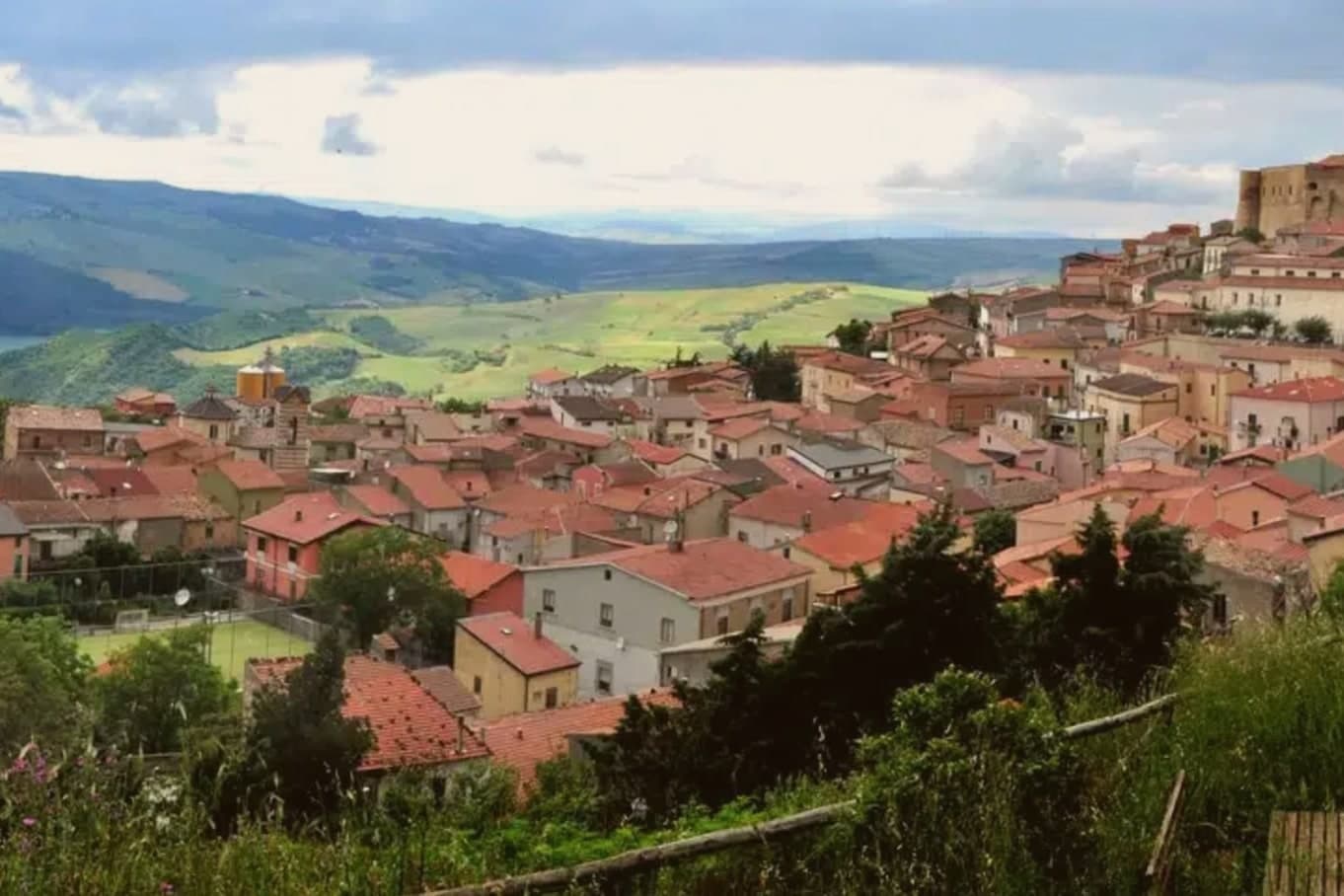
Monteverde sits at 740 meters on the eastern edge of Irpinia, on the Campania-Apulia border, 98 kilometers from Avellino: the geography puts it nearer Foggia than its own provincial seat. The Neolithic record on this ridge goes back four thousand years.
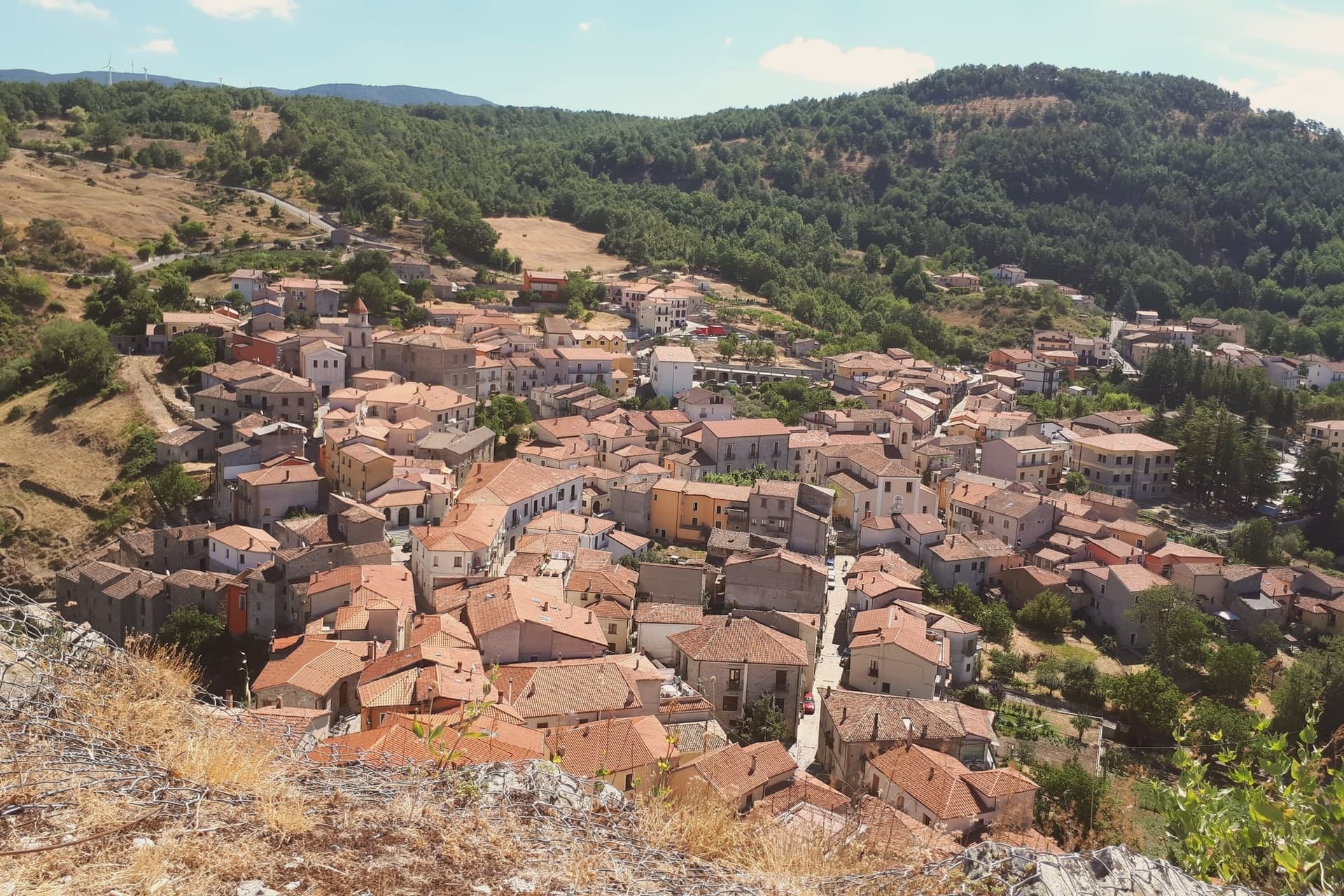
In the eleventh century the town became a bishopric and held that seat until 1531, when Charles V ceded the fief to Onorato I Grimaldi, Prince of Monaco, in exchange for the family's loyalty. The village stands as a single climbing core: the old town rises in stone-paved streets toward the fortress at its summit, while below, on the valley floor, the reservoir sits apart from the settlement entirely, a separate world of water and nesting birds rather than an extension of the town itself.
Monteverde joined the Borghi più belli d'Italia network. Between the bishopric lost in 1531, the fief held by a princely family from Monaco for over a century, and a modern reservoir that draws a bird rare in the south, the town has spent its history being claimed and repurposed by outside forces, and still absorbing them into its own shape.
What to see in Monteverde
- Castello Baronale Grimaldi. Fortress on the highest point of the village, its stone walls now enclosing the Museo del Grano within the rooms once held by the Grimaldi.
- Lago San Pietro. Artificial reservoir 460 meters below the village, holding 17 million cubic meters of water, with storks working the shallows where they have nested since 2010.
- Centro storico. Stone-paved medieval core climbing toward the castle, its slopes and passages the reason the village was singled out as the most accessible in Europe.
How to get to Monteverde
Foggia is roughly 60 minutes away by road.
Our tip
May through October is the open season at 740 meters: mild days, cool evenings, and clear views toward the Apulian plain. July and August stay tolerable up here while the Foggia lowland bakes; the village fills with returning emigrants on the August feasts. April and November are the shoulder months, when the migratory black storks come and go from Lago San Pietro.
Zungoli
Why visit Zungoli
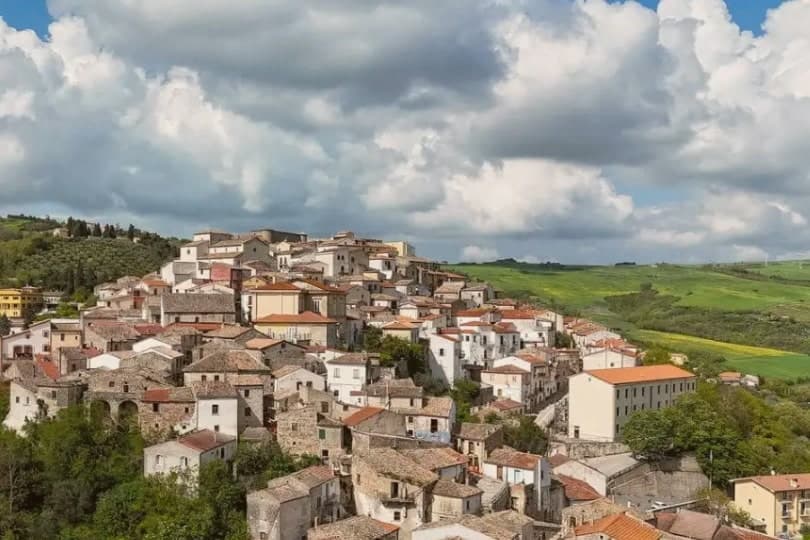
Zungoli sits on the eastern edge of the province of Avellino, one of the higher villages in Irpinia, with the Ufita valley on one side and the Daunian Mountains on the other. The settlement dates to around 900 AD.
Frederick II made it a universitas in 1232, by which point a Norman captain had already built the first fortification and left the place his name. The houses of the centro storico climb the ridge around that castle, and the ground beneath them is hollow: the whole old quarter sits over a network of caves cut by hand in the Byzantine period, long before the cheese and oil that now fill them.
Above ground the stone and the towers date the village; below it, the caves keep it at a constant temperature, which is why what was dug for one purpose is still put to use for another.
What to see in Zungoli
- Castello dei Susanna. The castle's three surviving towers rise over the roofline of the village, the fourth lost to the 1456 earthquake; the walls are the highest point on the ridge.
- Grotte Bizantine. The cave network runs beneath the streets, low and cool, still stacked with wheels of Caciocavallo Podolico and jars of oil the way it has been used for centuries.
- Centro storico medievale. Stone alleys and stairways around the castle on a 657-meter ridge, a Borgo più Bello d'Italia and Bandiera Arancione with views toward the Daunian Mountains.
How to get to Zungoli
Foggia is roughly 81 minutes away by road.
Our tip
April through June and September into October are the dry months on the Irpinia ridge, when the Ufita valley is green and the cave temperature stays even for cheese tasting. July and August touch the low thirties, lighter than the coastal heat but still drying the surrounding pasture; the tuff caves below the houses become the cool refuge. November through March is cold, with rain and occasional snow above six hundred meters, the castle silhouette appearing through low fog.
Savignano Irpino
Why visit Savignano Irpino
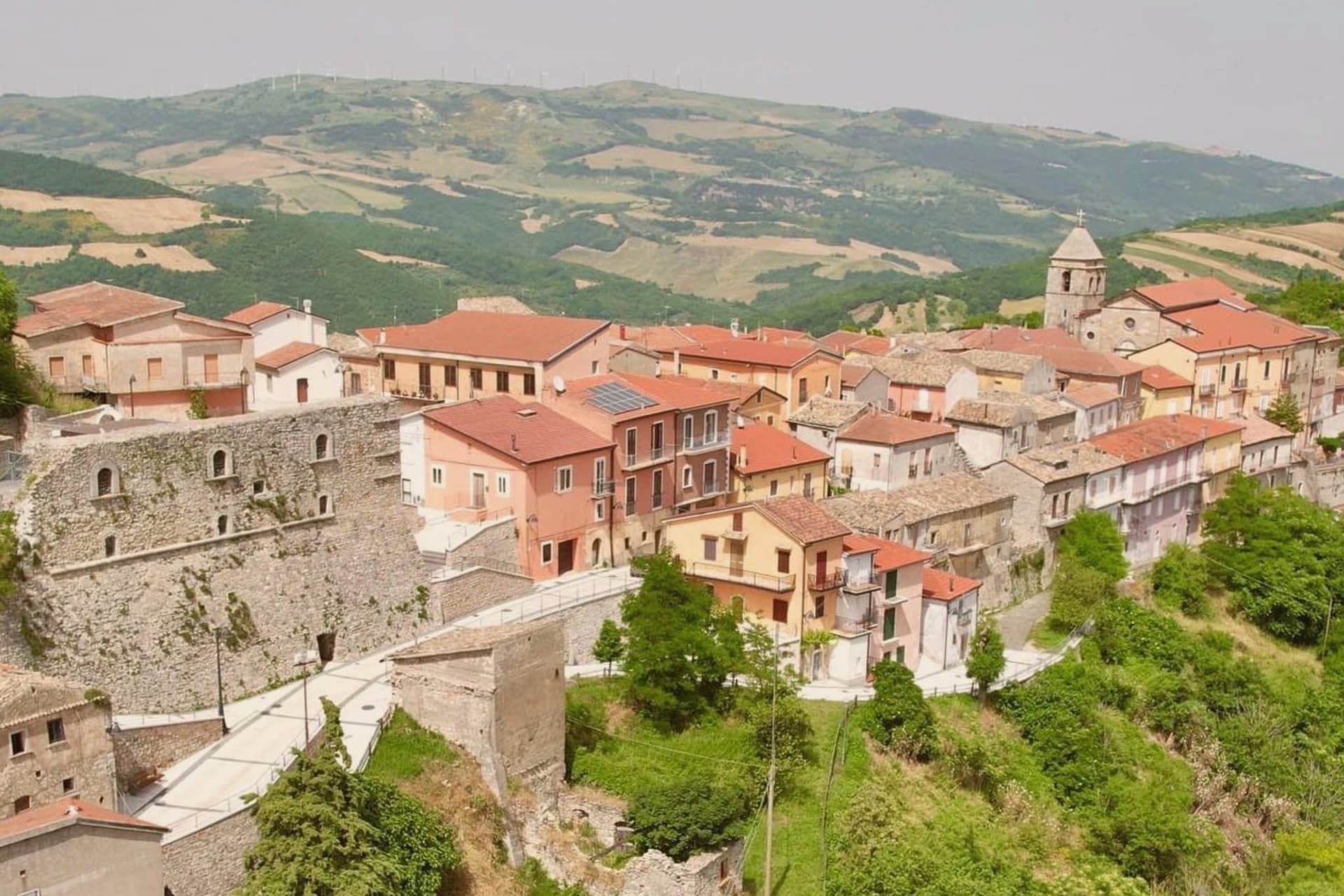
Savignano Irpino sits at 718 meters on the edge of Irpinia, where the province narrows toward Apulia. The Latin name Sabinius points to a Roman landowner, but the village as it stands now grew up between the seventh and eighth centuries around a defensive castle on the high ground.
Under the Normans it became part of a barony dependent on Ariano Irpino, with Ferrara and Greci. In 1193, during Tancredi d'Altavilla's reign, governor Sarolo Guarna was executed on the castle tower.
In 1445 the Guevara family, Spanish nobles, turned the medieval manor into a lordly residence; their name still attaches to the castle. The town was called Savignano di Puglia until 1963, when the border-of-region status pushed the rename.
The Mother Church of San Nicola and Sant'Anna and the Castello Guevara anchor the medieval core. It joined the Borghi più belli network in 2016.
What to see in Savignano Irpino
- Castello Guevara. Norman fortress on the high point of the village, rebuilt in 1445 by the Guevara family who held the fief for generations.
- Chiesa Madre di San Nicola e Sant'Anna. Mother church on a medieval sacred site, its bell tower originally a watchtower over the Cervaro valley below.
- Centro storico. Compact stone-built medieval core between castle and church, Borghi più belli member since 2016.
How to get to Savignano Irpino
There is a railway station in the town, so you can arrive without a car and never need one while you are here. Foggia is roughly 58 minutes away by road.
Our tip
May through October is the open season at 718 meters: warm days, cool nights, and the Cervaro valley below in long green light. July and August are tolerable up here while the Foggia plain bakes; the village fills with returning families on the August feasts. April and November are shoulder months with shifting weather.
Summonte
Why visit Summonte
Summonte sits at the foot of the Partenio massif, ten kilometers from Avellino. The name comes from the Latin Submontis, under the mountain.
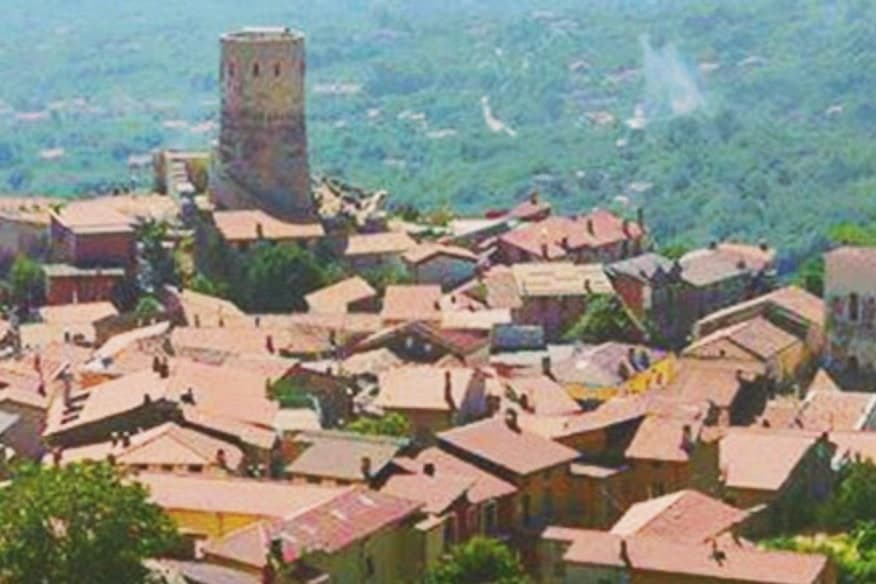
Pre-Roman tombs of the Osci show the slope was inhabited well before the current village, which dates from the 5th century when refugees from Nola, Abella and Abellinum took to the heights to escape the barbarian raids. The borgo grew in concentric arcs around its tower, and the arrangement still reads on the ground: stone houses ring the base of Monte Vallatrone in rising bands, with the old center closest to the summit and the parish church down in the lower village.
The Della Leonessa family held the fief through the late Middle Ages and the Doria del Carretto controlled it for two centuries until feudalism ended in 1806. Hazelnuts from the surrounding slopes feed the Avellino industrial chain that supplies Nutella and the pasticceria of Naples.
The shape of Summonte, refuge above, orchard below, is the same logic repeated twice: the village climbed the mountain for safety, and the economy came back down it for trade.
What to see in Summonte
- Torre Angioina. Built 13th-14th century on the ruins of a Norman-Swabian castle, the tower stands as the centre and emblem of the village on Monte Vallatrone, its cylinder rising clear of the rooftops.
- Centro storico di Summonte. Concentric medieval village wrapped around the tower, stone houses climbing the slope with views across the Partenio.
- Chiesa di Santa Maria Maggiore. Parish church in the lower village, with a Baroque interior reconstructed after the 1980 Irpinia earthquake.
How to get to Summonte
Salerno is roughly 90 minutes away by road.
Our tip
May through October is the comfortable window. June and September are the prime months at 738 meters: the temperature sits in the low twenties even when Avellino below pushes the upper twenties, and the Partenio trails are open without summer haze. July and August can run warm at midday but the upper village stays cool after sundown.
Gesualdo
Why visit Gesualdo
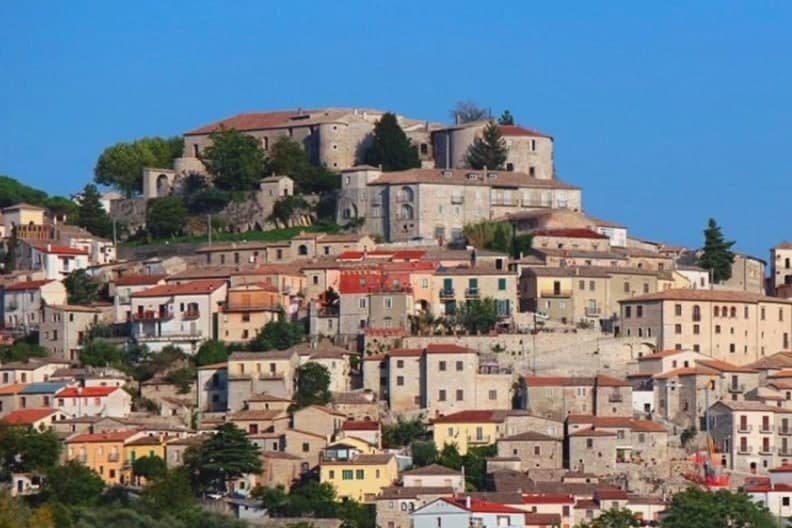
Gesualdo sits at 676 meters in central Irpinia, between the Fredane and Ufita valleys, 35 kilometers from Avellino. The castle on the hill is the reason the town exists in its present form: a Norman fortress raised in the 12th century, later rebuilt as a Renaissance court with frescoed apartments and an interior chapel.
The medieval village wraps around that hill, its stone houses set on the slopes above the two river basins, so the town reads as a single unit with the fortress at its head and the lower parish, home to the Chiesa del Santissimo Rosario, gathered below. The 1980 Irpinia earthquake damaged the castle severely, and reconstruction has been partial since the 2010s.
What stands today is a village still organized around a court that Carlo Gesualdo built for music and is remembered for a killing: the layout of Gesualdo, upper castle and lower village, mirrors the split in his own reputation, prince and composer above, the scandal that never left him below.
What to see in Gesualdo
- Castello di Gesualdo. Norman fortress of the 12th century, damaged in the 1980 earthquake and partly reopened in 2015 with restricted access. Carlo Gesualdo's frescoed apartments survive within, the rooms where the madrigals were composed and where Tasso and Marenzio were once received.
- Cappella di Santa Maria delle Grazie. Sixteenth-century chapel inside the castle complex, its frescoes commissioned by Carlo Gesualdo after his second marriage to Eleonora d'Este, a private space attached to the court rather than the parish.
- Centro storico di Gesualdo. Medieval village wrapped around the castle hill, stone houses on the slopes of the Fredane and Ufita basins, partly rebuilt after the 1980 earthquake.
How to get to Gesualdo
Salerno is roughly 80 minutes away by road.
Our tip
May through October is the comfortable window at 676 meters. June and September are the prime months: the temperature sits in the low twenties, the castle and the centro storico are walkable without summer heat, and the Gesualdo Festival of early music plays inside the castle complex on summer weekends. July and August run warmer at midday but the ridge cools after sundown.
Frigento
Why visit Frigento
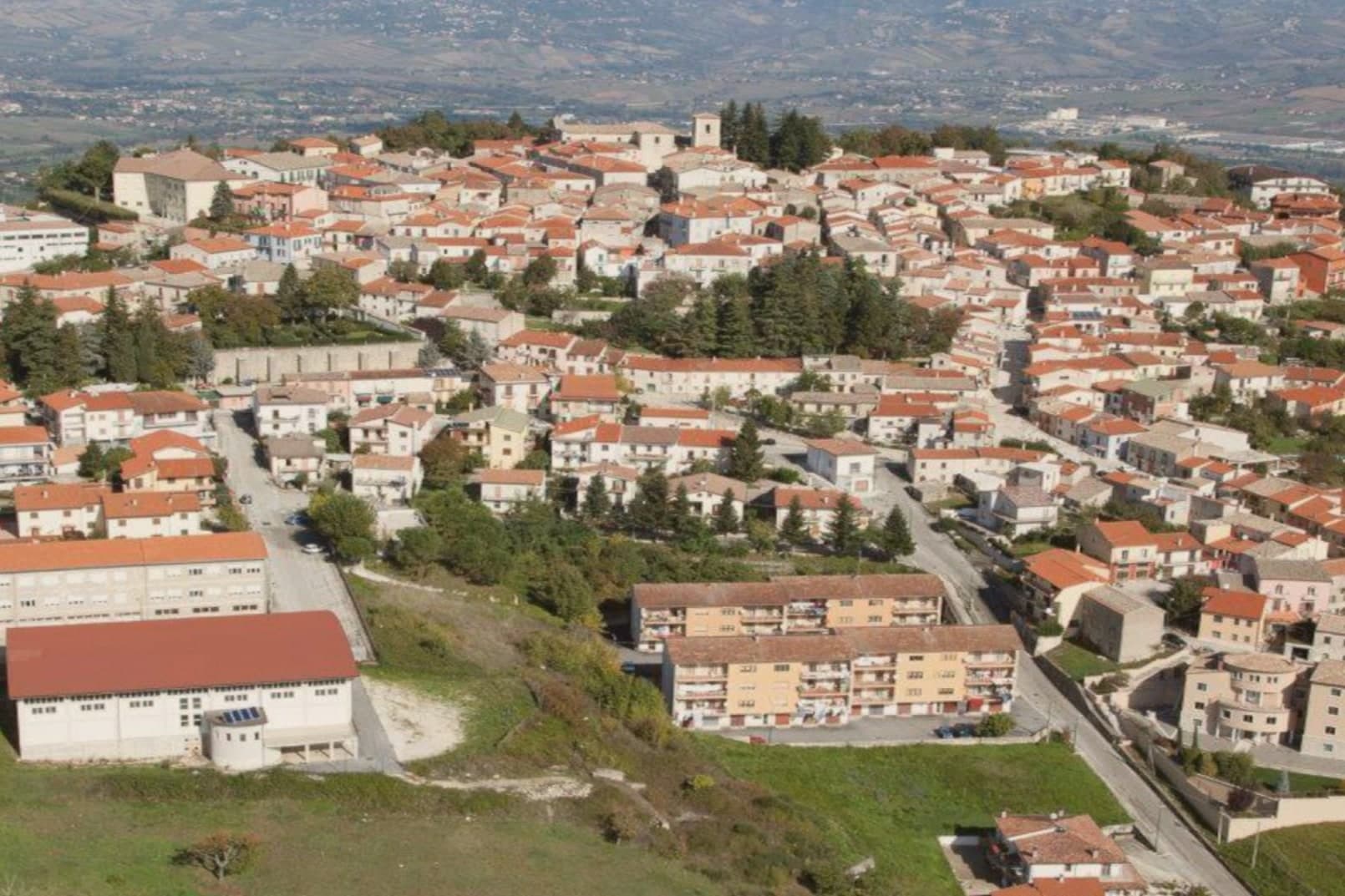
Frigento sits at 911 meters on a ridge in central Irpinia, 40 kilometers from Avellino, on a hill that overlooks the Ufita valley to the north, the Fredane to the south, the Ansanto to the east and the Calore to the west. The summit holds an opus incertum water complex from the 1st century BC, the Cisterne Romane, a vaulted chamber system probably built to serve a cluster of rustic villas linked to nearby Aeclanum on the Via Traiana.
The medieval village grew on top of the same ridge in the late Lombard period as a defensive site between the bishoprics of Benevento and Conza. The 1980 Irpinia earthquake hit the centro storico hard; reconstruction has been slow but most of the old village still stands in stone above the cisterns.
From the summit the view runs from the Apennines to the Daunia hills on a clear day. The commune is a Borgo più Bello d'Italia and a hazelnut and grain area, with cheese from the surrounding pastures.
What to see in Frigento
- Cisterne Romane. Opus incertum water complex from the 1st century BC at the highest point of the village, the largest preserved Republican cistern in Irpinia.
- Centro storico di Frigento. Medieval stone village on the summit ridge, partly rebuilt after the 1980 Irpinia earthquake, with the four-valley panorama from the upper streets.
- Chiesa di Santa Maria Assunta. Former cathedral of the Diocese of Frequentum, reconstructed after the 1980 earthquake, with a Renaissance baptismal font and a crypt.
How to get to Frigento
Salerno is roughly 84 minutes away by road.
Our tip
May through October is the comfortable window at 911 meters. June and September are the prime months: the temperature sits in the low twenties when Avellino below pushes the upper twenties, the four-valley views are clear, and the cistern site stays accessible. July and August can run warm at midday but the ridge cools off after sundown. Cicerchiamo falls in the season.
Nusco
Why visit Nusco
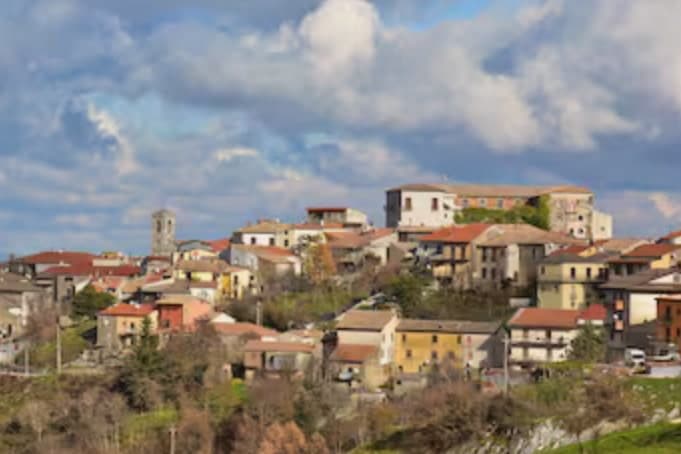
Nusco runs along a narrow ridge at 914 meters between the Ofanto and Calore Irpino river valleys, the watershed of inner Irpinia. The first written record is the 1093 will of bishop Amatus, who described his seat with the word civitas.
He was canonised after his death that year, and the Concattedrale di Sant'Amato in Piazza Vescovado holds his cult and treasury today, its composite stone façade and 33-meter bell tower set on a medieval church dedicated to Saint Stephen. In 1656 the plague killed up to a third of the population.
The streets of the centro storico are still paved in limestone slabs, which gives the town its nickname, the Balcony of Irpinia. Ciriaco De Mita, prime minister from April 1988 to July 1989, was born here and served as mayor until his death in 2022; the crowd applauded as his coffin reached the church.
What to see in Nusco
- Concattedrale di Sant'Amato. Co-cathedral in Piazza Vescovado, composite stone façade and 33-meter bell tower added in 1891, houses the relics and Treasure Room of the patron saint.
- Ruderi del Castello Longobardo. Ruins of the Lombard fortress at the highest point of the ridge, the original strongpoint that anchored the medieval civitas.
- Centro storico. Limestone-paved medieval lanes along the narrow ridge, the source of the Balcony of Irpinia nickname.
How to get to Nusco
There is a railway station in the town, so you can arrive without a car and never need one while you are here. Salerno is roughly 71 minutes away by road.
Our tip
May through October is the open season at 914 meters. Days run warm and dry, nights stay cool, and the limestone ridge gives long views across the Ofanto basin. July and August are tolerable up here while the lower Irpinia valleys bake, and the town fills on the August feasts as the diaspora returns from Avellino, Naples and abroad.
More from Anywhere Italy
 The best small mountain towns in Campania
 The best mountain towns within 90 minutes of Salerno
- The best olive oil towns within two hours of Naples
- The best olive oil towns within two hours of Salerno
- The prettiest small villages within 90 minutes of Foggia
- The prettiest villages within 90 minutes of Foggia