
The prettiest small villages that eat well in Toscana
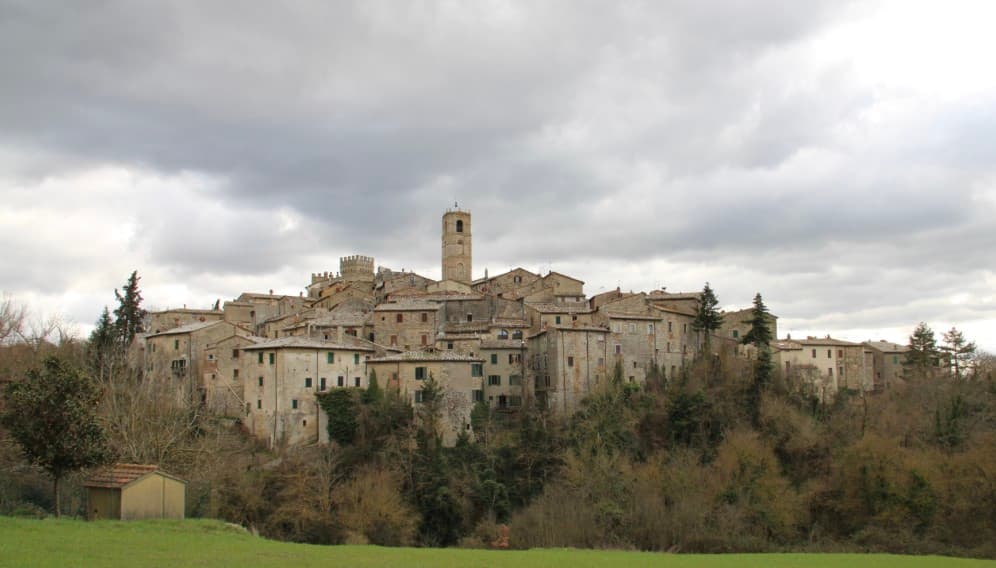
Tuscany builds its small villages out of what the ground gives: golden sandstone in the Sienese hills, dark volcanic tufa in the Maremma, brick and river stone further north. The good ones are compact enough to cross in the time it takes an oven to come up to heat, with a piazza, a church, a bar that opens early for the men who work the vines. Autumn is when the eating turns serious, when porcini come in from the chestnut woods, the new oil is cloudy and grassy and poured over bread still warm, and cinghiale goes into the pot with juniper and red wine. Spring brings artichokes and wild asparagus, and the tables move outside.
people come to Tuscany and go to Florence, then San Gimignano, then Siena, and they are right to, because those places are extraordinary. The consequence is a coach park, a queue for the Uffizi and a lunch menu translated into four languages within sight of the towers. Prices follow the crowds, and so does the cooking, which flattens towards what the largest number of visitors will accept.
The same hills, the same oil, the same butchers and the same wine lists continue for a long way past all of that. The villages here sit in the Val d'Orcia's southern edge, the Maremma, the Val di Cecina and the hills above the Elsa, all of them assessed and admitted to the national register of Italy's most beautiful villages, all of them with a table a serious dining guide thought worth naming. Fewer people go, and the ones who do usually come for lunch and stay for the walk afterwards.
Of the 84 communes we have mapped in Toscana, 14 qualify as prettiest villages that eat well: each has passed the national assessment of Italy's most beautiful villages, and a dining guide has named a table in each. This list is the small ones, 7 in all, ordered smallest first. The smallest, San Casciano dei Bagni, has 1,500 residents.
Elsewhere in the catalogue: The best small olive oil towns with a serious restaurant in Toscana and The prettiest hidden villages with a serious restaurant in Toscana.
San Casciano dei Bagni
Why visit San Casciano dei Bagni
San Casciano dei Bagni sits at 582 meters at the southern edge of the province of Siena, above 42 hot springs that average 42 degrees Celsius. The baths were used continuously from Etruscan through Roman times and again from the Renaissance, when visitors came from across Europe.
In 2022, an excavation that began in 2019 at the ancient sanctuary turned up 24 bronze votive statues protected by mud, with around 6,000 coins in gold, silver and bronze. The find was the largest of its kind in fifty years; most surviving Etruscan votive material is terracotta.
The 1,500 residents live on a basalt outcrop above the Roman thermal complex, in a centro storico of stone houses and three small churches. The borgo joined the Borghi più belli network in 2014 and remains one of the smallest communes in Toscana to carry both that label and Bandiera Arancione.
Daniela, Castello di Fighine have been named by a guide.
What to see in San Casciano dei Bagni
- Santuario Ritrovato. Etruscan-Roman thermal sanctuary excavated since 2019, where 24 bronze votives and around 6,000 coins were recovered in 2022.
- Bagno Grande. The principal natural pool of the 42 hot springs, used from the second century BC through the Renaissance and reopened to the public.
- Collegiata di San Leonardo. Romanesque parish church in the centro storico, restored in the seventeenth century, with a baptismal font carved from local travertine.
How to get to San Casciano dei Bagni
Perugia is roughly 68 minutes away by road.
Our tip
The thermal pools make the calendar different here. Winter is the season many visitors prefer, when the 42-degree water steams against cold air and snow occasionally dusts the basalt outcrop. April through June and September into October are the most balanced months: warm hill light, the dry-stone walls of the borgo at their best, the sanctuary excavations open to guided tours. Sagra del Ciaffagnone di San Casciano dei Bagni falls in June.
Montescudaio
Why visit Montescudaio
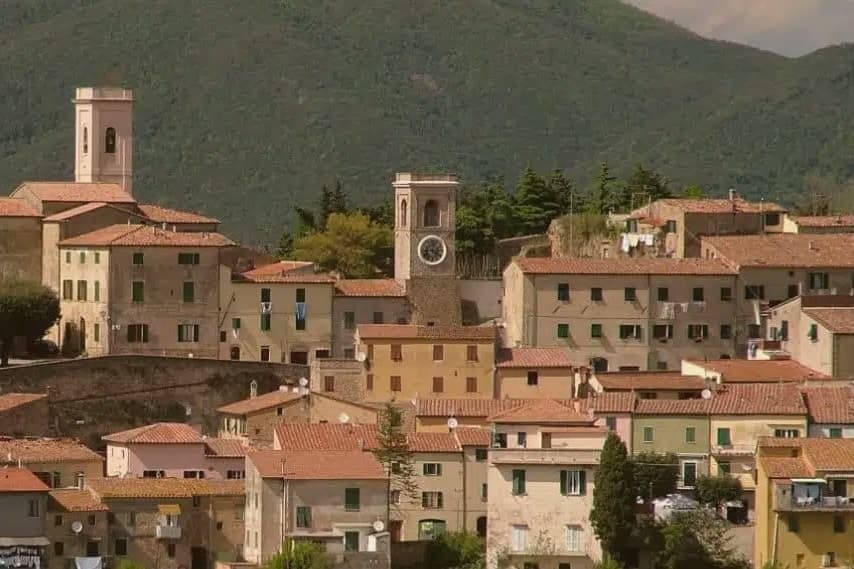
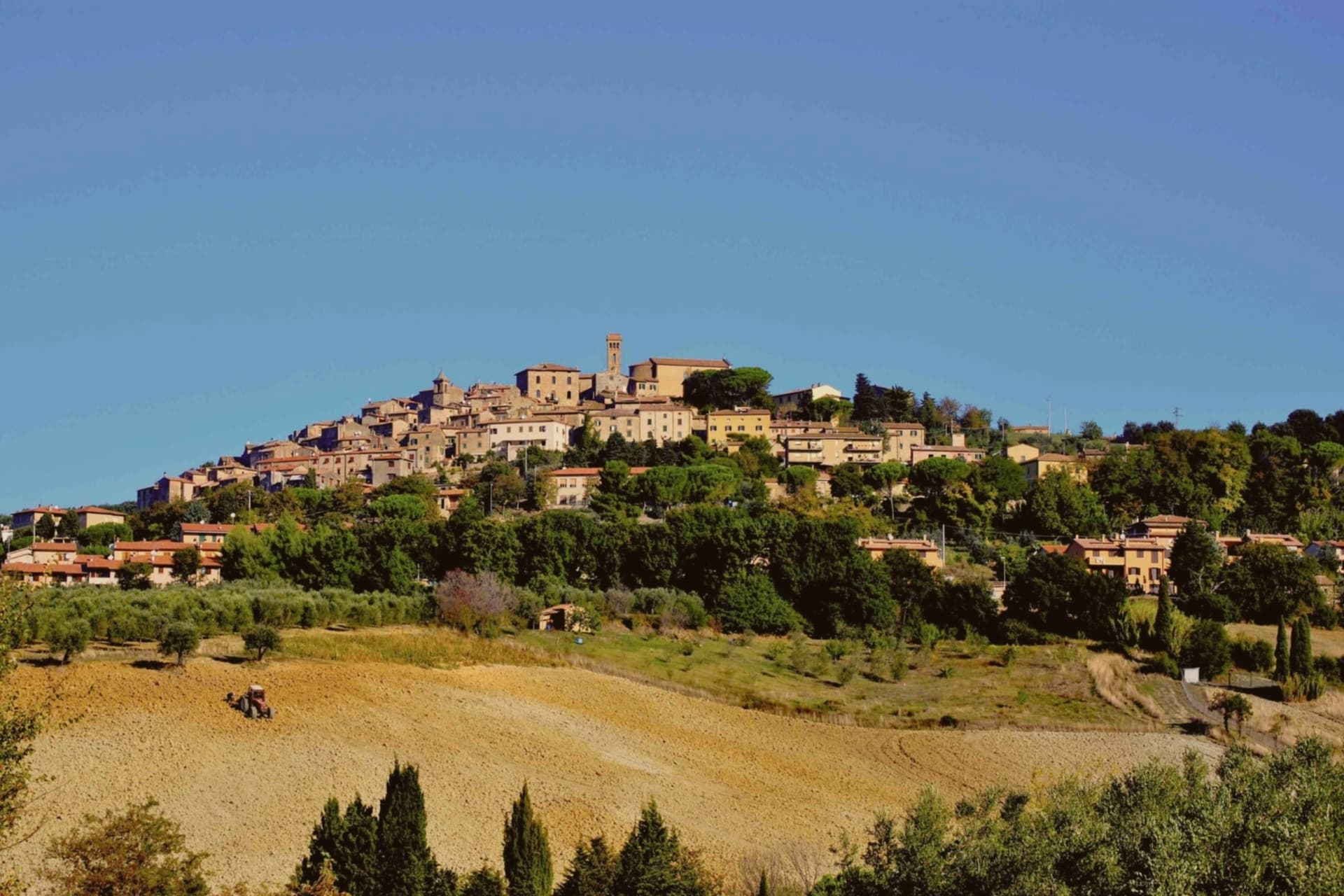
Montescudaio sits fifteen kilometers inland from the Tyrrhenian coast, on a hill above the valley the Cecina river cuts toward the sea. Fewer than 2,200 people live in the commune, and most of them are outside the centro storico, which is left as a tight knot of stone houses ringed by its old walls: a single church, the clock tower, and the terrace where the vines drop downhill toward the Val di Cecina and the water beyond.
The town carries four institutional signals at once, an unusual density for its size: a registered wine appellation, a bread-network membership rare in this part of Tuscany, a name that predates the medieval walls, and the walls themselves built around an eleventh-century abbey. Wine and bread are both grown and baked around the same hilltop that once needed fortifying.
The fortress, the loaf, and the vineyard are not three separate stories here but three uses of the same ground, worked over centuries after the shields it was named for stopped being necessary.
SaQua - Ristorante in Collina have been named by a guide.
What to see in Montescudaio
- Centro storico. Walled medieval village, a tight ring of stone houses on the hilltop, built around the abbey that gave the settlement its first walls and structure.
- Torre Civica. Clock tower at the entrance to the borgo, the tallest visible structure and former civic landmark of the fortified village.
- Chiesa di Santa Maria Assunta. Eleventh-century parish church on the site of the medieval abbey, the anchor around which the walled village took shape.
How to get to Montescudaio
Livorno is roughly 44 minutes away by road.
Our tip
May through September is the season on the Cecina hills: dry days, vine work, harvest from late August through September. The coast lies fifteen kilometers west and the sea breeze keeps evening temperatures lower than the inland Maremma. July and August bring crowds to the beaches at Cecina and Marina di Bibbona, but the borgo on the hill stays quieter. Festa del Vino di Montescudaio falls in October.
Cetona
Why visit Cetona
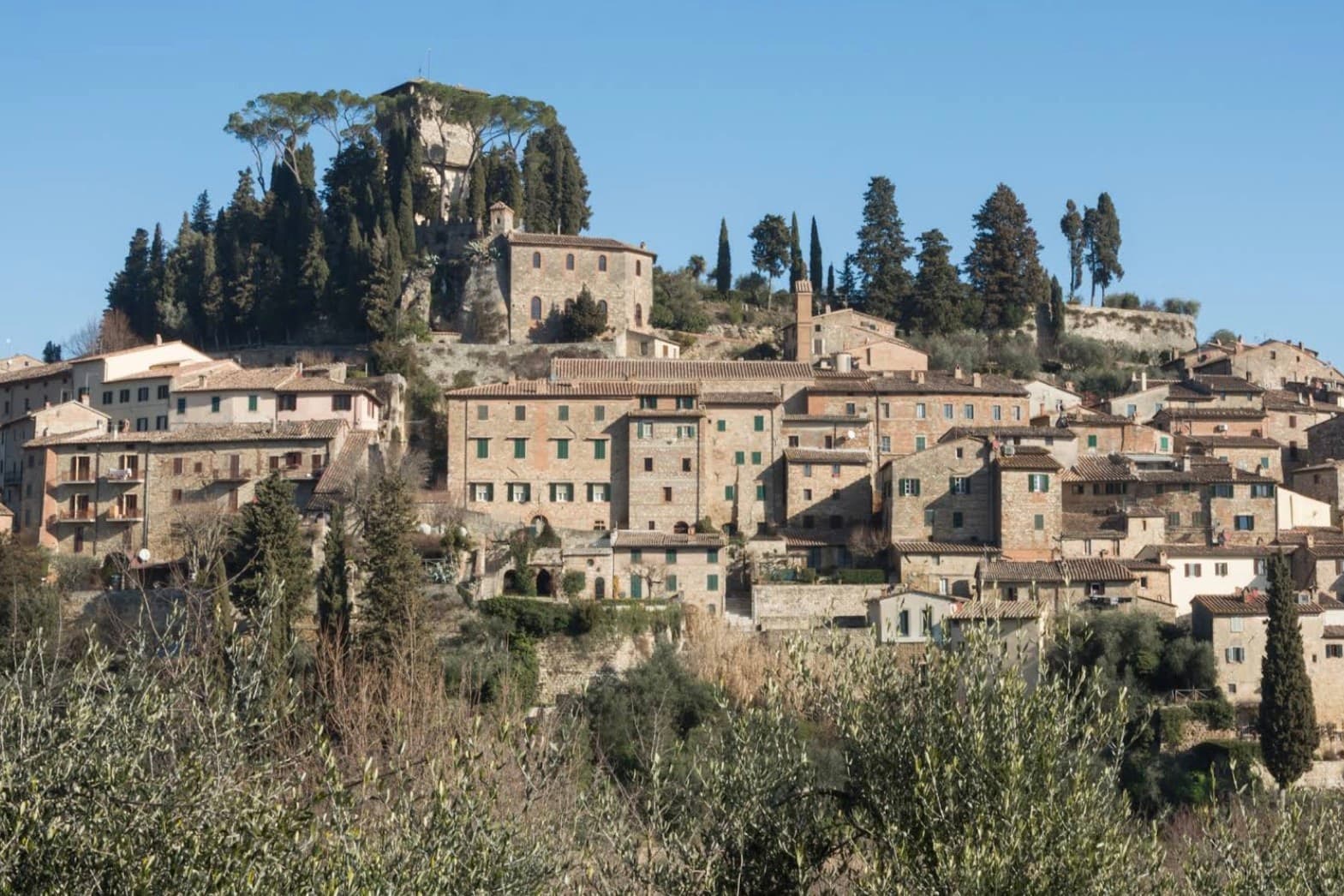
The town sits on the western flank of a ridge at the meeting point of Toscana, Umbria and Lazio, where the mountain divides the Val d'Orcia from the Val di Chiana. The medieval comune passed between Siena, Orvieto and Perugia before falling to Siena in the late fourteenth century, and it was Cosimo I who later sold it whole to a marchese.
The fortress at the top of the grid and the square laid out below it are two halves of the same Renaissance move: a private residence replacing a garrison at the summit, a flat civic stage opened up at the base. Above the town, in the woods, the hermitage and the caves belong to a much older layer, human use of the mountain reaching back to the Mesolithic, long before any comune or marchese laid claim to it.
What the town adds up to is a settlement built in tiers: a prehistoric mountain, a contested medieval center, and a Renaissance overlay that reorganized the base of the hill without touching what stood above it.
Da Nilo, Il Tiglio di Piazza da Nilo have been named by a guide.
What to see in Cetona
- Piazza Garibaldi. Elliptical square at the foot of the medieval grid, flat and open where the streets above it climb steeply. The civic stage of the borgo, still the first thing that orients a visitor.
- Rocca di Cetona. Fortress at the top of the centro storico, its walls and keep still standing though the interior became a private residence rather than a garrison.
- Convento di San Francesco. Franciscan convent below the borgo, founded in 1212, with a single-nave church and a small cloister still in religious use.
How to get to Cetona
Perugia is roughly 78 minutes away by road.
Our tip
April through June and September into October are the months Cetona keeps its calmest pace, the wooded slopes of Monte Cetona green or rust depending on the half. July and August are hot in the centro storico but the mountain trails above 800 meters stay cool. The Mostra del Tartufo, dedicated to the local white truffles, runs the second weekend of November in Piazza Garibaldi. Sagra del Bico di Cetona falls in June.
Suvereto
Why visit Suvereto
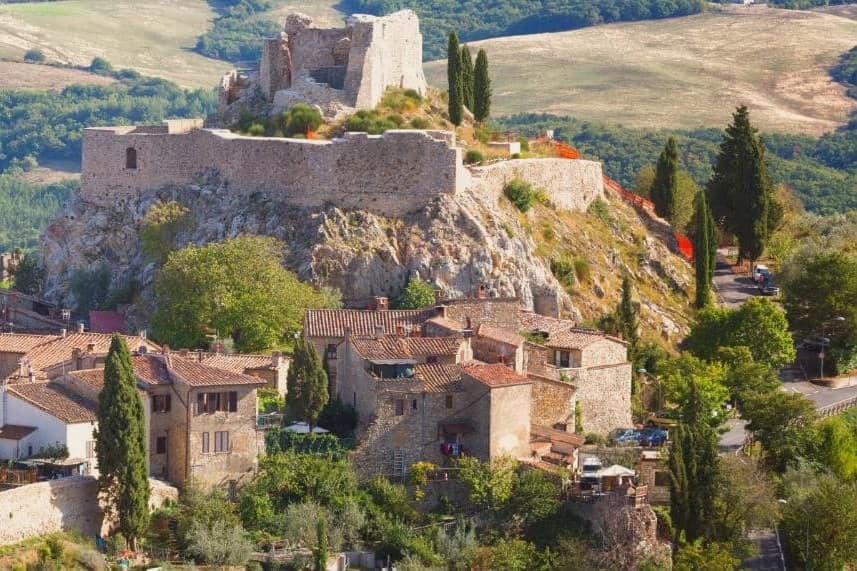
Suvereto sits at 127 meters on the inland edge of the Val di Cornia, twelve kilometers from the Tyrrhenian coast. The name comes from the Latin suberetum, a wood of cork oaks, and the surrounding forests still hold them.
The Rocca Aldobrandesca, first documented in 973, occupies the highest point of the borgo; the Aldobrandeschi family who controlled it also ruled large sections of southern Toscana and the Maremma. The town reached its golden age in the thirteenth century, when Frederick II granted it a charter of freedoms in 1216 and the Palazzo Comunale was built.
The centro storico is a tight grid of stone vicoli that runs uphill from the Romanesque Pieve di San Giusto to the fortress. Suvereto carries five institutional signals at once, a rare combination in the province of Livorno, and the surrounding wine country falls under the Val di Cornia DOC and Suvereto DOCG appellations.
I’ Ciocio have been named by a guide.
What to see in Suvereto
- Rocca Aldobrandesca. Fortress at the highest point of the borgo, documented from 973, expanded in the twelfth century and partly restored as an open archaeological site.
- Pieve di San Giusto. Eleventh-century Romanesque parish church at the foot of the borgo, with a sandstone façade and a single nave divided by stone columns.
- Palazzo Comunale. Thirteenth-century town hall with a double external staircase and Ghibelline merlons, one of the earliest surviving civic palaces of the Maremma.
How to get to Suvereto
Livorno is roughly 84 minutes away by road.
✷ We have written about Suvereto
“That is the thing the young man on the beach did not see, and the man who lives here cannot stop seeing. This is an industrial coast wearing a beach towel. Run it back far enough and the whole of it, the swamp and the steel and the slag and the white water, is one long story about iron, and the holiday is the costume the story put on after the work ran out.”
Read our piece on Suvereto →The Iron Coast | The Wrong Sea
Our tip
April through June and September into October are the dry months in the Val di Cornia, when the cork forests behind the town hold their light and the wine harvest runs in September. The Sagra del Cinghiale, celebrating the wild boar of the surrounding hills, runs across two weekends in December and draws a different crowd. July and August are hot at 127 meters and most visitors descend to the Tyrrhenian coast in the afternoon. Palio dell'Imperatore falls in August.
Capalbio
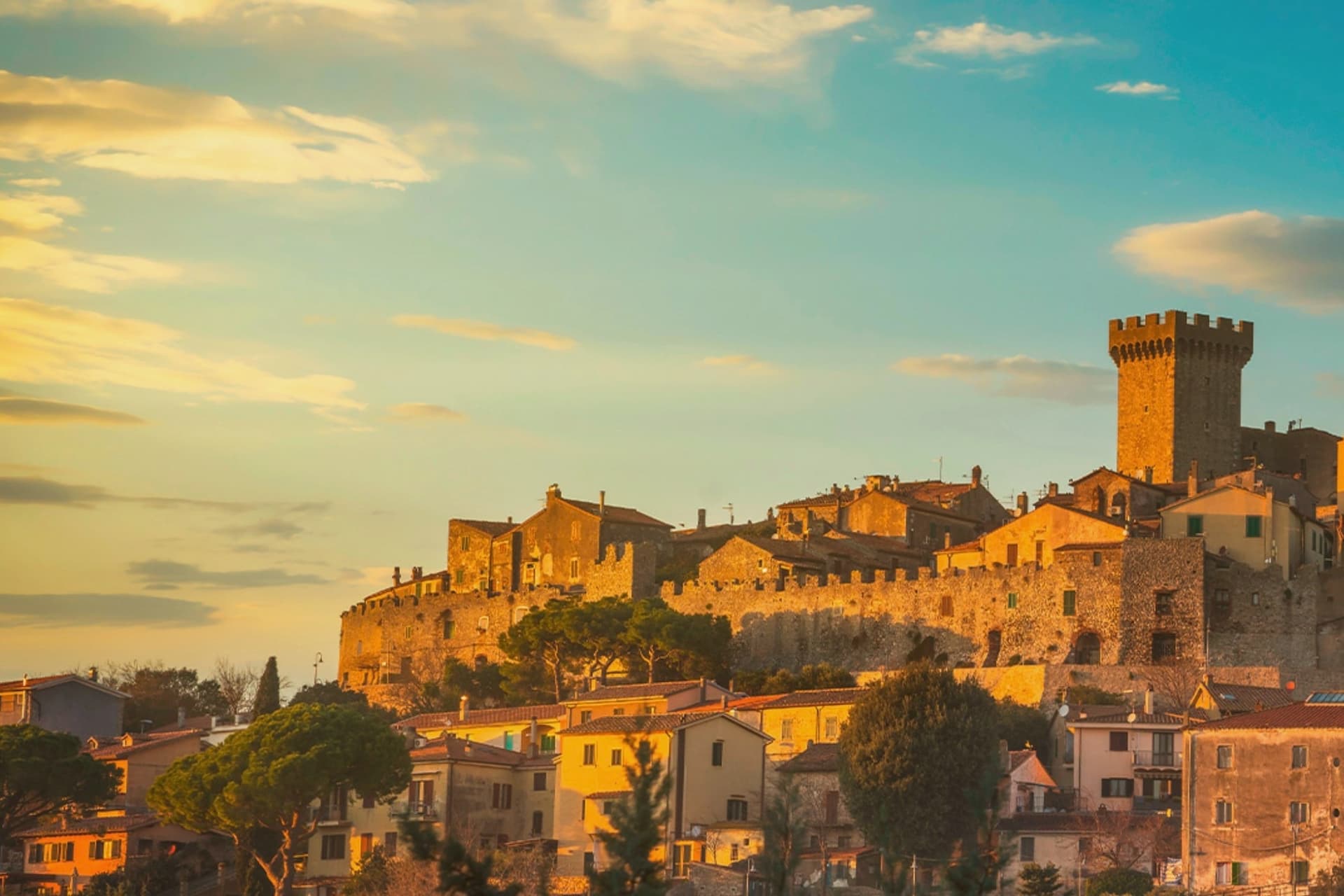
Why visit Capalbio
Capalbio stands twelve kilometers from the Tyrrhenian coast, the last hill town before the border with Lazio. Charlemagne gave the land to the Abbey of Tre Fontane in 805; the Aldobrandeschi held it through the medieval period, the Orsini built the castle, and Cosimo I de' Medici took it in 1555.
It became an independent commune in 1960. The medieval walls and the fortress define the centro storico at the top of the hill; the surrounding territory drops from the wooded uplands of Monte Calmata down to the coastal reserve at Lago di Burano.
The sculpture park sits four kilometers south of the walls, apart from the old town rather than within it. A borgo that governed itself late, held by abbey, feudal lords and Medici in turn before its own commune, and a territory that runs in one line from hilltop stone to coastal wetland.
Agriturismo Antica Pinciana, Il Frantoio, La Dogana by Enoteca la Torre and 1 more have been named by a guide.
What to see in Capalbio
- Rocca Aldobrandesca. Medieval fortress at the top of the borgo, later expanded by the Orsini, with a square tower and battlements that overlook the Maremma.
- Mura medievali. Two concentric circles of walls enclosing the centro storico, with a walkable parapet that opens onto views toward the Argentario.
- Giardino dei Tarocchi. Sculpture park four kilometers south of the borgo, its ceramic and mirrored figures set among holm oaks.
How to get to Capalbio
There is a railway station in the town, so you can arrive without a car and never need one while you are here. Roma is roughly 108 minutes away by road.
✷ We have written about Capalbio
“Everyone driving from Florence down to Rome crosses the Maremma without noticing, because there is nothing on that stretch to make them slow down. The hills give out. The cypresses stop. What opens up instead is flat open country, wheat and grass running off to a few low rises, the least Tuscan-looking part of Tuscany, a landscape you would call dull if you were being honest and which most guidebooks solve by leaving out.”
Read our piece on Capalbio →Maremma | The Last Cowboys of Tuscany
Our tip
May through September is the season the borgo and its territory work together: the centro storico stays cool at 217 meters while the Tyrrhenian coast at Chiarone-Capalbio fills with swimmers. The Giardino dei Tarocchi runs April through October. July and August are hot inland; afternoon hours in the borgo thin out and the coast takes over. Sagra del Cinghiale falls in September.
Montaione
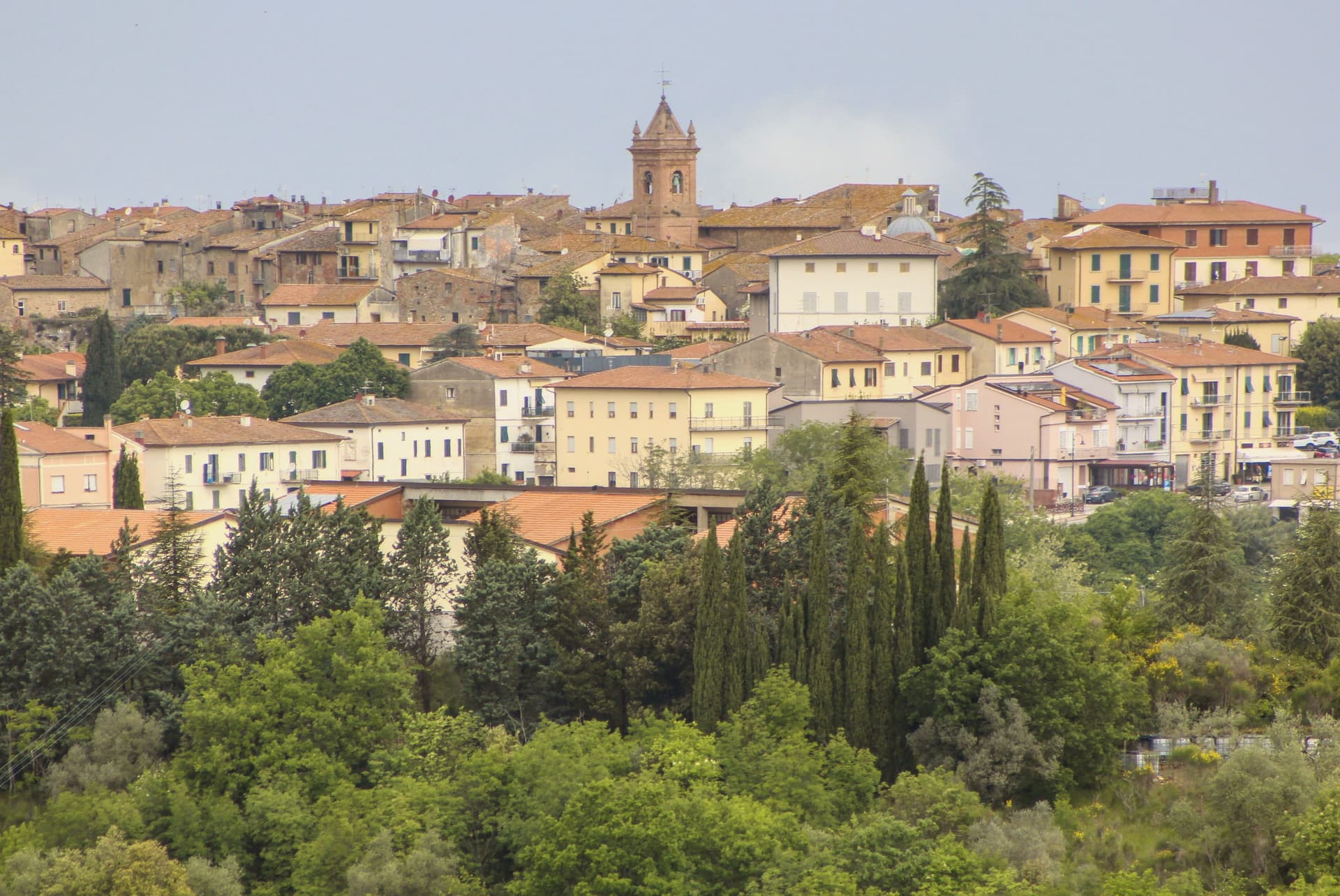
Why visit Montaione
Montaione sits at 341 meters on a ridge above the Valdelsa, in the wooded hills west of Florence on the road toward Volterra. Etruscan and Roman finds at Poggio all'Aglione, Bellafonte and Iano confirm continuous occupation across the territory, material now held in the town's archaeological museum.
The medieval castello was the seat of an autonomous comune from 1256 and passed to Florence in 1369. From the early fourteenth century, glassmaking ran in the surrounding woods, and an eighteenth-century decree by the Grand Duke required master glassmakers to teach the craft to their fellow citizens.
The town joined Borghi più belli in 2007. The territory spreads well beyond the ridge itself.
Five kilometers west, a Franciscan convent founded in 1500 stands in the woods, its chapels laid out as a walkable replica of Jerusalem's holy sites. Ten kilometers south, Castelfalfi carries a separate, older Lombard origin, now a resort with its own vineyards and church.
Between them, the centro storico keeps the civic core: the tower, the palace, the parish church rebuilt on twelfth-century foundations. The comune, in effect, holds three distinct centuries of settlement at once: an ancient scatter of finds, a fourteenth-century craft economy, and a devotional complex from the 1500s, spread across ridge, castle and wood rather than gathered in one place.
La Rocca di Castelfalfi have been named by a guide.
What to see in Montaione
- Sacro Monte di San Vivaldo. Complex five kilometers west of the borgo. Seventeen chapels stand among oak woods, each holding a scene built as part of the topographical replica, still reached on foot along the paths between them.
- Castelfalfi. Lombard-origin castle and frazione ten kilometers south, restored as a private resort with vineyards and a Romanesque church of San Floriano.
- Centro storico. Medieval grid on the ridge, with the Palazzo Pretorio, the Torre del Cassero and the Chiesa di San Regolo restored after 1118 foundations.
How to get to Montaione
Firenze is roughly 67 minutes away by road.
Our tip
April through June and September into October are the months Montaione shows best, the Valdelsa light low on the wooded ridges and the San Vivaldo chapels in their full October ochre. The Mostra del Tartufo Bianco runs the last weekend of October and the first of November. July and August push past thirty in the valley but the centro storico at 341 meters stays manageable.
Pitigliano
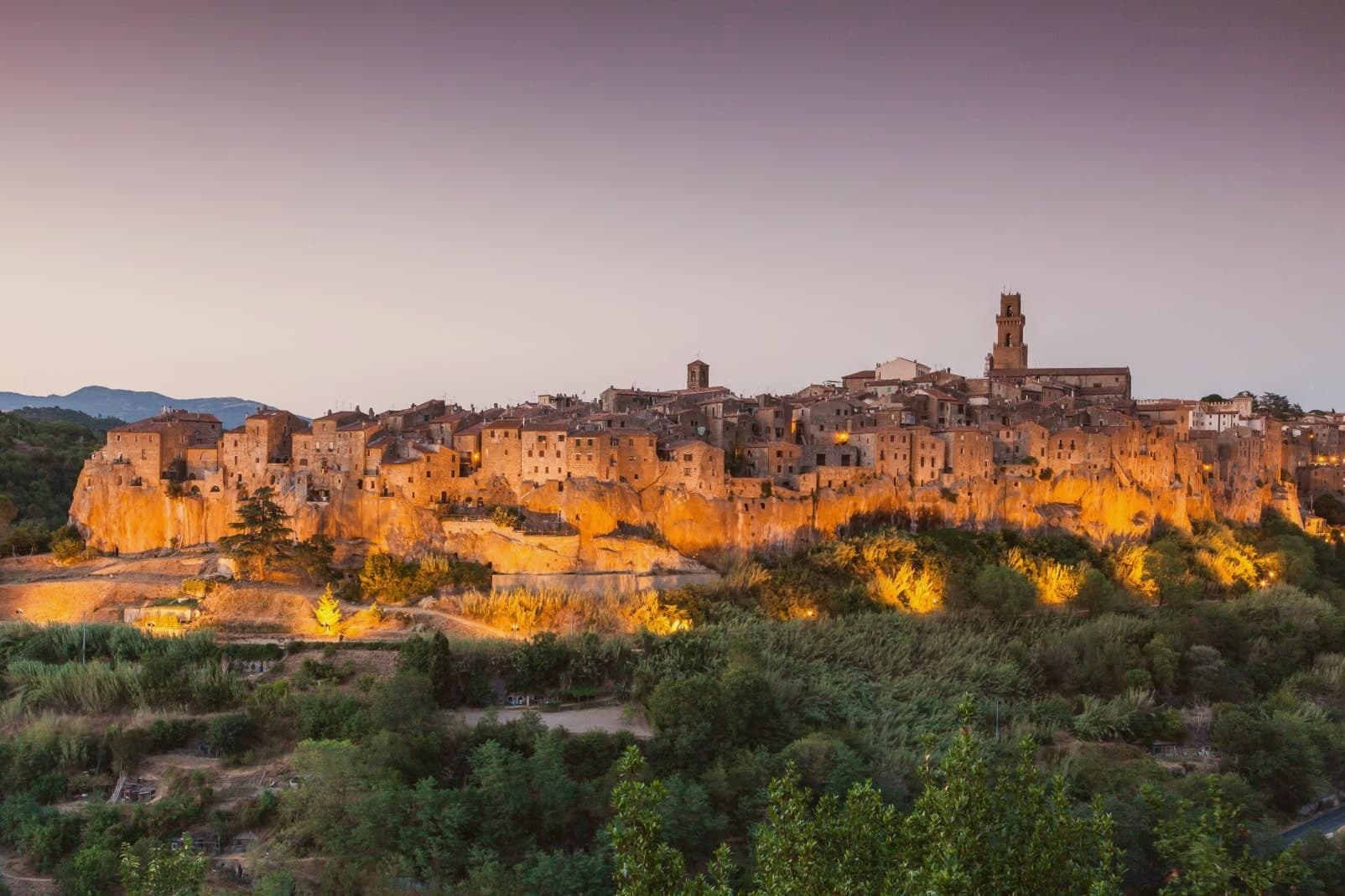
Why visit Pitigliano
Pitigliano sits at 313 meters on a tuff spur in the southern Maremma, eighty kilometers southeast of Grosseto and close to the Lazio border. The town is built into the rock it stands on: cellars, stables and synagogue all carved into the same volcanic tuff that the houses rise from above.
The county passed to the Orsini family in 1293 and stayed Orsini for 150 years of wars with Siena. In 1556 Niccolò IV Orsini gave land for a Jewish cemetery to his physician David de Pomis; the synagogue followed in 1598.
When Pitigliano was absorbed into the Grand Duchy of Tuscany in 1608, the Medici imposed a ghetto in 1622 around the synagogue, on the cliff edge. The nickname Little Jerusalem comes from there.
The Etruscan tagliate, channels cut into the tuff at depths from one to over ten meters, were carved long before any of that, and remain in use as paths and roads. The DOC Bianco di Pitigliano, a Trebbiano blend, is grown on the surrounding slopes.
Il Tufo Allegro, Angiolina, Il Caveau and 1 more have been named by a guide.
What to see in Pitigliano
- Palazzo Orsini. Twelfth-century fortress remodeled by Antonio da Sangallo the Younger in the sixteenth century, now housing the Museo Civico Archeologico and the Diocesan Museum.
- Sinagoga di Pitigliano. Synagogue built in 1598, restored after partial collapse, the heart of the Jewish quarter that gave the town its Little Jerusalem nickname.
- Quartiere Ebraico. The ghetto established in 1622 around the synagogue, with the kosher bakery, mikveh, oven and wine cellar carved into the tuff.
How to get to Pitigliano
Terni is roughly 107 minutes away by road.
Our tip
April through June and September into October are the dry months in the southern Maremma: vine work, mild days, evening light that hits the tuff cliff at low angle. July and August push into the mid-thirties and the rock holds the heat; the centro storico empties between four and seven. The Sagra dello Sfratto, celebrating the Jewish honey-and-walnut pastry, runs in September.
More from Anywhere Italy
 The best small olive oil towns with a serious restaurant in Toscana
- The prettiest hidden villages with a serious restaurant in Toscana
 The 10 prettiest villages with a food festival in Toscana
 The best small towns with a food festival in Toscana
- The best wine towns with a food festival in Toscana
- The best small hill towns with a serious restaurant in Toscana