
The best ski towns you can reach by train in Trentino-Alto Adige
90 towns visited, 910 to go. Follow along, free: Subscribe on Substack
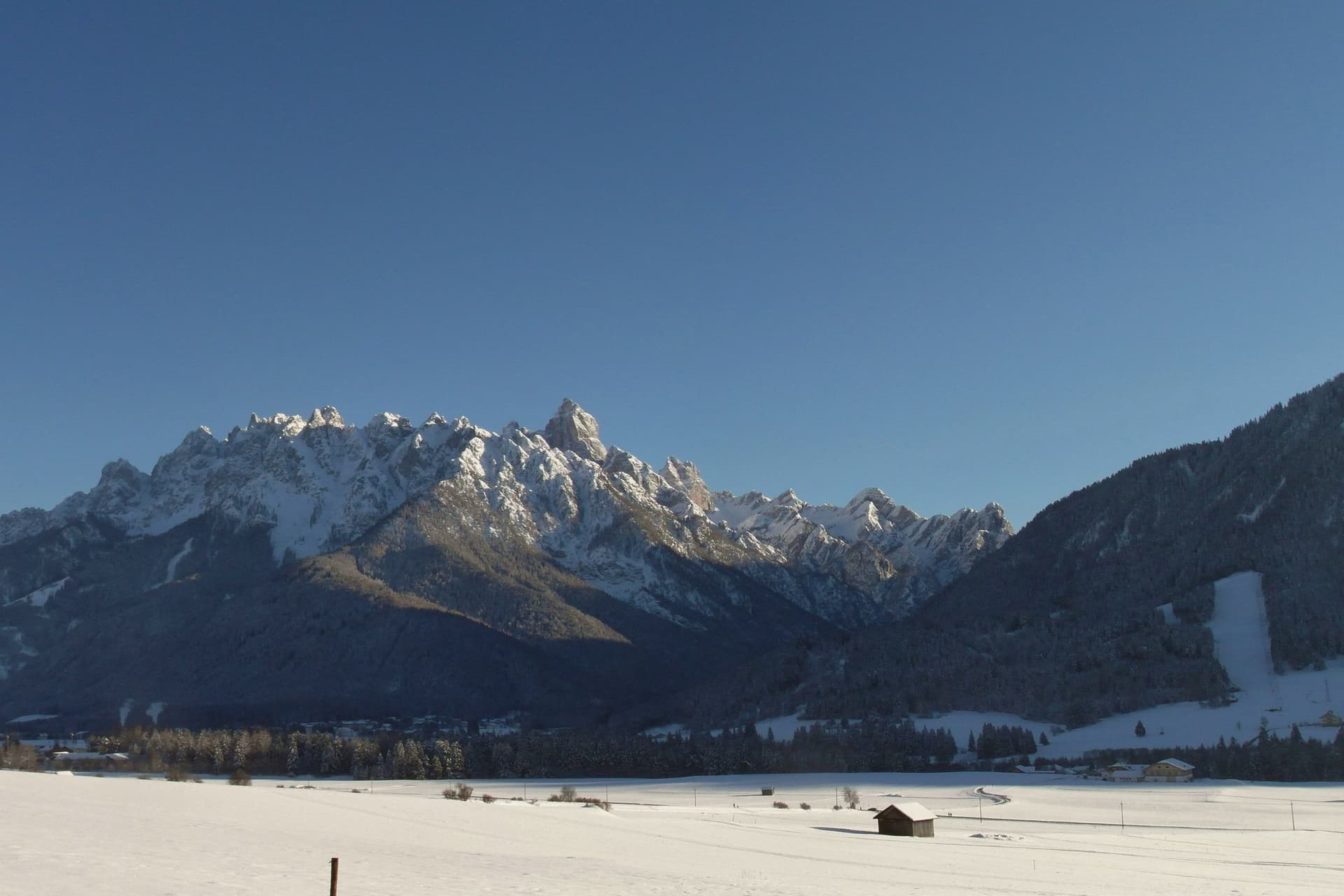
Winter arrives early in Trentino-Alto Adige and stays late, packing the high pastures above the Puster and Isarco valleys under snow that holds its quality into spring. The towns down in the valley floors are built of stone and painted stucco, with arcaded main streets, onion-domed church towers and Stuben panelled in old pine, and they eat like the Alps rather than like Italy: speck cut thick, canederli in broth, barley soup, apple strudel, a glass of Lagrein or Vernatsch afterwards. Trains run the valleys all winter, hourly and cheap, and in most of these places the cable car or the ski bus stop is a short walk from the platform. It is one of the few parts of the Alps where a ski week without a car is straightforward.
The name most people arrive with is Cortina d'Ampezzo, over the provincial border in the Veneto, and after the Olympic build-out its car parks, hotel rates and lift queues reflect that. The Sella Ronda circuit draws the same crowd, filling Val Gardena and Alta Badia through February half term and the Italian holiday weeks. These are serious mountains and the skiing earns its reputation. It is the arithmetic of getting there, and of finding a room, that has worsened.
The Dolomites do not stop at the famous valleys. The same limestone walls, the same lift networks and the same kitchens continue north along the Brenner line and east along the Pustertal, through towns where fewer people go, where the snow report is the same and where the railway does the driving. These are the ones in this list, each with a ski area on its own ground and each confirmed reachable without a car.
Of the 33 communes we have mapped in Trentino-Alto Adige/Südtirol, 6 qualify as ski towns you can reach by train: each has a ski area on its own territory, and we have confirmed each is reachable without a car. The smallest, Toblach, has 3,363 residents.
Two more lists worth reading alongside this one: The 7 best towns you can reach by train that eat well in Trentino-Alto Adige and The 6 best hidden towns you can reach by train in Trentino-Alto Adige.
Why visit Toblach
Dobbiaco sits at 1,256 meters in the upper Val Pusteria, on the Austrian border, its written record going back to 827. The old settlement, Alt-Toblach, grew around the parish church, while the newer part of town took shape lower down around the railway station built alongside the hotel that opened in 1877, which turned Dobbiaco into one of the first alpine resorts in the Habsburg empire.
Further out in the woods at Alt-Schluderbach stands the cabin where a composer once retreated each summer to write, apart from the hotel guests and the trains. South of the settlement the land opens into the Tre Cime Nature Park, holding an alpine lake with a trail for walkers, and the old railbed continues in that direction as a route over Cimabanche pass toward Cortina d'Ampezzo.
Beyond all of it, reached by way of Val di Landro and Misurina, rise the three spires that anchor the eastern Dolomites. The Gustav Mahler Musikwochen festival fills the town each July and August with concerts named for the man who once needed its quiet.
Taken together, the town reads as three layers set one behind the other: a medieval nucleus, a Habsburg-era resort built on the railway, and beyond both, the mountains and woods that drew a composer to withdraw and now draw everyone else to pass through.
What to see in Toblach
- Chiesa di San Giovanni Battista. Rebuilt 1764-1774 over the remains of a ninth-century Benedictine chapel, standing at the center of the historic settlement of Alt-Toblach, the nucleus the rest of the town grew around.
- Grand Hotel Toblach. Built 1877-1878 beside the new railway station. The building now holds the nature park visitor center and the Mahler Auditorium, where the composer's name is heard again each summer.
- Lago di Dobbiaco/Toblacher See. Alpine lake south of town in the Tre Cime Nature Park, with a circular educational trail and observation platforms for waterfowl.
How to get to Toblach
It has its own railway station. Bolzano is about 1 h 33 min away by road. The full route from Venice.
Our tip
June through September is the summer Dolomite season, with cool evenings, the Mahler Musikwochen in July and August at the Grand Hotel auditorium, and the Tre Cime and Dobbiaco-Cortina cycle path at their busiest. December through March is the ski and Nordic season: the Dobbiaco-Cortina cross-country track replaces the cycle path, and the Tre Cime ski circuit runs from nearby Plan de Corones. April and May are quiet shoulder months, snow gone but many lifts and hotels closed.
Why visit Innichen
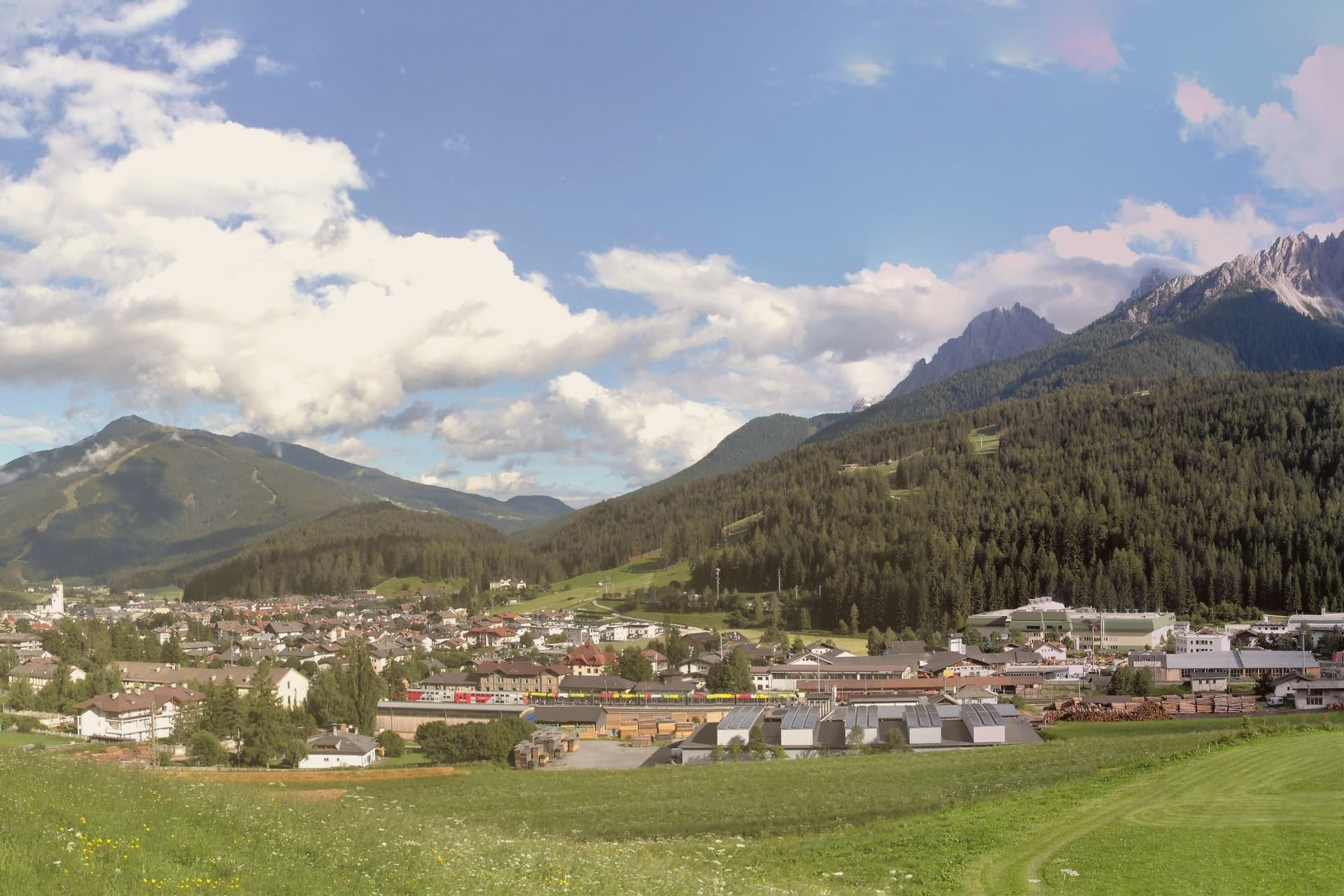
San Candido, Innichen in German, sits at 1,175 meters in the Alta Pusteria valley near the Austrian border, twenty-six kilometers west of Lienz and the headwaters of the Drava river. The town was founded as a Benedictine monastery in 769 by Duke Tassilo III of Bavaria, charged with the Christianisation of the Slavic populations of the eastern Alps.
The monastery was turned into a college of canons in 1143, which is the founding date of the collegiate church that still stands at the center of the town today. The town is bilingual, German first and Italian second; the Italian name San Candido was applied after 1918 by the Tolomei program that renamed every place in South Tyrol.
The old town, laid out along the Pusteria road with its squares and burgher houses, sits at the foot of the slope that rises directly into the Monte Baranci ski area, so the built center and the mountain terrain meet with almost no transition. To the south the Drei Zinnen, the Tre Cime di Lavaredo, mark the most photographed silhouette in the Dolomites, with Innichen serving as the road, rail and trailhead base for reaching them through Sesto and Auronzo.
East, the valley opens toward the Drava river and Austria, followed for its whole length by the cycle path to Lienz. The town works because of this arrangement: a monastic and Romanesque core, a wall of Dolomite peaks to the south, and open riverine access to Austria to the east, three directions of identity meeting at a single, small, bilingual place.
What to see in Innichen
- Stiftskirche / Collegiata di San Candido. Extended around 1280 with a Creation cupola that is the largest surviving fresco of its kind, the interior carrying the weight of the building's Romanesque reputation in stone and paint.
- Stiftsmuseum. Chapter museum next to the church, holding thirteenth-century sculpture, manuscripts and liturgical objects that trace the life of the foundation across its centuries as monastery and college.
- Historic centre. Pedestrianised core around the church, with Tyrolean burgher houses, painted facades and the Pflegplatz and Atoplatz squares laid out along the old Pusteria road.
How to get to Innichen
It has its own railway station. Bolzano is about 1 h 41 min away by road. The full route from Venice.
Our tip
Innichen runs on a two-peak alpine calendar. June through September is the hiking and cycling season, with the Tre Cime trails open, the rifugi in the Sesto Dolomites fully staffed and the Drava cycle path busy with families heading to Lienz. July and August are the warmest weeks, comfortable at 1,175 meters while the valley floors farther south overheat.
Why visit Levico Terme
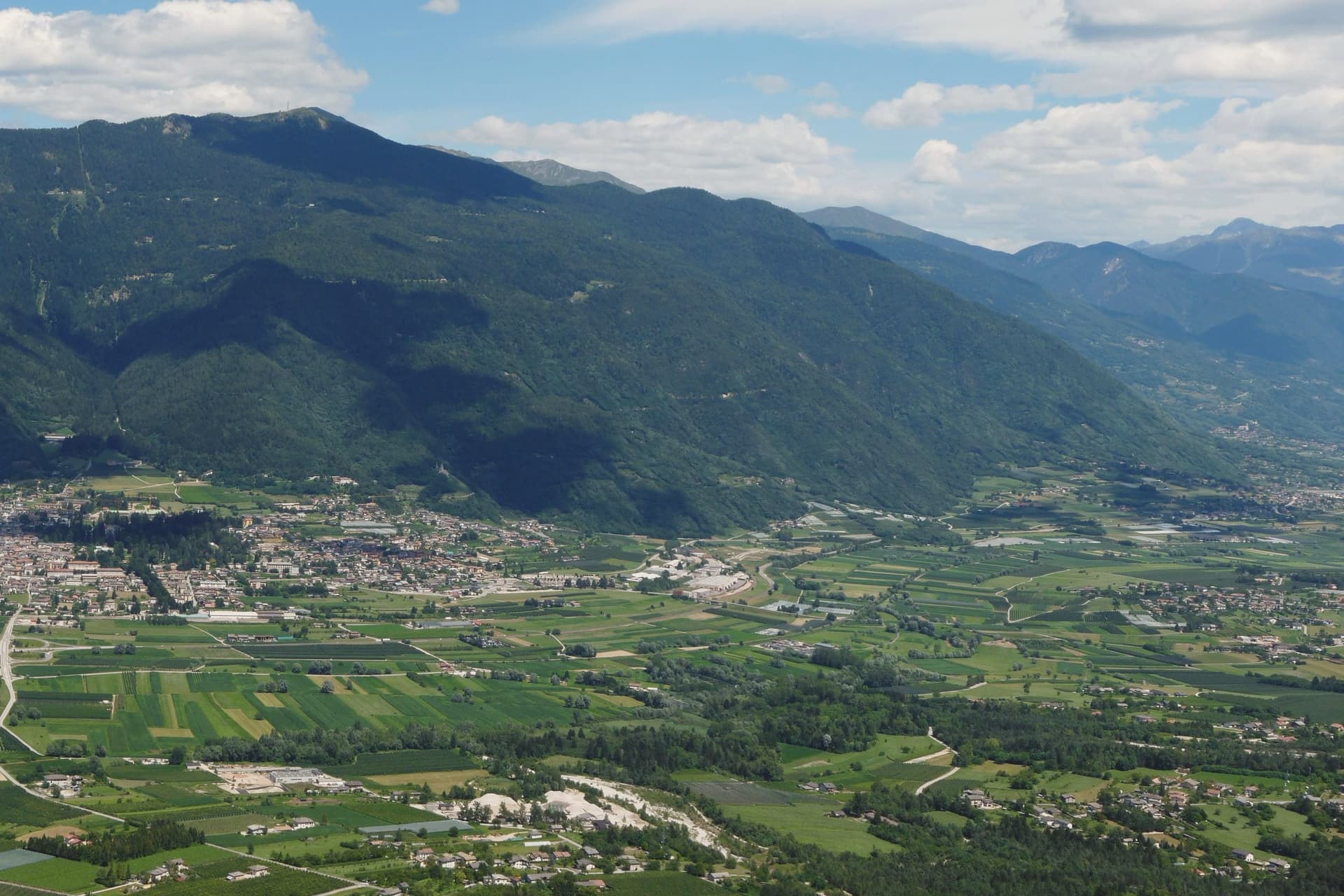
Levico Terme sits at 520 meters in the Valsugana, twenty kilometers east of Trento, between the Lagorai chain and the high plateaus of Folgaria and Lavarone. The settlement later passed under Habsburg rule and was elevated to city rank in 1894 by decree of Franz Joseph I.
The spa quarter, the park and the lake sit close together at the edge of the old center, with the fort watching all three from the hill above. The historic center, with its imperial-era villas and the parish church of Santissimo Redentore, grew up around the spa rather than the other way round: the streets follow the shape of a resort built in the space of a few decades under Austro-Hungarian rule, rather than a town that predates it.
What survives is a place whose entire layout, from park gate to lakeshore to the fort on the ridge, still reads as the imperial spa it was built to be.
What to see in Levico Terme
- Parco delle Terme. Grounds laid out by Georg Ziehl around the spa buildings and the hotel, with paths shaded by mature planting where the Christmas market sets up each winter.
- Grand Hotel Imperial. Art Nouveau facade facing the park it anchors, the rooms where Empress Elisabeth stayed still forming the core of the working hotel.
- Terme di Levico. The spa buildings that gave the town its purpose, drawing on water piped down from the mountain springs and still run as a treatment center today.
How to get to Levico Terme
It has its own railway station. Trento is about 30 min away by road. The full route from Verona.
Our tip
Levico runs year-round: the thermal cures operate from spring through autumn, the Christmas market fills the Habsburg park through December, and the spa hotels stay open through the cold months. May through October is the lake season, with the Bandiera Blu waters warm enough for swimming from mid-June and the sailing and windsurfing clubs open. June through August can hit thirty degrees in the valley floor; the park and the lakeside hold the heat better than the centro storico in the afternoon.
Why visit Brunico
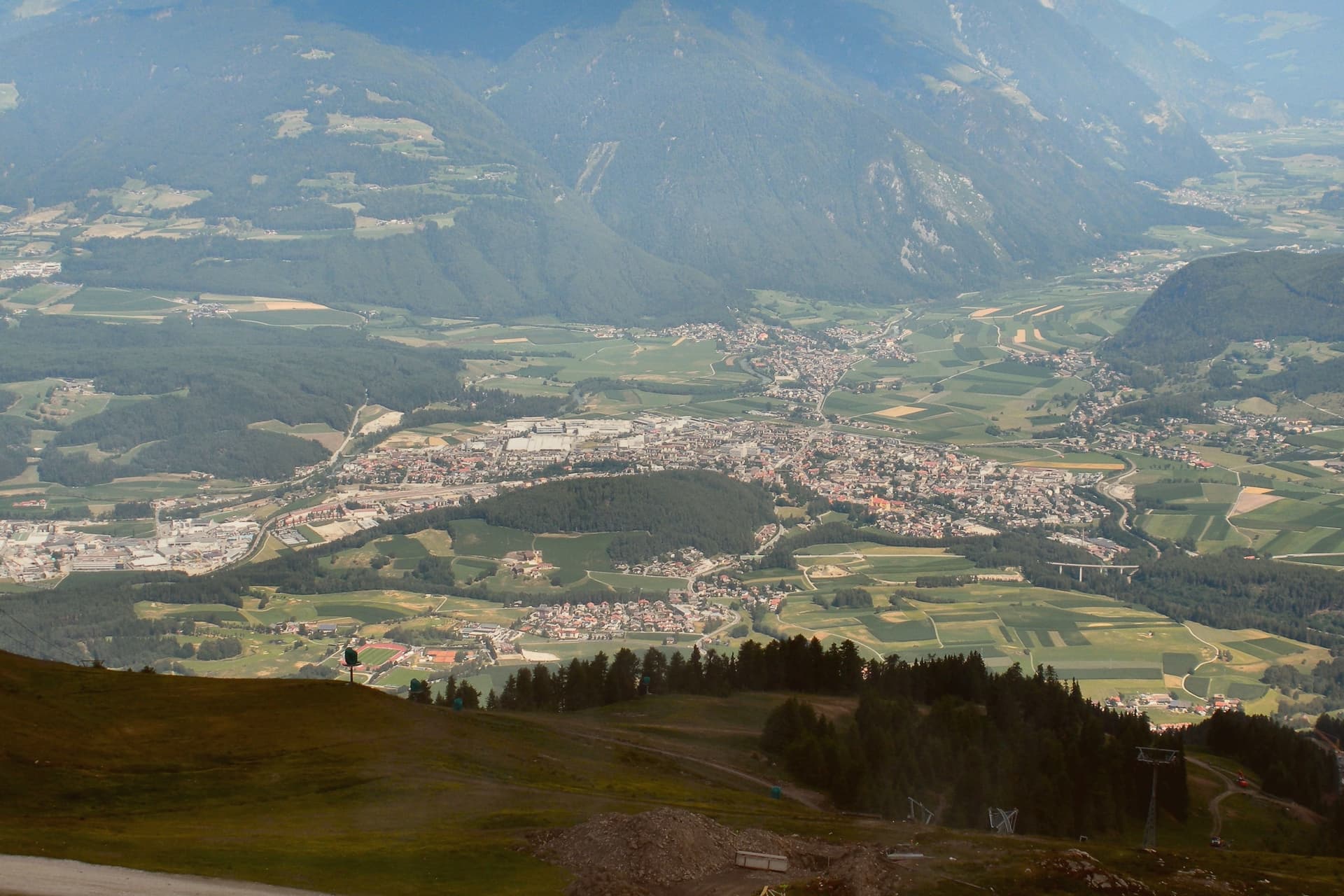
Brunico, Bruneck in German, sits at 838 meters in the eastern Alto Adige, in the Val Pusteria. The name comes from the castle built above the settlement, and the town below grew up around it rather than the other way round.
First documented as Bruneke in 1256, it received weekly market rights and the privilege of high justice, and grew rich in the fourteenth and fifteenth centuries on the Augsburg-Venice trade that ran across the valley, the same trade that filled the Stadtgasse with merchant houses. The town has three distinct layers that sit close together but answer different purposes: the castle above holding the seat of the former prince-bishops, the walled Stadtgasse below as the commercial spine between the four gates, and Teodone at the edge of town, where the Mair am Hof Residence and its rebuilt farmhouses preserve a rural way of life that the town center does not.
The mountain above the valley, reached from the town, adds a fourth register entirely, modern and built for a single striking structure rather than for defence or trade. Together these layers show a town shaped by three different economies in three different eras: episcopal power, alpine commerce, and now winter tourism, each leaving its own mark rather than replacing what came before.
What to see in Brunico
- Castello di Brunico. The castle sits above the town as the former summer residence of the Brixen bishops. The museum inside occupies rooms that still read as a bishop's seat rather than a purpose-built gallery.
- Stadtgasse. Pedestrian street between the four gates, its townhouses carrying bay windows and ornate shop signs at close range, the kind of detail that only shows up on foot.
- Museo Etnografico Sudtirolese. South Tyrolean Folklore Museum in the Mair am Hof Residence at Teodone, built 1690-1700, with twenty-four rebuilt farmhouses from across the province in its open-air section.
How to get to Brunico
It has its own railway station. Bolzano is about 1 h 9 min away by road.
Our tip
May through October brings the warm months in the Pustertal, with the Stadtgasse and the castle terrace usable from early afternoon and Plan de Corones open for hiking and biking from late June. June and July are the cool alpine months, with long evenings in the historic center and the cable cars running up from the south side of town. September and October bring the autumn colors and the start of Törggelen, the South Tyrolean chestnut-and-new-wine season.
Why visit Bressanone
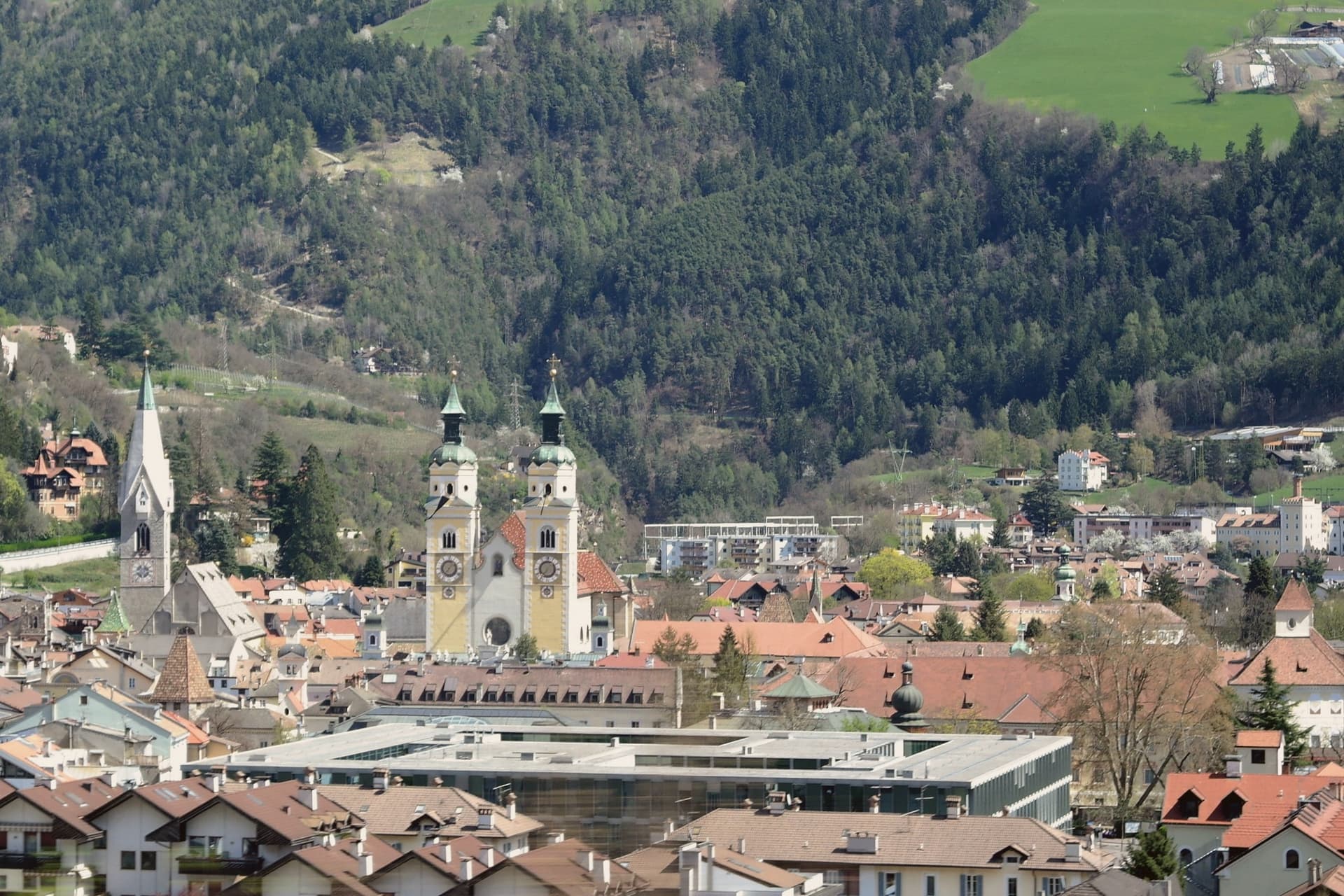
Bressanone, Brixen in German, is the third-largest town and the oldest urban settlement in South Tyrol, founded in the sixth century at the confluence of the Eisack and Rienz rivers at 560 meters, forty kilometers north of Bolzano. The bishopric was established here in the early Middle Ages and received imperial immediacy in 1027; in 1179 Frederick Barbarossa granted the bishop the title of prince of the Holy Roman Empire, and Brixen remained a prince-bishopric until secularisation in 1803.
The Hofburg, the bishops' palace, served as the seat of that power from the thirteenth century, with Renaissance courtyards, Baroque state rooms and the Diocesan Museum of religious art and historic nativity scenes inside. The Romanesque cathedral was rebuilt in Baroque form between 1745 and 1754, its interior lined with thirty-three different types of marble and joined to the older cloister.
The Stufles district, across the Eisack bridge, is the oldest neighborhood in the city. The Augustinian Abbey of Novacella, founded in 1142 by Bishop Hartmann four kilometers north, runs South Tyrol's northernmost winery, producing Müller-Thurgau, Kerner and Sylvaner.
What to see in Bressanone
- Duomo di Bressanone. Cathedral on the site of a tenth-century church, rebuilt as a Romanesque basilica in 1174 and reworked between 1745 and 1754 in Baroque form with thirty-three types of marble.
- Hofburg. Bishops' palace and seat of the prince-bishops from the thirteenth century to 1803, with Renaissance courtyard, Baroque state rooms and the Diocesan Museum.
- Torre Bianca / Weißer Turm. Seventy-eight meter bell tower of the parish church of San Michele, named for its bright tiled roof, with the present shape dating to 1459 and now a museum.
How to get to Bressanone
It has its own railway station. Bolzano is about 51 min away by road. The full route from Verona.
Our tip
April through June brings mild weather in the Eisack valley, with the cloister gardens of the Duomo and the courtyards of the Hofburg in shade and the high paths above the Plose opening from late May. September and October are dry and cool, with apple harvest across the orchards north of the city and the Törggelen season starting in early autumn. July and August can hit thirty degrees at 560 meters, with the Plose cable car carrying day-trippers up to cooler ridges.
Why visit Trento
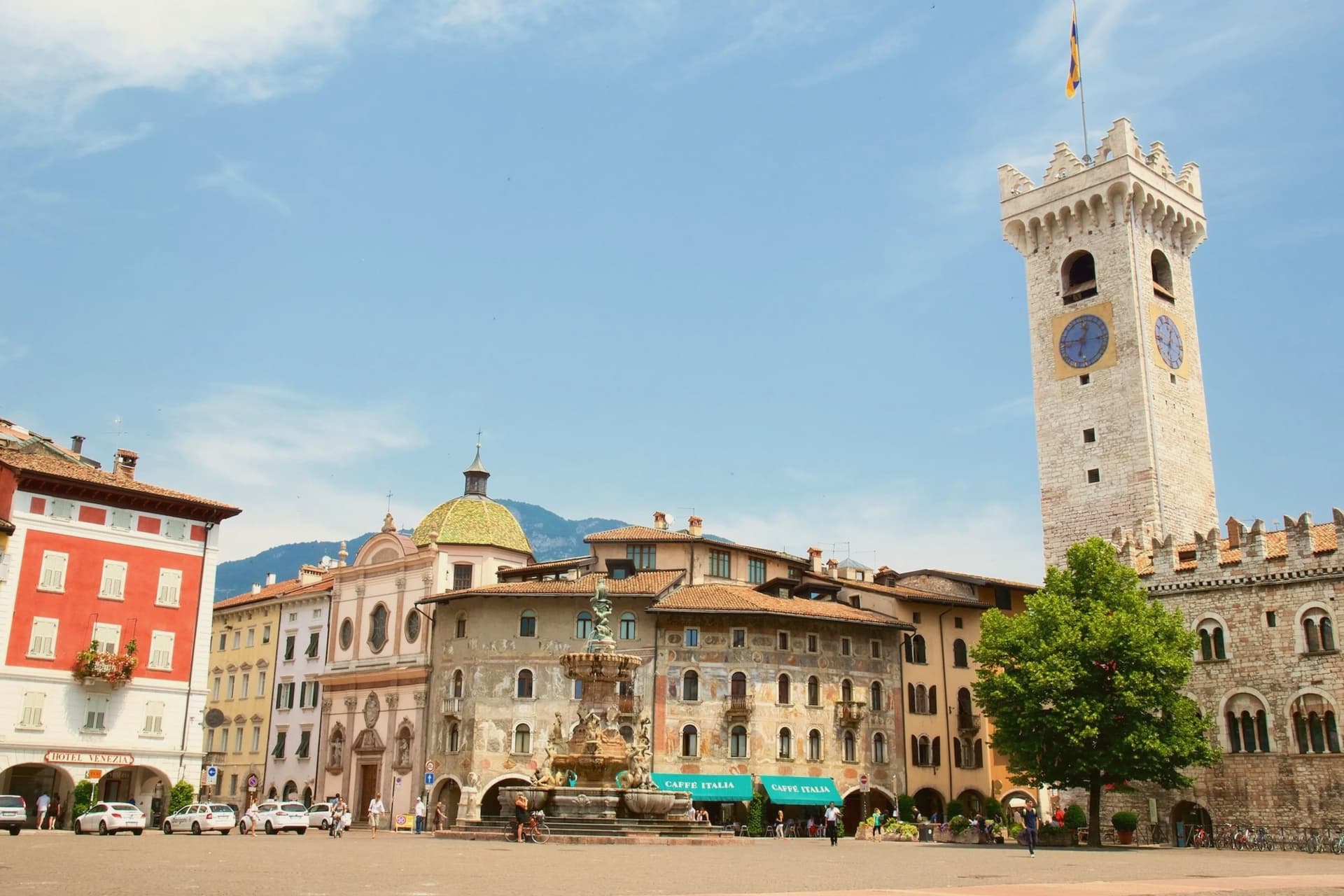
Trento sits at 194 meters on the Adige, the city Italy chose as the seat of one of its two northern autonomous provinces and the regional capital of Trentino-Alto Adige. Monte Bondone rises to two thousand meters directly above the western edge; the Brenta Dolomites are an hour west.
Between 1545 and 1563, the Council of Trent met here in twenty-five sessions across the Duomo di San Vigilio and the Castello del Buonconsiglio, formulating the Catholic response to the Protestant Reformation and shaping the next four centuries of European Christianity. The Duomo, begun in 1212 on the foundations of a late-Roman basilica, still stands at the center of Piazza Duomo.
The Buonconsiglio, built 1239 to 1255 as the residence of the prince-bishops, is now the city's main museum. In 2013 Renzo Piano completed MUSE, the natural science museum on the south edge of town, with a six-storey jagged roofline that imitates the Dolomites.
What to see in Trento
- Castello del Buonconsiglio. Thirteenth-century residence of the prince-bishops of Trento, host to sessions of the Council of Trent and now the city's main museum, with Gothic frescoes in the Torre Aquila.
- Duomo di San Vigilio. Romanesque-Gothic cathedral begun in 1212 on the remains of a late-Roman basilica, where most public sessions of the Council of Trent were held between 1545 and 1563.
- MUSE. Museum of natural science by Renzo Piano, opened 2013, with a 130-meter roofline that rises and falls in imitation of the Dolomites visible to the east.
How to get to Trento
It has its own railway station. The full route from Verona.
Our tip
April through June brings green slopes on Monte Bondone, mild evenings in Piazza Duomo and the start of the open-air concert season. September and October are dry and clear, with the Trento Film Festival of mountain cinema and the start of the autumn wine sagre in the Vallagarina to the south. July and August can hit thirty-three degrees in the city center at 194 meters; the air cools sharply if you climb Monte Bondone, and locals spend afternoons on the mountain or at the lake.
Read a sample letter
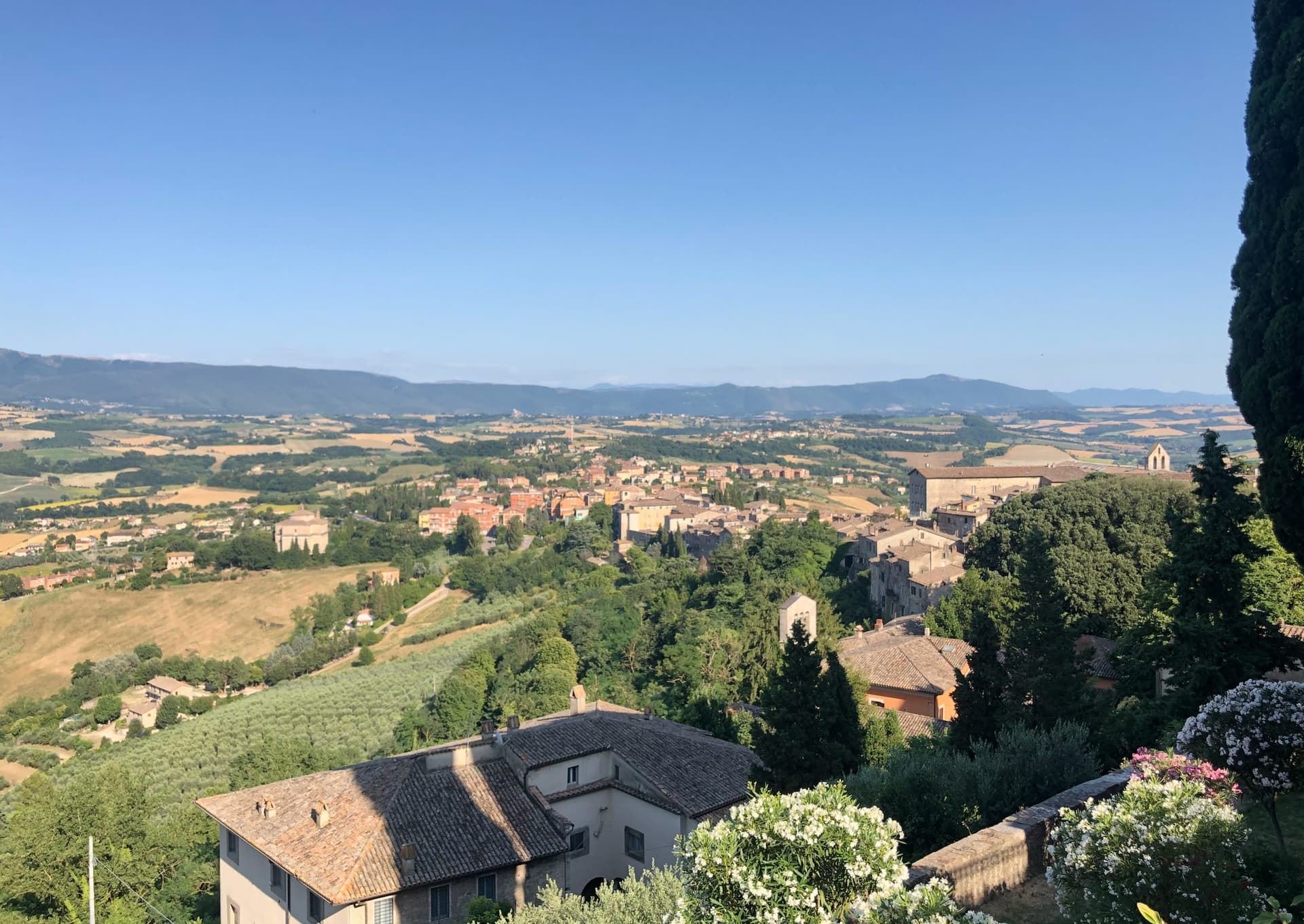
Todi | The Beverly Hills of Umbria
An unusually global town on a clay hill
Letters from the towns we visit. Free.
The button takes you to the letter's own page on Substack, where you leave your email. About the letter
More from Anywhere Italy
- The 7 best towns you can reach by train that eat well in Trentino-Alto AdigeTrentino-Alto Adigeby traineats well7 towns · smallest 3,363 residents
- The 6 best hidden towns you can reach by train in Trentino-Alto AdigeTrentino-Alto Adigeby trainhidden6 towns · smallest 1,086 residents
- The best ski towns with a serious restaurant in Trentino-Alto AdigeTrentino-Alto Adigeski areaserious restaurant9 towns · smallest 1,396 residents
- The best towns worth staying overnight in the province of Bolzano/BozenBolzano provinceworth staying overnight8 towns · smallest 1,396 residents
- The best hidden towns worth staying overnight in Trentino-Alto AdigeTrentino-Alto Adigeworth staying overnighthidden7 towns · smallest 1,396 residents
- The best hill towns in Trentino-Alto AdigeTrentino-Alto Adigehill town6 towns · smallest 2,002 residents