
The best olive oil towns within 90 minutes of Napoli
Olive country around Napoli is not one landscape but several. There is the tufa and river plain of the Volturno, where trees stand in ordered rows behind farmhouse walls of pale volcanic stone. There is the steep limestone of the Sorrentine peninsula, where the terraces are held up by dry walls and the oil comes out grassy and sharp. Pressing begins in late autumn, and for a few weeks the frantoi smell of cut grass and warm stone, with new oil poured over bread and salt at the counter. Winter is the season to come, when the tables are heavy and nobody is queuing for anything.
Most visitors work the coast instead. Sorrento fills its clifftop terraces from spring onwards, the Amalfi road backs up at Positano, and the whole peninsula is timetabled around ferries and day trips out to Capri. It is a fine stretch of water and the lemon groves are real, but the pressure of numbers has changed what is on the menu and what it costs. Agricultural Campania has largely been pushed inland by the price of a sea view.
The olives carry on past all of it. They climb the hills behind the Gulf of Gaeta and the Garigliano, run up the Volturno valley towards the Matese, and cross into Molise where the groves meet cold air and the oil turns peppery. The towns here are working ones, with mills, ceramic and cheese traditions alongside the oil, and Roman remains that see almost no coaches. Fewer people go, and all of them sit within a comfortable drive of the city.
Of the 21 communes we have mapped within 90 minutes of Napoli, 6 qualify as olive oil towns: each belongs to the national association of olive-oil towns. The smallest, Cerreto Sannita, has 3,607 residents.
Elsewhere in the catalogue: The 9 best olive oil towns in Campania and The best hidden hill towns within 90 minutes of Napoli.
Cerreto Sannita
Why visit Cerreto Sannita
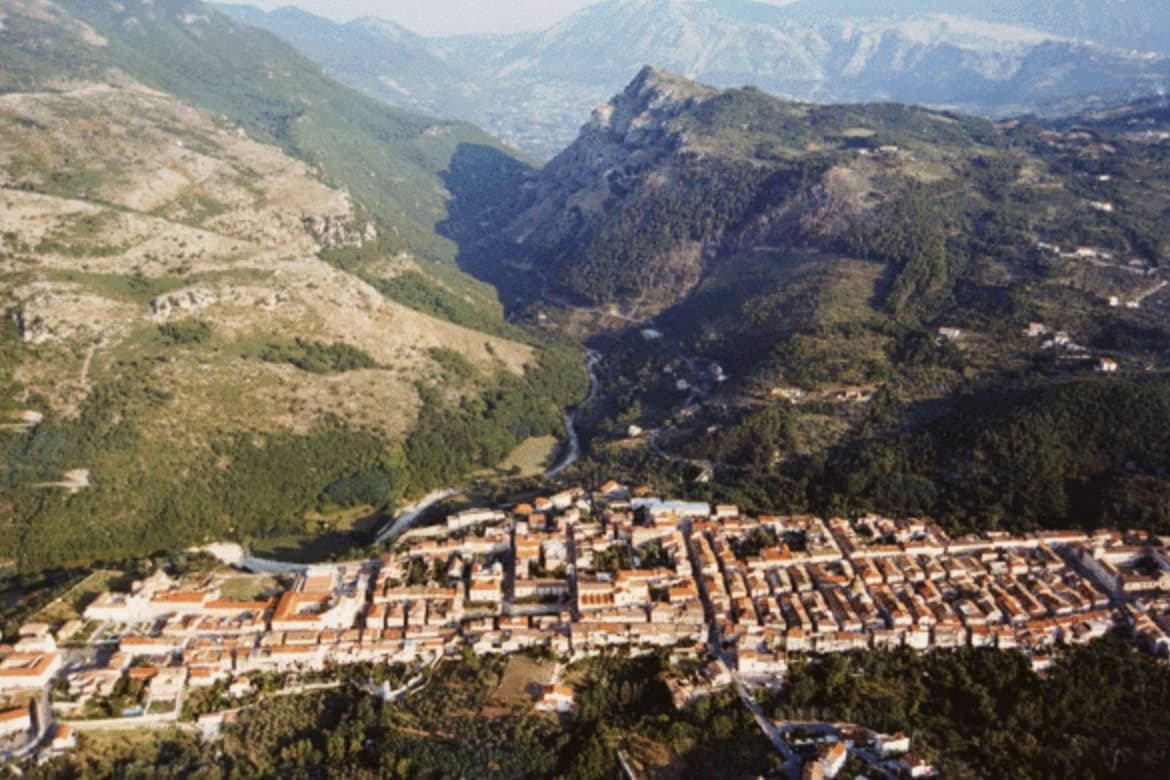
Cerreto Sannita sits at 290 meters in the Titerno valley of the Sannio, fifty-five kilometers northeast of Naples, with the Matese massif rising behind. The town was rebuilt at the order of Count Marzio Carafa, his brother Marino, and Bishop Giovanni Battista de Bellis, and the resulting grid runs orthogonally around a central piazza, a rare case of late-baroque urban planning in southern Italy.
The other anchor is ceramics, an industry the town has long shared with its neighbour. Workshops in both places have produced majolica since at least the sixteenth century, and the State Art Institute revived the craft in the mid-twentieth.
Workshops still turn out ceremonial plates, lobed jugs, apothecary jars and riggiole tiles painted with wind-rose and garland motifs. The town is a Bandiera Arancione, a Cittaslow, and one of Italy's official Città della Ceramica.
What results is a town whose street plan and whose craft both trace back to the same recovery: one rebuilt the ground it stands on, the other kept its hands busy on top of it.
What to see in Cerreto Sannita
- Cattedrale della Santissima Trinità. Baroque facade and tiled dome at the centre of the new town plan, standing where the piazza anchors the orthogonal grid.
- Museo Civico e della Ceramica Cerretese. Civic museum dedicated to four centuries of local majolica, with ceremonial plates, riggiole tiles and apothecary jars from Cerreto and San Lorenzello workshops.
- Chiesa di San Martino. Late seventeenth-century church with painted majolica floor of Cerreto tiles, one of the best preserved riggiole pavements in the Sannio.
How to get to Cerreto Sannita
Napoli is roughly 85 minutes away by road.
Our tip
April through June and September into October are the dry, walkable months in the Titerno valley, when the Matese is still green and the ceramic workshops keep regular hours. July and August push the valley into the mid-thirties; the orthogonal centro storico holds shade well enough, but afternoons go quiet between two and six. November through March is winter on the Matese flank, with cold rain and occasional snow above the town and several workshops on reduced hours.
Caiazzo
Why visit Caiazzo
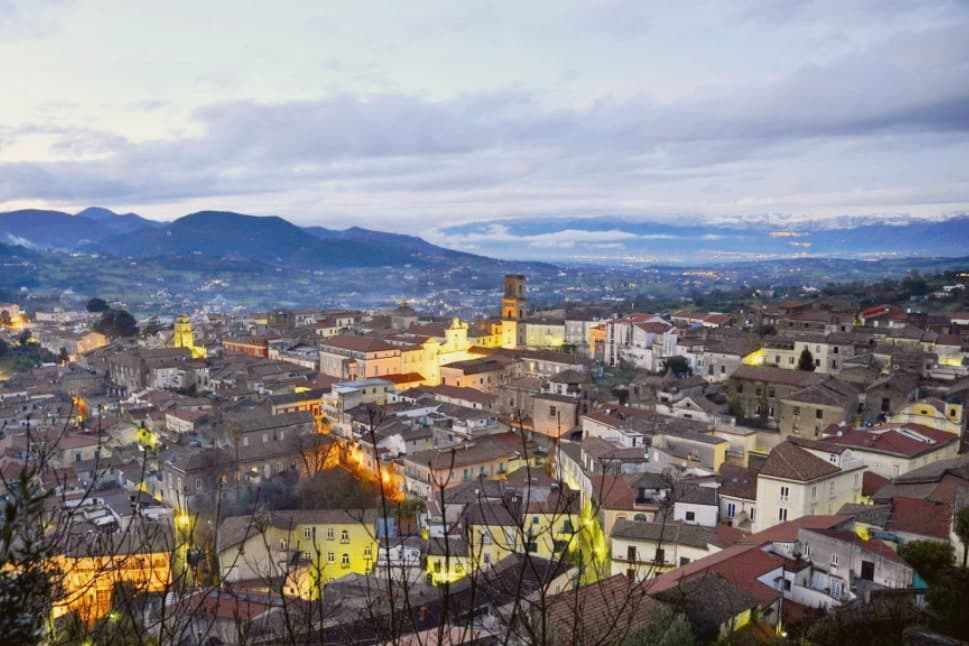
Caiazzo sits at 200 meters on a small hill above the Volturno, forty kilometres north of Naples, between the Matese foothills and the Caserta plain. The town is older than the surrounding province: Caiatia was already a Samnite then Roman centre, and the medieval cathedral preserves a Lombard crypt under its eleventh-century floor.
What pulls visitors today is not the cathedral but a pizzeria. In 2012 Franco Pepe, third-generation baker, opened Pepe in Grani in an eighteenth-century palazzo on Vico San Giovanni Battista, working long-fermented doughs with local Pallagrello flour, Conciato Romano cheese and Caiazzo olive oil.
Tre spicchi from Gambero Rosso for ten straight years and a Michelin world-best ranking in 2018 turned the centro storico into a destination that handles 800 pizzas a day. Caiazzo is a Cittaslow, a Città del Vino for Pallagrello and Casavecchia, and a Città dell'Olio.
Pepe in Grani have been named by a guide.
What to see in Caiazzo
- Cattedrale di Santa Maria Assunta. Eleventh-century cathedral with a Lombard crypt beneath the floor, baroque interior and the relics of San Stefano Minicillo, patron of Caiazzo.
- Castello di Caiazzo. Medieval castle of Lombard origin on the highest point of the centro storico, remodelled under the Normans and later princes of Caiazzo.
- Pepe in Grani. Franco Pepe's pizzeria in an eighteenth-century palazzo on Vico San Giovanni Battista, ranked best in the world by Michelin in 2018.
How to get to Caiazzo
There is a railway station in the town, so you can arrive without a car and never need one while you are here. Napoli is roughly 53 minutes away by road.
Our tip
April through June and September into October are the cleanest months in Caiazzo, when the Volturno valley is green and the Pepe in Grani tables are easier to book at lunch. July and August push the Caserta plain past thirty-five degrees and the centro storico empties between two and six in the afternoon. Harvest runs September and October for Pallagrello and Casavecchia and pulls weekend wine visitors.
Venafro
Why visit Venafro
Venafro lies at 222 meters in the lower Volturno valley, on the road between Cassino and Isernia, near the Lazio border. Horace praised the place as a resort, and the surrounding hills still carry the native Aurino olive groves that made the town's name.
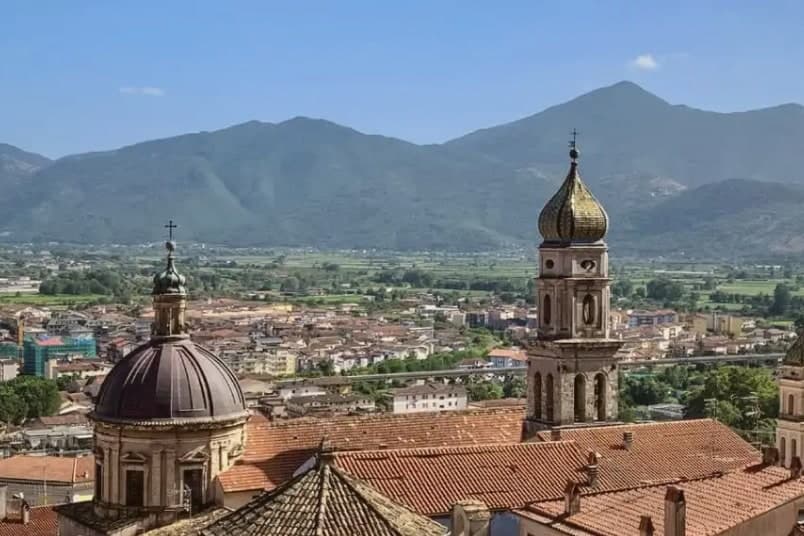
Until 1863 Venafro belonged to the Terra di Lavoro and the province of Caserta, was then reassigned to Campobasso, and joined the new Isernia province only in 1970, a late arrival to the map it now sits on. The old town climbs from the lower quarters up toward the castle at its highest point, with the basilica and its convent anchoring the base of that climb below.
Roman remains, amphitheatre, theatre, and aqueduct, lie folded into and beneath the medieval fabric, so that walls, churches, and antiquity share the same ground rather than sitting in separate districts. Venafro carries Parco Nazionale and Città dell'Olio marks.
The town reads as a place where a Roman colony, a resort praised by poets, and a shifting patchwork of provincial borders all left their layer without erasing the ones beneath.
Il Monsignore della Tenuta Santa Cristina have been named by a guide.
What to see in Venafro
- Castello Pandone. Hilltop castle of the Pandone family from the fifteenth century. The noble rooms carry the equestrian frescoes, among them the Sala del Cavallo di Carlo V and the gallery of racehorses, painted over the whole cycle of chambers.
- Basilica di San Nicandro. Town basilica with attached convent, where Padre Pio stayed for medical treatment in the early twentieth century.
- Centro storico. Old town said to hold 33 churches between Roman remains and medieval walls, climbing toward the castle at its high point.
How to get to Venafro
There is a railway station in the town, so you can arrive without a car and never need one while you are here. Napoli is roughly 79 minutes away by road.
Our tip
April through October is the working season. Spring brings the Volturno valley back into colour and the Pandone castle's outdoor rooms back into use. June and September are the steadiest months for walking the centro storico.
Massa Lubrense
Why visit Massa Lubrense
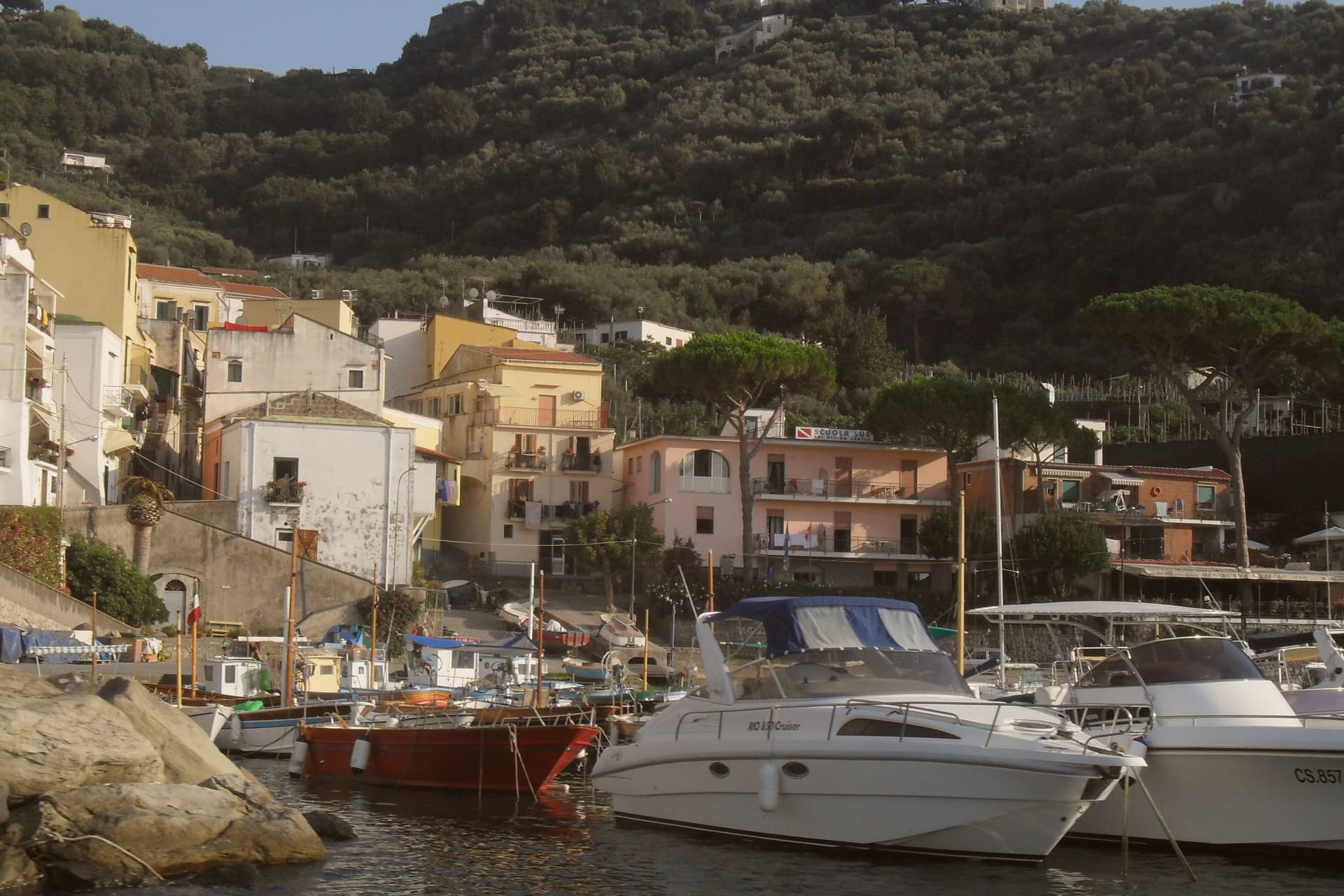
Massa Lubrense holds the western tip of the Sorrentine Peninsula, the largest municipal area on the peninsula and the closest land to Capri, three nautical miles across the Bocche di Capri. The hilltop centro sits at 121 meters; the commune's eighteen frazioni spread between the Tyrrhenian and the Gulf of Salerno, including Termini, Nerano, Sant'Agata sui Due Golfi and the Marina della Lobra.
Punta Campanella, the cape at the end, has the remains of a Roman sanctuary of Athena and a sixteenth-century watchtower against Saracen raids; the surrounding sea is a protected marine area established in 1997. The commune holds a Bandiera Blu, a Spiga Verde, and Città dell'Olio status: the Penisola Sorrentina DOP olive groves climb the hills above the bays.
Spaghetti alla Nerano, courgette and provolone del Monaco, is the dish that came out of these kitchens in the 1950s.
Ristorante Antico Francischiello da Peppino, Quattro Passi, Relais Blu and 6 more have been named by a guide.
What to see in Massa Lubrense
- Punta Campanella. Cape at the western tip of the peninsula, with the ruins of a Roman sanctuary of Athena, a watchtower, and the marine reserve established in 1997.
- Marina del Cantone. Pebble bay at Nerano, Italy's largest pebble beach by some measures and the kitchen where spaghetti alla Nerano was created.
- Chiesa di Santa Maria della Lobra. Sixteenth-century mother church above the small Marina della Lobra, with a wooden coffered ceiling and a former Franciscan convent attached.
How to get to Massa Lubrense
Napoli is roughly 69 minutes away by road.
Our tip
May, June, September and early October are the months Massa Lubrense was built for. The water around Punta Campanella sits above twenty degrees, the marine reserve runs daily boat tours, and the Sentiero degli Dei from Bomerano descends through olive groves in stable weather. July and August are full: the parking at Marina del Cantone closes by mid-morning and the SS145 from Sorrento backs up.
Sessa Aurunca
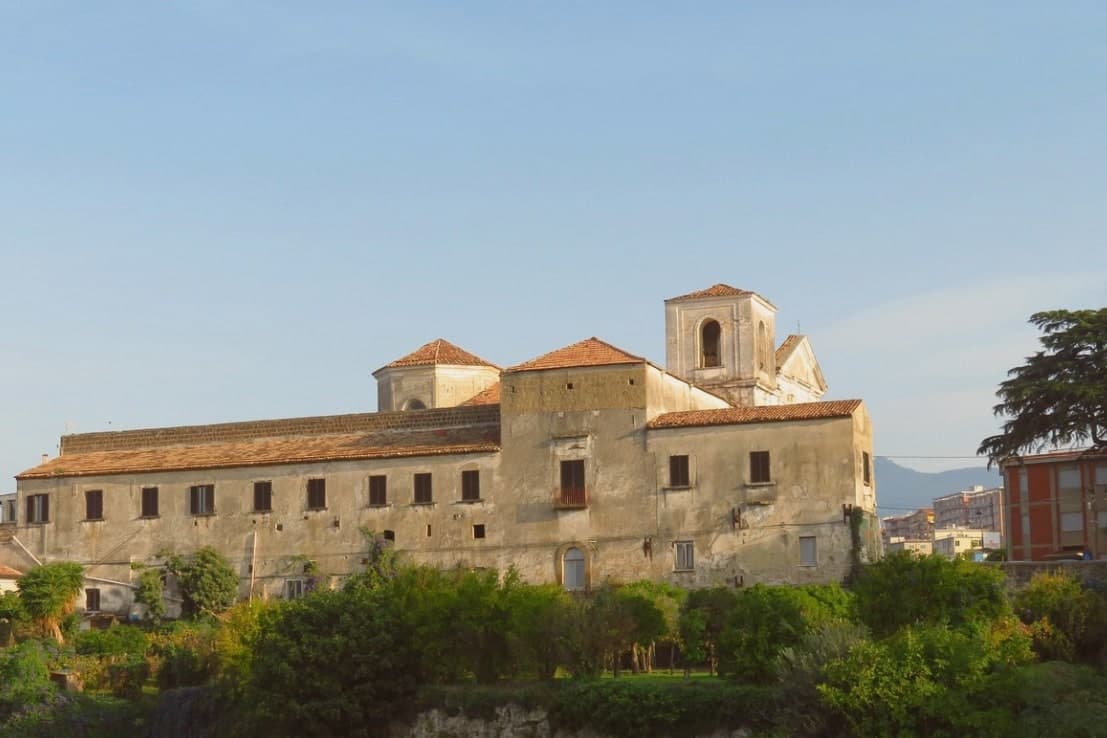
Why visit Sessa Aurunca
Sessa Aurunca sits at 203 meters on the southwest slope of the extinct volcano Roccamonfina, between the Garigliano river and the Aurunci hills, forty kilometers west-northwest of Caserta. The Aurunci, the Italic people who held this land before Rome, gave the town its name; the Latin colony of Suessa Aurunca was founded here in 313 BC on the road between Capua and Rome.
The Roman theater on the slope below the cathedral is one of the largest in southern Italy, with stage decoration found in the 2000s excavations now on display in the Castello Ducale. The Cattedrale dei Santi Pietro e Paolo was built in 1103 over an Augustan-era temple, with twelve antique columns in the nave, an ambon and Easter candelabrum covered in Cosmatesque marble inlay, and a Byzantine-influenced apse.
The commune is Città dell'Olio for the Aurunci olive groves, Città del Tartufo for the truffles of the Roccamonfina foothills, and lies on the Via Francigena del Sud between Rome and Brindisi.
What to see in Sessa Aurunca
- Cattedrale dei Santi Pietro e Paolo. Romanesque cathedral consecrated in 1113 with twelve antique columns, a Cosmatesque ambon and paschal candelabrum, and a Byzantine apse.
- Teatro Romano di Sessa Aurunca. First-century Roman theater on the slope below the cathedral, one of the largest in southern Italy, with sculpted stage decoration recovered after 2000.
- Castello Ducale. Medieval fortress rebuilt by the Lombards, the Normans and the Aragonese, now housing the civic museum with Roman finds from the theater.
How to get to Sessa Aurunca
There is a railway station in the town, so you can arrive without a car and never need one while you are here. Napoli is roughly 72 minutes away by road.
Our tip
April through early June and September into October are the strongest months. The Roccamonfina slopes green and the trails through the chestnut woods open. The Cattedrale opens longer hours and the Roman theater is walkable in shirt sleeves. Festa Popolare della Tammorra falls in July.
Minturno
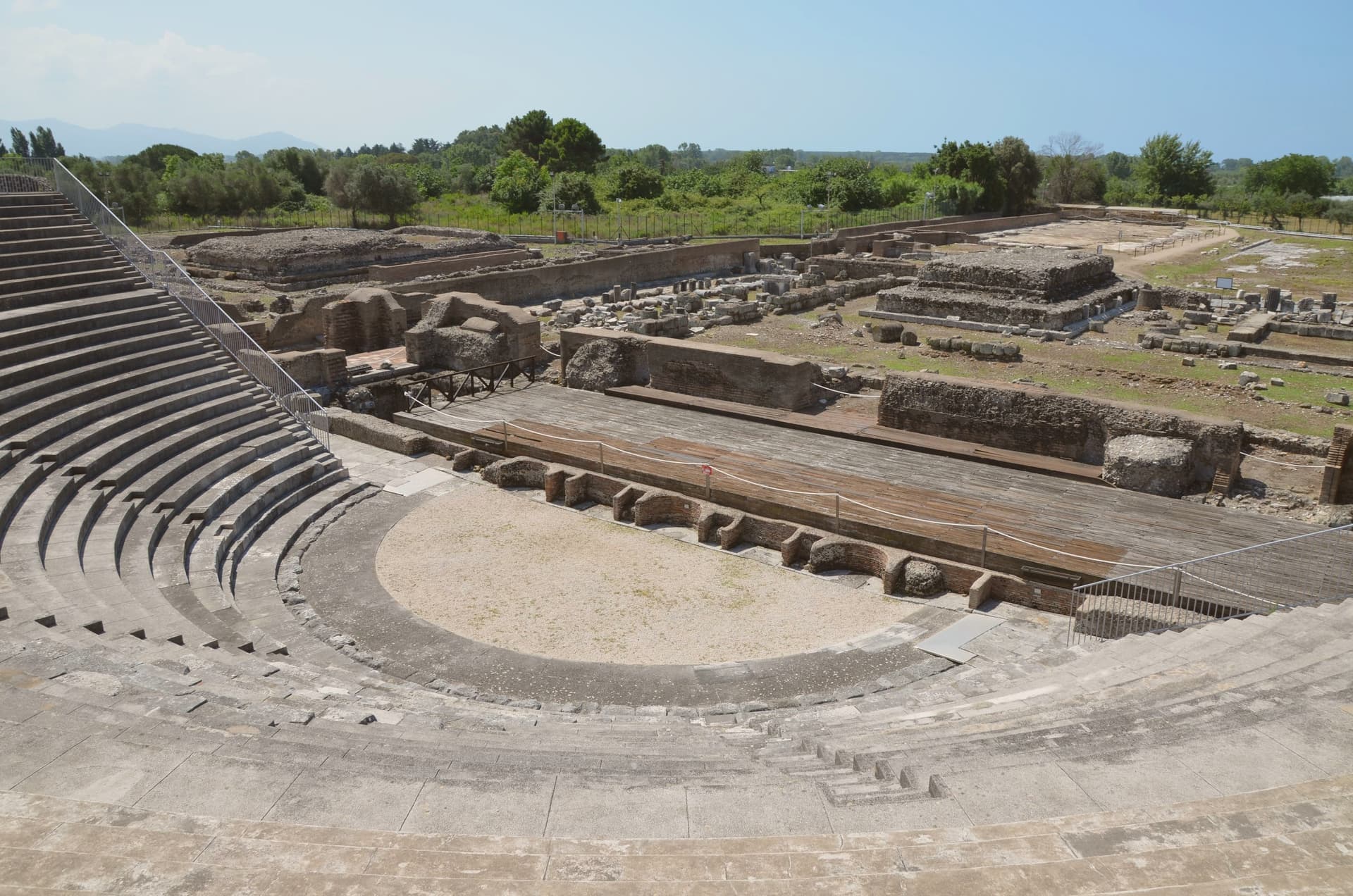
Why visit Minturno
Minturno sits on a hill at 140 meters above the right bank of the Garigliano, with the Scauri and Marina coast running down from it to the Tyrrhenian. The two halves of the comune answer different needs and different centuries: the river mouth held the Roman colony and its flat, engineered plain, while the hill above took over as the medieval settlement once malaria and Saracen raids made the lowland unsafe to live on.
The castle at the center of the upper town carries that shift in its own fabric, with a ninth-century core built up over time by later lords. The coast has its own separate history again, flattened in 1943-44 as a battlefield on the German defensive line and rebuilt afterward around the bathing village of Scauri.
Olive country runs inland behind all of this, and the comune belongs to the Città dell'Olio network. What the town amounts to, then, is three settlements stacked in time rather than one: a Roman river port, a medieval hill town built in retreat from it, and a rebuilt postwar coast, each still legible in its own part of the comune.
What to see in Minturno
- Parco Archeologico di Minturnae. Theater, forum, aqueduct and amphitheater standing together at the river mouth, on the stretch of the Via Appia that once ran through the colony.
- Castello Baronale. Hilltop castle in the centro storico, its core built in the ninth century and expanded in stages by the Caetani and the Carafa through the medieval period.
- Basilica di San Pietro Apostolo. Basilica in the upper town holding a cosmatesque pulpit and Easter candlestick, both worked in the twelfth and thirteenth centuries.
How to get to Minturno
There is a railway station in the town, so you can arrive without a car and never need one while you are here. Napoli is roughly 79 minutes away by road.
Our tip
May through September is the season on the Garigliano coast. June and September give the best balance of warm sea and emptier beaches; July and August fill with Roman and Neapolitan weekenders and the seaside road slows. October is still warm enough to swim on calm days, and the inland olive harvest in late October and November is the busiest moment in the upper town.
More from Anywhere Italy
 The 9 best olive oil towns in Campania
- The best hidden hill towns within 90 minutes of Napoli
- The best hill towns you can reach by train within 90 minutes of Napoli
- The best olive oil towns within two hours of Salerno
 The best hill towns that eat well within 90 minutes of Napoli
- The best olive oil towns within two hours of Naples