
The best hill towns within 75 minutes of Venice
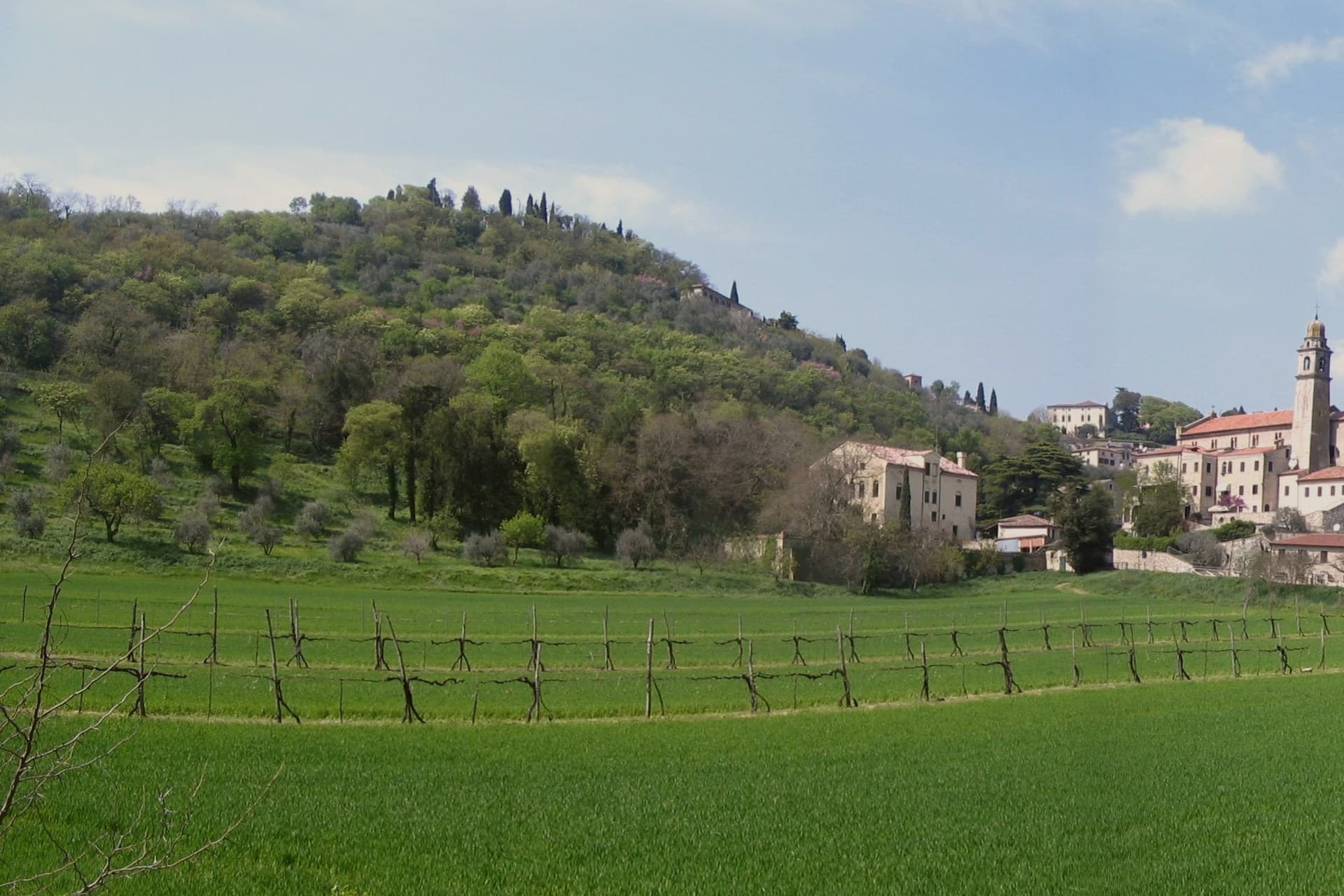
The Veneto is flat until it suddenly is not. Southwest of Padua the Colli Euganei rise as isolated volcanic humps planted with olives and moscato vines, and north of Treviso the land pleats into the steep glera-covered ridges above the Piave before hitting the grey wall of the Prealps. The towns up there are built of trachyte and river stone, with porticoes, a Palladian villa or two on the lower slopes, and cellars selling wine by the litre. Autumn is the season: grape harvest, chestnuts, torchiato pressed from dried bunches, radicchio arriving in the markets as the fog settles on the plain below.
Almost everyone arriving in the region goes to Venice and stays there, then treats the mainland as the place the airport is. The queues at Piazza San Marco and the Rialto absorb most of a short trip, and the day trips that do leave the lagoon tend to go to Verona for the arena or to Padua for the Scrovegni Chapel. Both are worth the ticket. Both are also full, and both are on the flat.
The same hills that make the Prosecco and the moscato keep going, and they are close. From Venice you can be standing on a ridge with vines below you and the Dolomites on the horizon before lunch, in towns where the bar is the centre of the day and fewer people get off the train. These are the ones on high ground, small enough to walk end to end, close enough to reach and return the same evening.
Of the 19 communes we have mapped in a 75-minute drive of Venice, 6 qualify as hill towns: each stands on high ground rather than on the plain. The smallest, Arquà Petrarca, has 1,810 residents.
Elsewhere in the catalogue: The best hill towns within 90 minutes of Padua and The 9 best hidden hill towns in Veneto.
Arquà Petrarca
Why visit Arquà Petrarca
Arquà sits between Monte Ventolone and Monte Castello, in the Euganean Hills south of Padova. The name dates to medieval records; the suffix Petrarca was added in 1868, after the Veneto's annexation to the Kingdom of Italy, as a public homage to the poet who chose to die here.
Francesco Petrarca arrived in 1370 and lived in a thirteenth-century house he renovated himself across two stories, the Casa del Petrarca, now a museum with frescoes from the fifteenth and sixteenth centuries. He died at his desk on the night of 18-19 July 1374.
His tomb, an ark in red Verona marble inspired by Roman sarcophagi, was placed in the churchyard of Santa Maria Assunta in 1380 and reset in 1965. The village kept its medieval layout: two piazzas linked by a stepped path, the Casa above and the church and tomb below.
The hills around it grow Colli Euganei DOC wine, olives, and the giuggiole that go into the local liqueur Brodo di Giuggiole.
What to see in Arquà Petrarca
- Casa di Francesco Petrarca. The poet's thirteenth-century house, renovated by him on two floors and now a museum with frescoes added by later owners in the fifteenth and sixteenth centuries.
- Tomba di Petrarca. Sarcophagus in red Verona marble in the churchyard of Santa Maria Assunta, placed in 1380, six years after the poet's death.
- Chiesa di Santa Maria Assunta. Parish church first documented in 1026, enlarged through the centuries, with frescoes of the Venetian-Byzantine school up to the fifteenth century.
How to get to Arquà Petrarca
There is a railway station in the town, so you can arrive without a car and never need one while you are here. Padova is roughly 28 minutes away by road.
Our tip
April through June and September through October are the months Arquà is built for. The hills are green in spring and gold in autumn; the slope from Piazza Roma down to the church is comfortable walking weather. July and August push past thirty degrees and the village empties between two and six, though Padova day-trippers still arrive in the late afternoon.
Follina
Why visit Follina
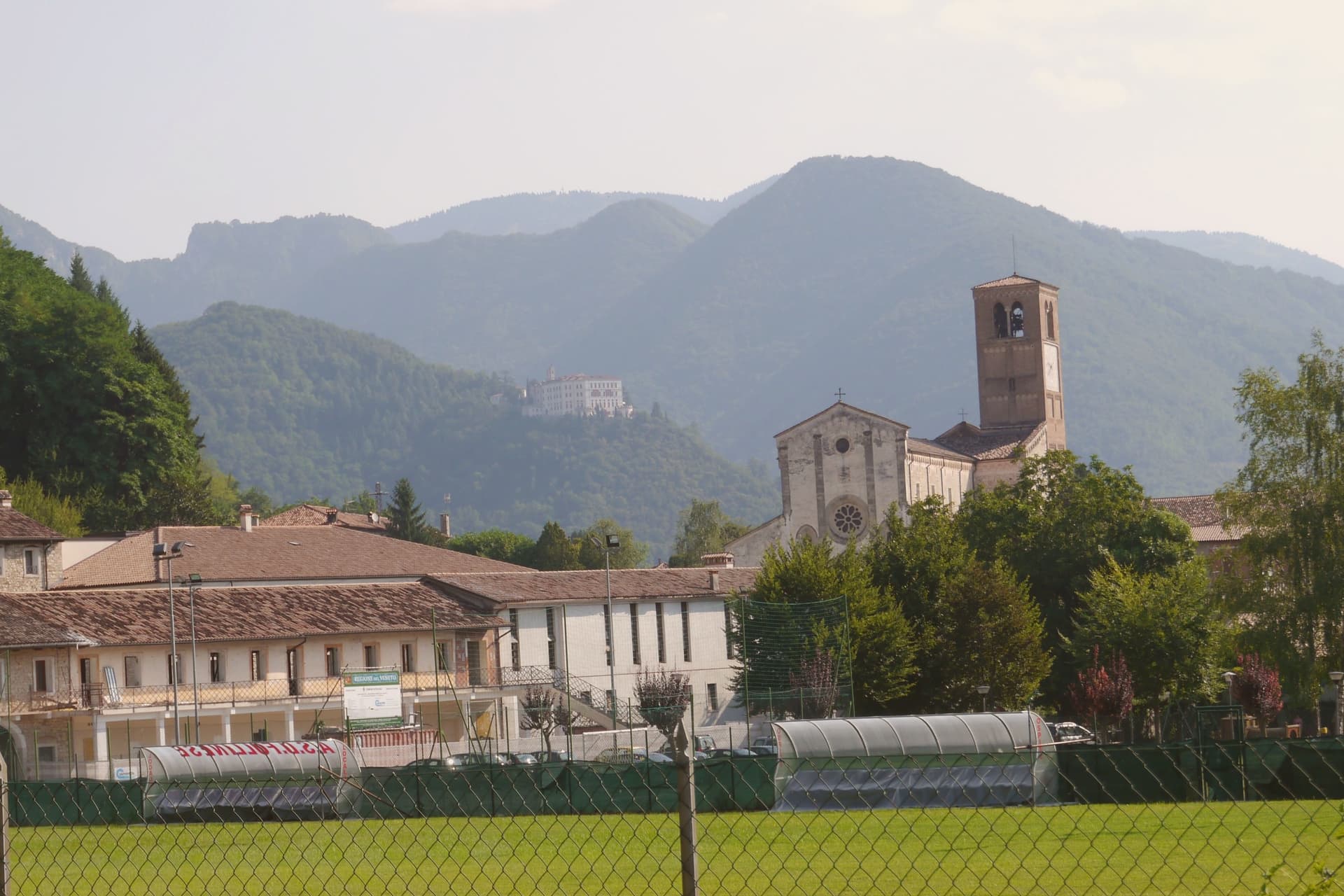
Follina sits at 191 meters where a stream cuts out of the Treviso Prealps into the upper Prosecco hills, sixty-five kilometers northwest of Padova. The name comes from follare, to full wool, and the Sanavalle stream powered fulling mills here from antiquity through the nineteenth century.
A monastic complex existed before the Cistercians arrived in the mid-twelfth century, likely a Benedictine house dependent on San Fermo di Verona. The Cistercians built the Abbey of Santa Maria from 1170; the cloister was completed in 1268.
The abbey is now a minor basilica and parish seat, a national monument since 1921, with frescoes of the Veneto-Byzantine school in the chapter house and a thirteenth-century stone Madonna inside the church. The Brandolini family, lords of nearby Cison di Valmarino, used Follina as a textile center through the Venetian period.
The borgo carries five institutional signals at once. The frazione of Pedeguarda holds the older parish church; the centro of Follina runs along the abbey wall and the stream that powered the mills.
What to see in Follina
- Abbazia di Santa Maria. Cistercian abbey built from 1170, with the cloister completed in 1268, raised to minor basilica and a national monument since 1921.
- Chiostro dell'Abbazia. Cistercian cloister of 1268, with twin colonnettes, sculpted capitals and a central well, intact in its medieval form.
- Sala del Capitolo. Abbey chapter house with frescoes of the Veneto-Byzantine school from the late thirteenth and early fourteenth centuries.
How to get to Follina
Venezia is roughly 73 minutes away by road.
Our tip
April through October is the working season. April and May bring the abbey gardens into bloom and the Prosecco hills into green; September and October bring harvest and the gold light the Rive belt is built on. July and August push into the low thirties and the centro empties in the afternoon, though the cloister stays cool.
Farra di Soligo
Why visit Farra di Soligo
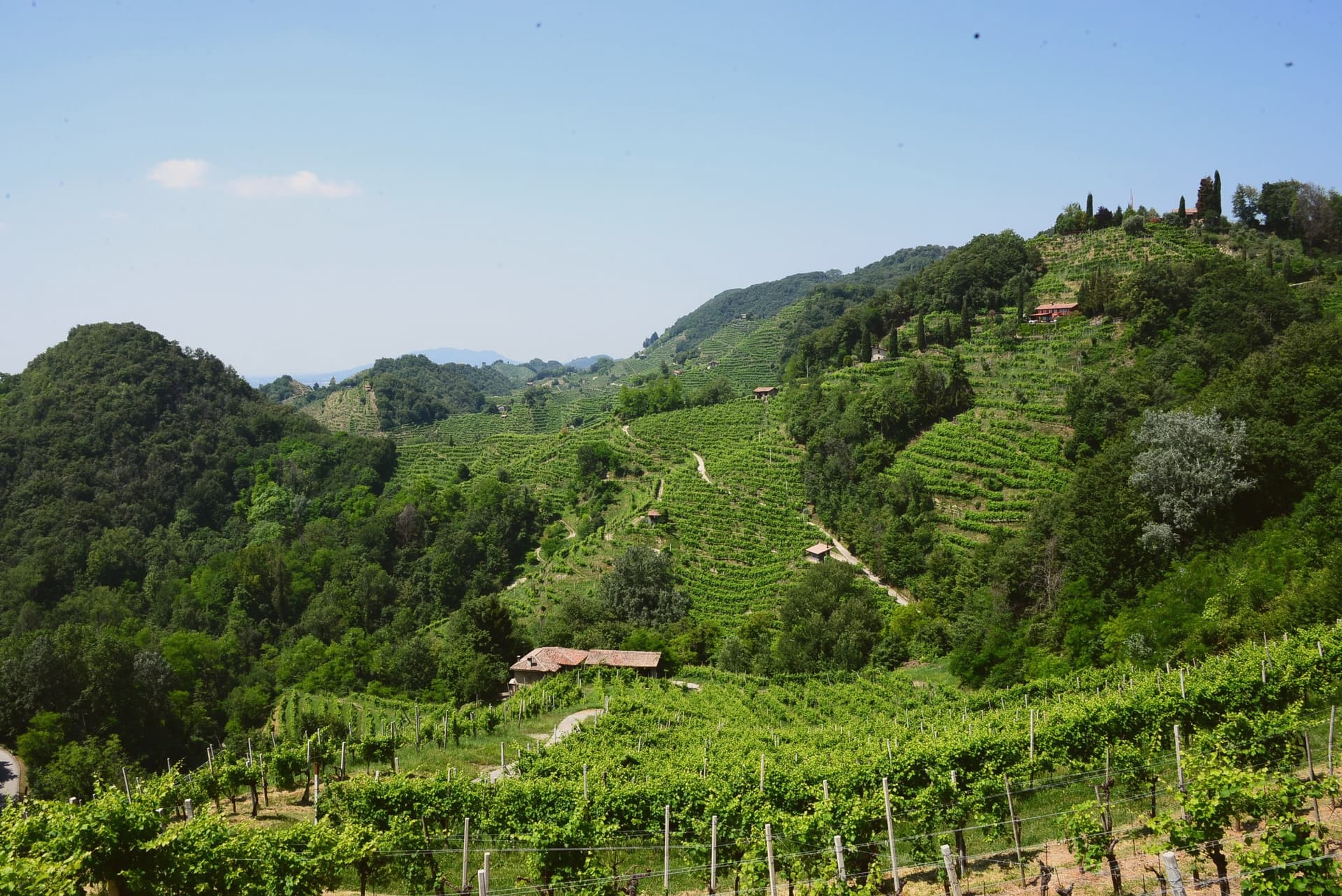
The Conegliano-Valdobbiadene Prosecco Hills take their local name, rive, from the steep hogback ridges that corrugate the landscape, terraced by hand over more than a thousand years and planted almost entirely to Glera. The whole landscape was inscribed as 'Le Colline del Prosecco di Conegliano e Valdobbiadene' in 2019, recognizing both the vineyard cultivation system and the long history of hillside terracing behind it.
Farra di Soligo sits at the literal centre of this territory, one of 15 comuni inside the inscribed area, an 8,477-resident commune at 161m altitude positioned between Conegliano (10 km east) and Valdobbiadene (5 km west), with the most-photographed stretch of the rive running through its own ground. Soligo, the frazione that gives the comune its name, holds the hilltop site of the triple watchtower ensemble above it, reached by marked paths climbing directly from the village rather than by road.
Beyond the towers and the vineyards, the territory holds two Romanesque parish churches, one in Farra itself with its campanile standing detached from the main body, another at Col San Martino with later frescoes added to its 12th-century fabric, and a working wooden watermill on the Lierza river, its wheel still turning, the photogenic centrepiece of a Sunday walking circuit that closes vineyard roads to cars between April and October. The Cistercian abbey at Follina extends the same religious-medieval layer 4 km to the southeast, ranking among the more important monastic ensembles in the Veneto.
The comune also carries the Cittaslow and Città del Vino marks alongside the UNESCO inscription, a rare triple signal for a town this size. Wine production runs through all of it: over 200 producers work the DOCG zone across the comune and its immediate neighbours, making the extra-dry Prosecco Superiore, the dry Cartizze grand-cru, and the rarer col fondo, unfiltered and naturally cloudy, the traditional version before the modern method took over.
Food follows the same prealpine register: spaghetti with duck ragù, baccalà alla vicentina, formaggio di Malga, tiramisù, invented 30 km south at Treviso. The Festa del Vino in May and the Sagra dell'Uva in October mark the calendar's two fixed points.
What holds the place together is the terracing itself: a landscape shaped by a single, continuous agricultural practice long enough that the medieval towers, the parish churches, and the working mill all read as features of one worked hillside rather than separate monuments set into it.
What to see in Farra di Soligo
- Conegliano-Valdobbiadene Prosecco Hills (UNESCO). The corrugated rive landscape of steep hogback ridges with Glera vineyards, inscribed as UNESCO World Heritage in 2019. Farra sits centrally in the inscribed area, with the most-photographed stretch running through its territory.
- Torri di Credazzo. The towers stand above Soligo, a frazione of Farra, reached by marked paths climbing from the village itself rather than by road.
- Molinetto della Croda. The mill's wheel still turns on the Lierza river, its wooden works exposed to view. It anchors the Rive Vive walking route, when vineyard roads nearby close to cars.
How to get to Farra di Soligo
Venezia is roughly 68 minutes away by road.
Our tip
Farra di Soligo is best April–June and September–October. The Rive Vive Sunday walks (April-October) close vineyard roads to cars and open them to cellar-hopping walkers — the signature local activity. October is harvest; the air smells of fermentation across the whole comune.
Asolo
Why visit Asolo
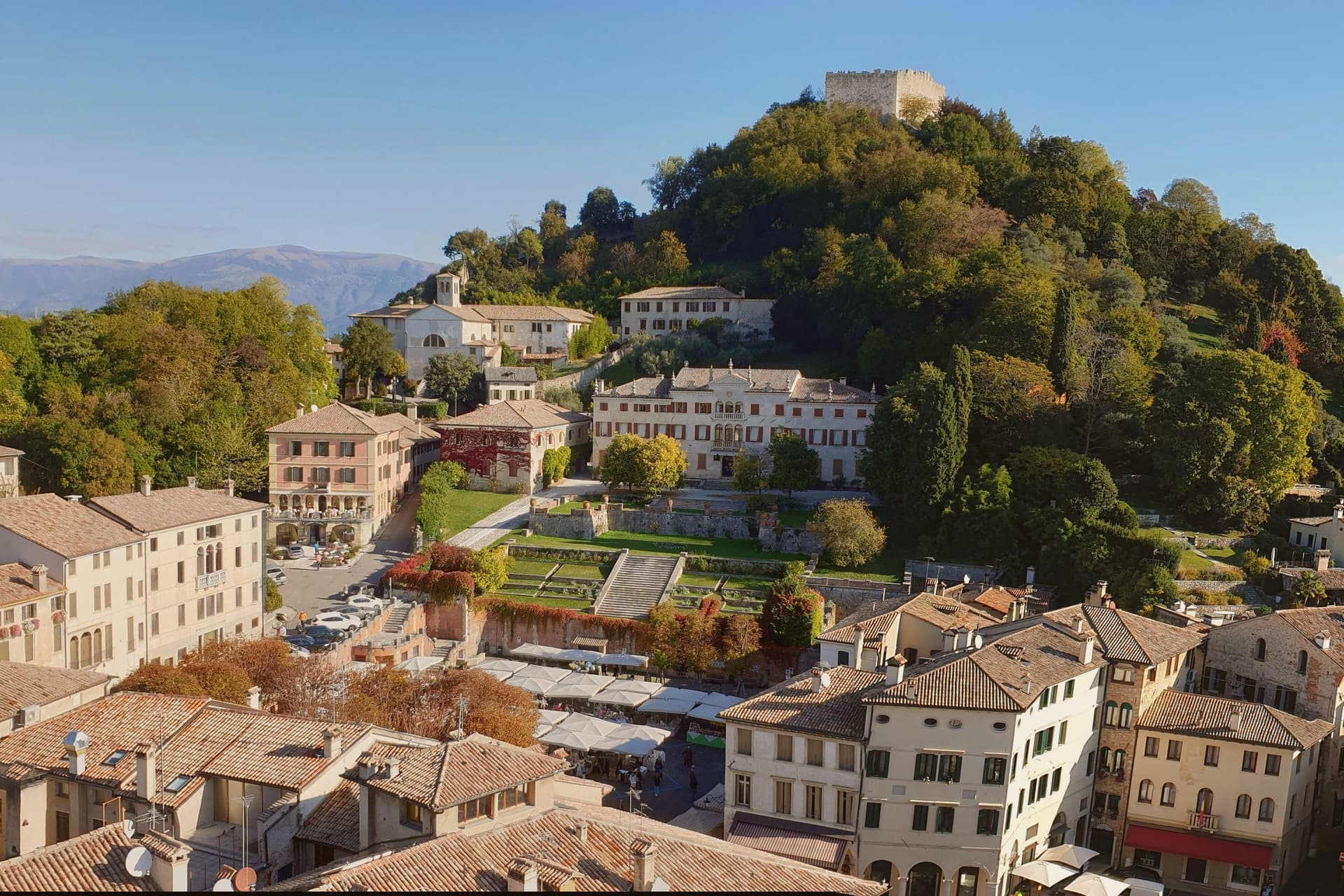
Asolo perches at 205 meters on a ridge between the Asolan hills and the Veneto plain, forty kilometers north of Padova. Pliny knew it as Acelum.
The Ezzelini family held it in the early Middle Ages; the Rocca on the hill above town dates from the late twelfth and early thirteenth centuries and was restored in 2020 after a 2016 storm damaged the walls. The defining episode came in 1489, when the Republic of Venice gave Asolo as a fiefdom to Caterina Cornaro, the deposed Queen of Cyprus, in exchange for her island.
She kept a court here for twenty years until the League of Cambrai sacked the town in 1509. Her circle included Gentile Bellini, the humanist Pietro Bembo and the poet Andrea Navagero.
Robert Browning wintered in a villa here from 1838 onward, and the actress Eleonora Duse retired to Asolo and is buried in the local cemetery. The town carries six institutional signals at once.
What to see in Asolo
- Rocca di Asolo. Late twelfth and early thirteenth-century fortress on the hill above the town, restored in 2020 with €300,000 in ministry funding.
- Castello di Caterina Cornaro. Medieval castle in the town, court of the Queen of Cyprus from 1489 to 1509, now home to the Eleonora Duse theater.
- Duomo di Asolo. Cathedral rebuilt in 1747 with an Assunta altarpiece by Lorenzo Lotto, standing on the foundations of a Roman bath complex.
How to get to Asolo
Vicenza is roughly 57 minutes away by road.
Our tip
April through June and September through October are the right months. The ridge stays a few degrees cooler than the plain, and the views north to Monte Grappa are clearest in spring and autumn. July and August are warm and busy; weekend traffic from Venice and Padova fills the Piazza Garibaldi car park by ten.
Pieve di Soligo
Why visit Pieve di Soligo
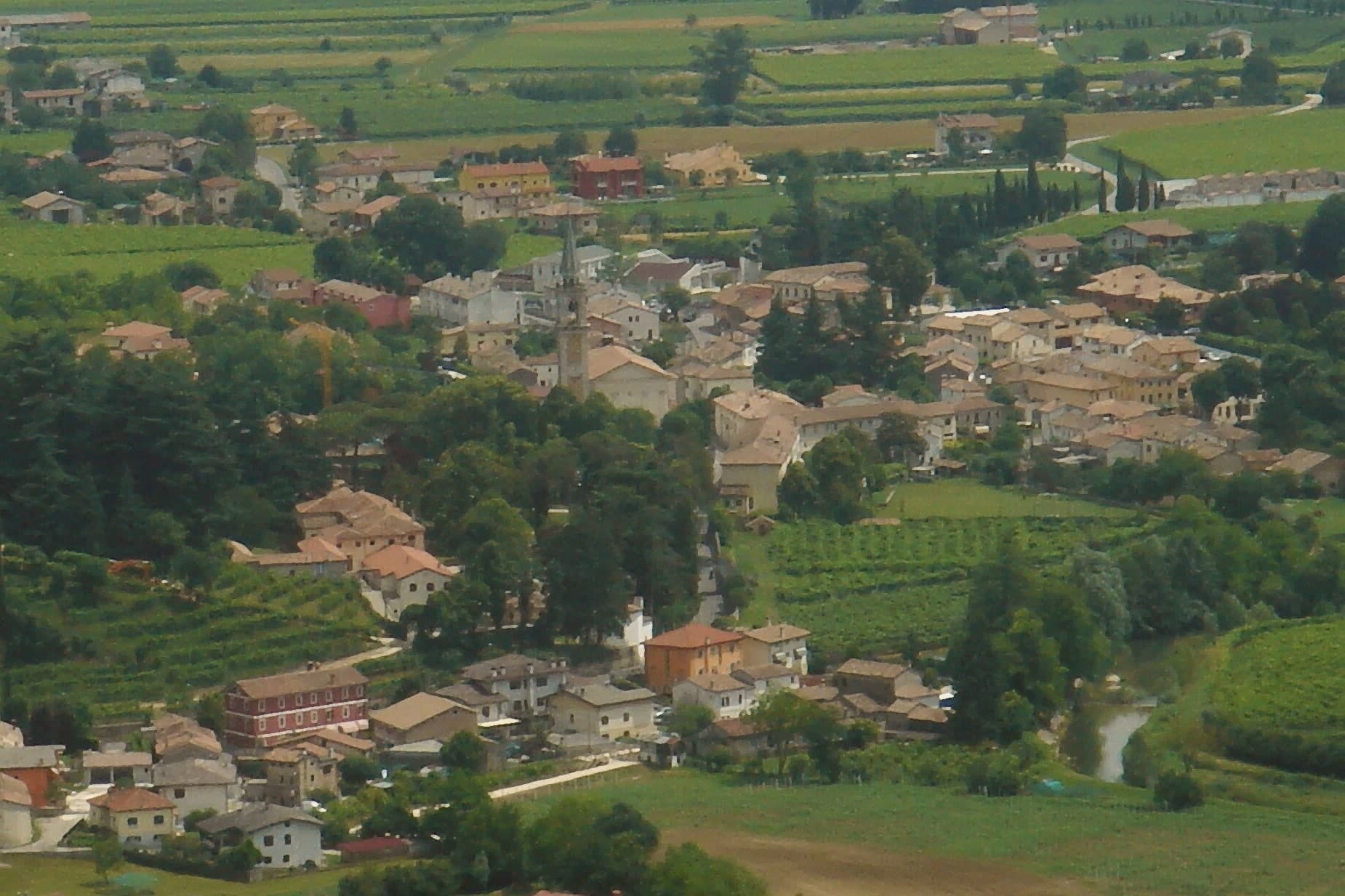
Pieve di Soligo sits at 132 meters, fifty-five kilometers north of Venice, where the Soligo and Lierza rivers meet on the commune's flat valley floor. The territory splits roughly two-thirds level ground to one-third hillside, the lower edge of a hogback landscape that rises toward the vineyard slopes to the north.
The market town occupies the flat stretch between the two watercourses; the upper village, where the old paved street of Cal Santa runs, sits apart from the newer centro that has grown around the cathedral and its campanile. An eighteenth-century country estate on the edge of town, with Venetian stuccoes and a private chapel, now serves an administrative function tied to the wine that covers the northern hills, while the Solighetto frazione keeps its own smaller eighteenth-century parish church, campanile detached from the nave, with a garden that shares the Brandolini name.
The poet born and later died in the town gave his late work a mapped version of the upper village, renaming its street in verse. Between the rivers below and the vineyard hills above, the commune reads as a working valley floor with a market town at its center, its administrative reach over regional wine production and its literary claim both rooted in the same small geography.
What to see in Pieve di Soligo
- Villa Brandolini. Eighteenth-century country estate with Venetian stucco interiors and a private chapel, now headquarters of the Consorzio di Tutela del Prosecco Superiore DOCG.
- Duomo di Santa Maria Assunta. Neo-Romanesque cathedral with neo-Gothic elements designed by Domenico Rupolo, consecrated in 1924, with a 75-meter campanile over the centro.
- Colline del Prosecco. UNESCO World Heritage hogback hills on the northern edge of the commune, inscribed in 2019, with Prosecco Superiore DOCG vineyards between 150 and 300 meters.
How to get to Pieve di Soligo
Venezia is roughly 64 minutes away by road.
Our tip
April through June and September through October are the working months for Pieve di Soligo. The vineyards open in spring with the Primavera del Prosecco events from March through June, and the harvest from late August into October keeps the town busy. The Premio Pieve Zanzotto poetry prize runs in October. Pieve di Sera falls in July.
Vittorio Veneto
Why visit Vittorio Veneto
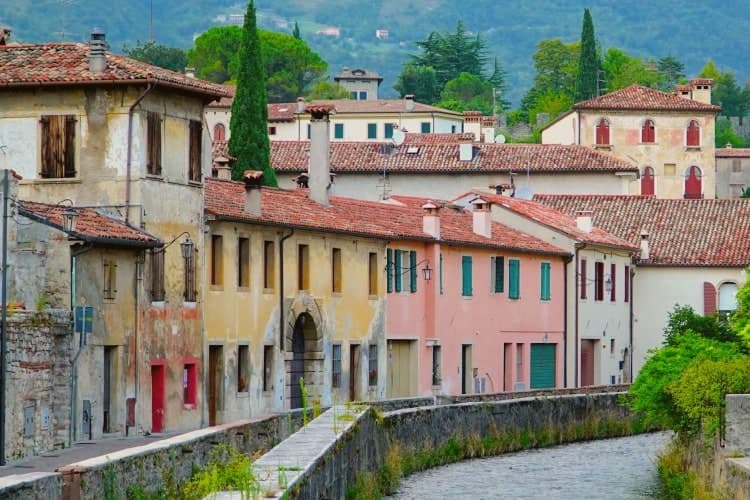
Vittorio Veneto sits at 138 meters at the foot of the Cansiglio plateau, seventy-five kilometers north of Padova. The commune was formed in 1866 by merging Ceneda, on the plain, with Serravalle, in the narrow valley above, and named for King Vittorio Emanuele II.
The two centers kept their own identities rather than blending into one. Serravalle is the older, walled district, set higher in the valley, with its cathedral holding the altarpiece of the Virgin with two saints.
Ceneda lies lower down on the plain, holding the Loggia of the Comunità and an eighteenth-century cathedral of its own alongside the castle ruins on the hill above it. In July 1923 the town took the name it carries now, after the battle that had taken its name from it three years earlier: the offensive of 24 October 1918 broke the Austro-Hungarian line, and the Armistice of Villa Giusti, effective 4 November, closed the war on this front.
The renaming fixed a wartime event permanently onto a place that had, until then, been two separate medieval settlements sharing a valley. What stands today is that same double structure, upper town and lower town, walled district and plain, still legible as two places joined by one name.
What to see in Vittorio Veneto
- Duomo di Serravalle. Rebuilt cathedral in the upper walled centro storico, holding the altarpiece of the Virgin with Saints Peter and Andrew in continuous liturgical use since it was painted.
- Museo della Battaglia. In the Loggia of the Comunità di Ceneda, built 1534-1538, with relics and documents of the offensive that ended the war on this front.
- Serravalle. Northern walled district above Ceneda, with sixteenth-century arcaded houses along the Meschio and the 1462 Loggia Serravallese.
How to get to Vittorio Veneto
There is a railway station in the town, so you can arrive without a car and never need one while you are here. Venezia is roughly 59 minutes away by road.
Our tip
April through October is the working season. April and May bring the Cansiglio plateau into play with walking weather and the upper Meschio at full flow. June through August stays cooler than the plain, with the narrow Serravalle valley holding shade through midday; the lower part around Ceneda pushes into the low thirties. Festa della Val Lapisina falls in July.
More from Anywhere Italy
 The best hill towns within 90 minutes of Padua
- The 9 best hidden hill towns in Veneto
 The best hill towns in the province of Treviso
- The best hill towns with a serious restaurant in Veneto
- The best towns with a World Heritage site within 75 minutes of Venice
- The best wine towns within 75 minutes of Venice