
The 6 best towns inside a nature park in the province of Genova
Liguria narrows to almost nothing between the Apennine watershed and the sea, and the province of Genova is where that squeeze is most obvious. Regional nature parks protect the best of it: the Portofino promontory with its terraces of olive and its footpaths cut into the rock, the Beigua ridge above Arenzano where you can look down on the Gulf while standing in serpentine grassland, the upper Aveto valley with its beech forest, its cattle and its cheese. Building material changes as you go inland, from painted plaster and green shutters on the coast to grey slate and thick stone walls in the mountains. Autumn brings mushrooms, chestnuts and a plate of testaroli; spring brings orchids on the Beigua and empty coastal paths before the heat.
The default itinerary here starts and ends further east, on the Cinque Terre, where trains disgorge day trippers onto paths that were built for people carrying grapes. The famous coast is good and correspondingly full, particularly between late spring and September, and the walking is often single file. Genoa itself absorbs the rest of the traffic, its old town dense and worth the time, though little of it is green.
The parks of the province of Genova are the same landscape carried on past that. Some of these towns are well known, others hardly get visitors at all, but each sits inside a protected park, which is why the woods behind them are still woods and the paths are still signed and maintained. Coast, ridge and inland valley are all represented, and all are within reach of the city by train or bus.
Of the 13 communes we have mapped in the province of Genova, 6 qualify as towns inside a nature park: each sits inside a regional nature park. The smallest, Portofino, has 355 residents.
Two more lists worth reading alongside this one: The best coastal towns inside a nature park in Liguria and The best small towns inside a nature park in Liguria.
Santo Stefano d'Aveto
Why visit Santo Stefano d'Aveto
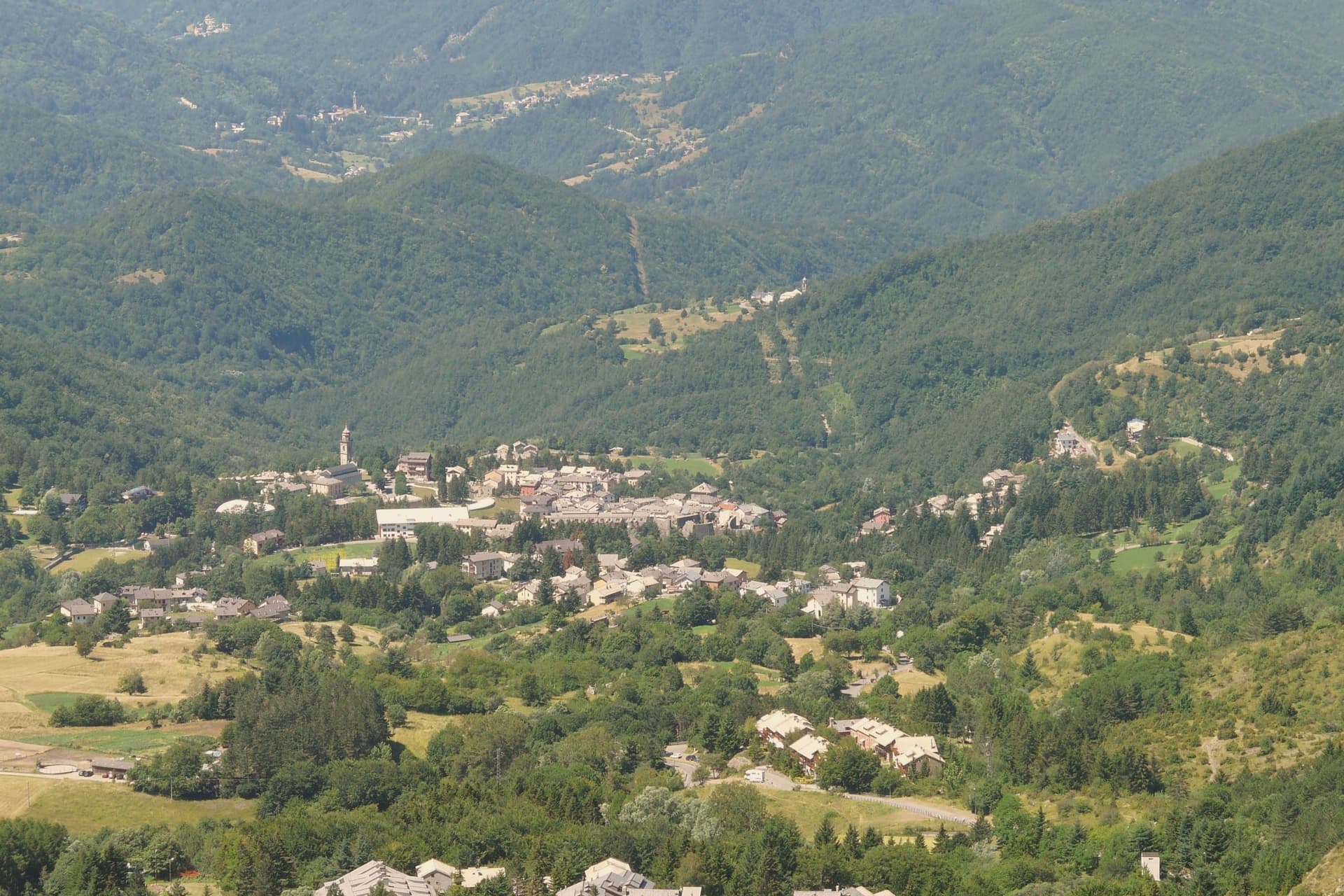
The Upper Val d'Aveto sits forty-five kilometers from Genova, on the border with the provinces of Parma, Piacenza and La Spezia, a position that puts the commune closer to Emilian territory than to the Ligurian coast. Frederick Barbarossa granted the fief to the Malaspina in the twelfth century.
It later passed to the Fieschi and then to the Doria, a succession that left its mark in the layered stonework of the castle rising off the central piazza and in the church furnishings donated generations later by a member of the same Doria line. The town's two halves work on different clocks: the historic center, built around the castle and the piazza, and the higher ground toward the peaks above the valley, given over to the ski area in winter and to the reservoir at Giacopiane in the warmer months.
A commune this high, on a border this far inland, ends up organized less around a single center than around the alternation of the seasons that use its slopes and its lake in turn.
What to see in Santo Stefano d'Aveto
- Castello Malaspina-Doria. Fortress on an irregular polygonal base off the central piazza. The walls still show the outline of successive rebuildings by the families who held the fief.
- Santuario della Madonna di Guadalupe. Parish church built around the donated painting and the door medallion, a small pilgrimage point folded into the ordinary fabric of the town center.
- Monte Bue ski area. Two new chairlifts carry skiers up the slope, the only lift-served skiing in the region and a rare winter draw at this elevation.
How to get to Santo Stefano d'Aveto
Genova is roughly 81 minutes away by road.
Our tip
December through March is the season of the Monte Bue lifts and the only Ligurian ski runs, with snow held above 1,200 meters when conditions are right. June through September is the warm counterpart, with hikes to Lago di Giacopiane and Monte Maggiorasca and temperatures around 22 to 25 degrees, ten cooler than the coast. April and May, October and November are the shoulder months, when the lifts close, the snow melts, and the village rests; many hotels close. Arte e Gusto Mercatini a Santo Stefano d'Aveto falls in July.
Campo Ligure
Why visit Campo Ligure
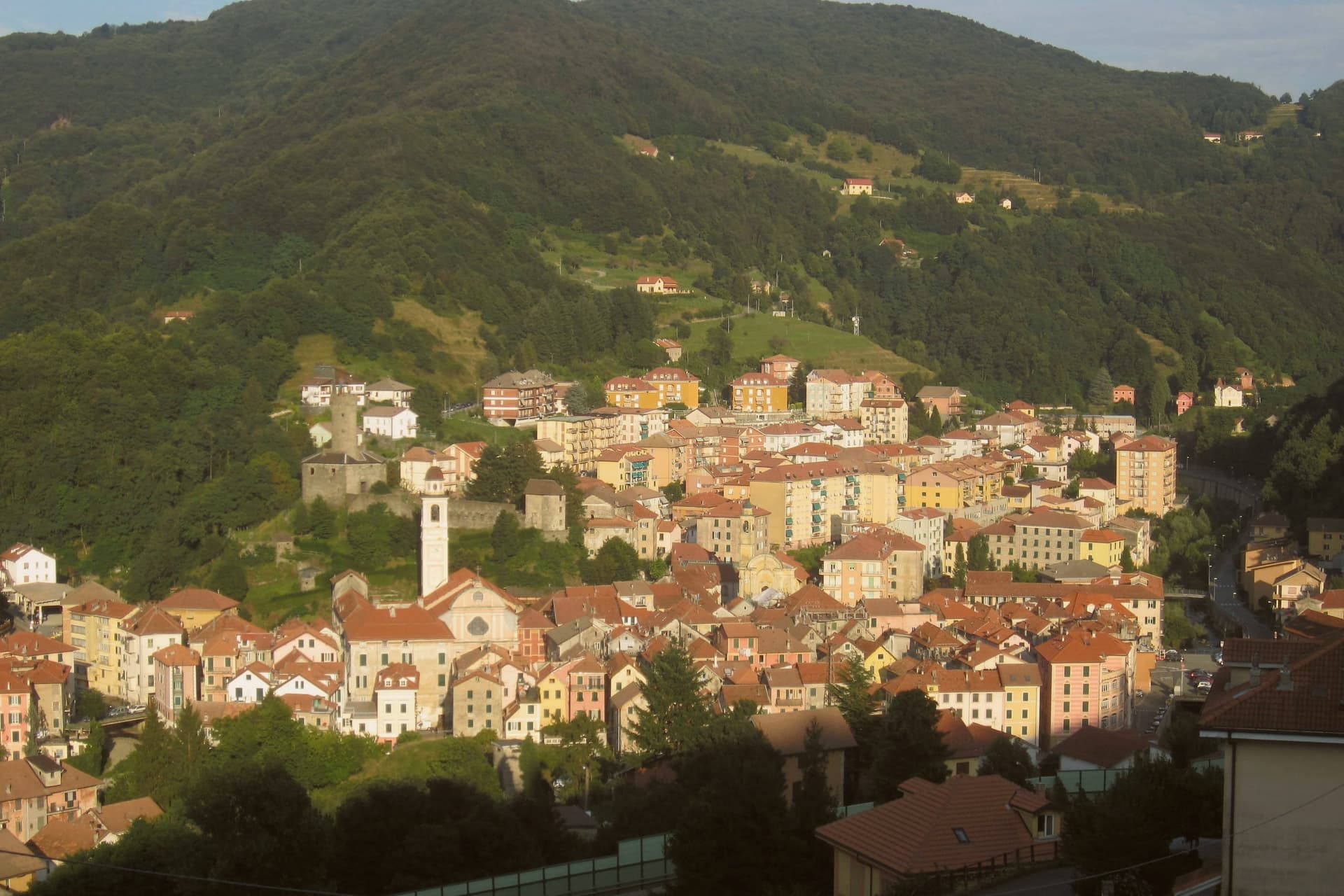
Campo Ligure sits on the right bank of the Stura at 342 meters, twenty-five kilometers north of Genoa where the Apennines start to climb. The Spinola family took the fief in the thirteenth century and built the hexagonal castle on the hill above the village; the cylindrical tower is more than twenty-two metres tall and six across.
The first filigree workshop opened in 1884. Within a generation Campo Ligure had become the national centre for the craft, fine gold and silver threads twisted with pliers called bruscelle and welded under a torch.
It remains the only working filigree centre in Italy. The Museo della Filigrana, founded in 1984 around the Pietro Carlo Bosio collection, holds filigree work from across the world.
A medieval stone bridge over the Stura, originally ninth-century and rebuilt several times from the eighteenth century onward, anchors the lower end of the borgo.
What to see in Campo Ligure
- Castello Spinola. Twelfth and thirteenth-century hexagonal fortress on the hill above the village, cylindrical tower 22 metres tall, residence of the Spinola fief.
- Museo della Filigrana Pietro Carlo Bosio. Founded 1984 around the Bosio collection, filigree work from across the world, the only museum of its kind in Italy.
- Ponte medievale sullo Stura. Stone bridge over the Stura with ninth-century origins, rebuilt several times from the eighteenth century, marks the southern entrance to the borgo.
How to get to Campo Ligure
There is a railway station in the town, so you can arrive without a car and never need one while you are here. Genova is roughly 41 minutes away by road.
Our tip
May through October is the working window: the Stura runs clear, the trail network up into the Parco del Beigua opens, the filigree workshops keep their doors open for visitors. The Mostra della Filigrana in late August is the year's main draw, three days of open studios and demonstrations. July and August can touch 30 degrees in the valley but the 342-metre elevation keeps evenings cool.
Santa Margherita Ligure
Why visit Santa Margherita Ligure
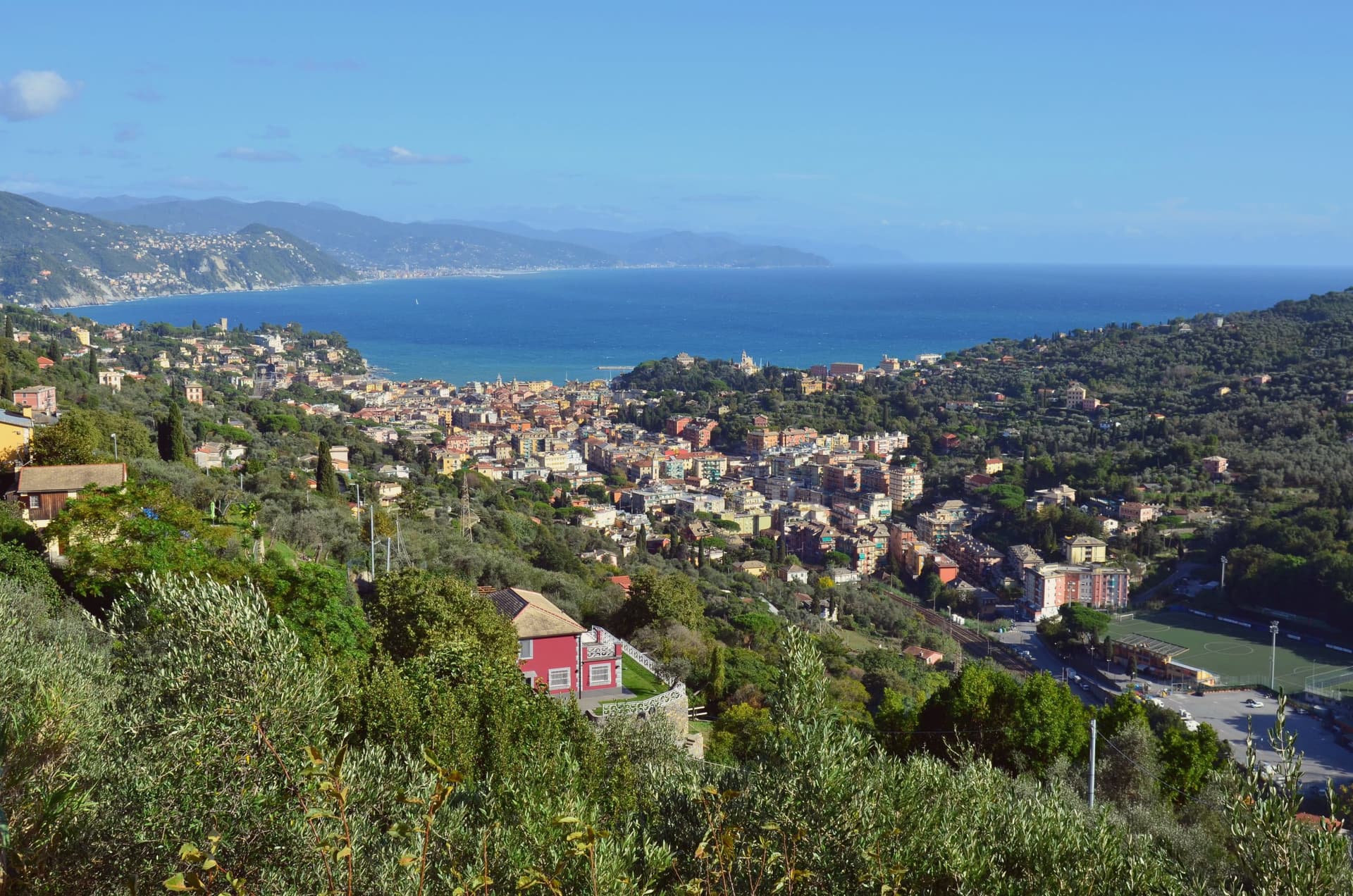
Santa Margherita Ligure sits on the inner curve of the Tigullio gulf, 35 kilometers southeast of Genova, between Camogli and Portofino. The two medieval burghs of Pescino and Corte were unified in 1813 under Napoleonic rule as Porto Napoleone, then renamed when the Kingdom of Sardinia took the coast back in 1815.
Genoese architecture survived the merger: trompe-l'oeil facades on the seafront, the 1658 Basilica of Santa Margherita d'Antiochia with its baroque interior of marble and crystal, the 1550 castle built against North African corsair raids by the architect who built Rapallo's. Villa Durazzo, raised in 1678 as a Genoese summer residence, holds three hectares of terraced gardens above the harbor.
The port still works fishing boats alongside the yachts. Most day-trippers continue to Portofino.
The ones who stop find a town that uses its seafront rather than performing it.
What to see in Santa Margherita Ligure
- Basilica di Santa Margherita d'Antiochia. Baroque parish basilica from 1658, crystal chandeliers and gilded statuary, dominating Piazza Caprera in the centro storico.
- Villa Durazzo-Centurione. Genoese summer villa from 1678 with frescoed Piano Nobile apartments and a three-hectare terraced park above the Tigullio gulf.
- Castello di Santa Margherita Ligure. Coastal fort raised by the Republic of Genoa in 1550 against Saracen and Barbary raids, designed by the architect of Rapallo's castle.
How to get to Santa Margherita Ligure
There is a railway station in the town, so you can arrive without a car and never need one while you are here. Genova is roughly 40 minutes away by road.
Our tip
April through June and September into October are the strongest months. The sea is warm enough from late May, the Tigullio quiets after September, and Villa Durazzo's gardens are at their best in shoulder season. July and August fill the seafront, the Portofino ferries run packed, and the inland streets keep a few degrees of shade.
Portofino
Why visit Portofino
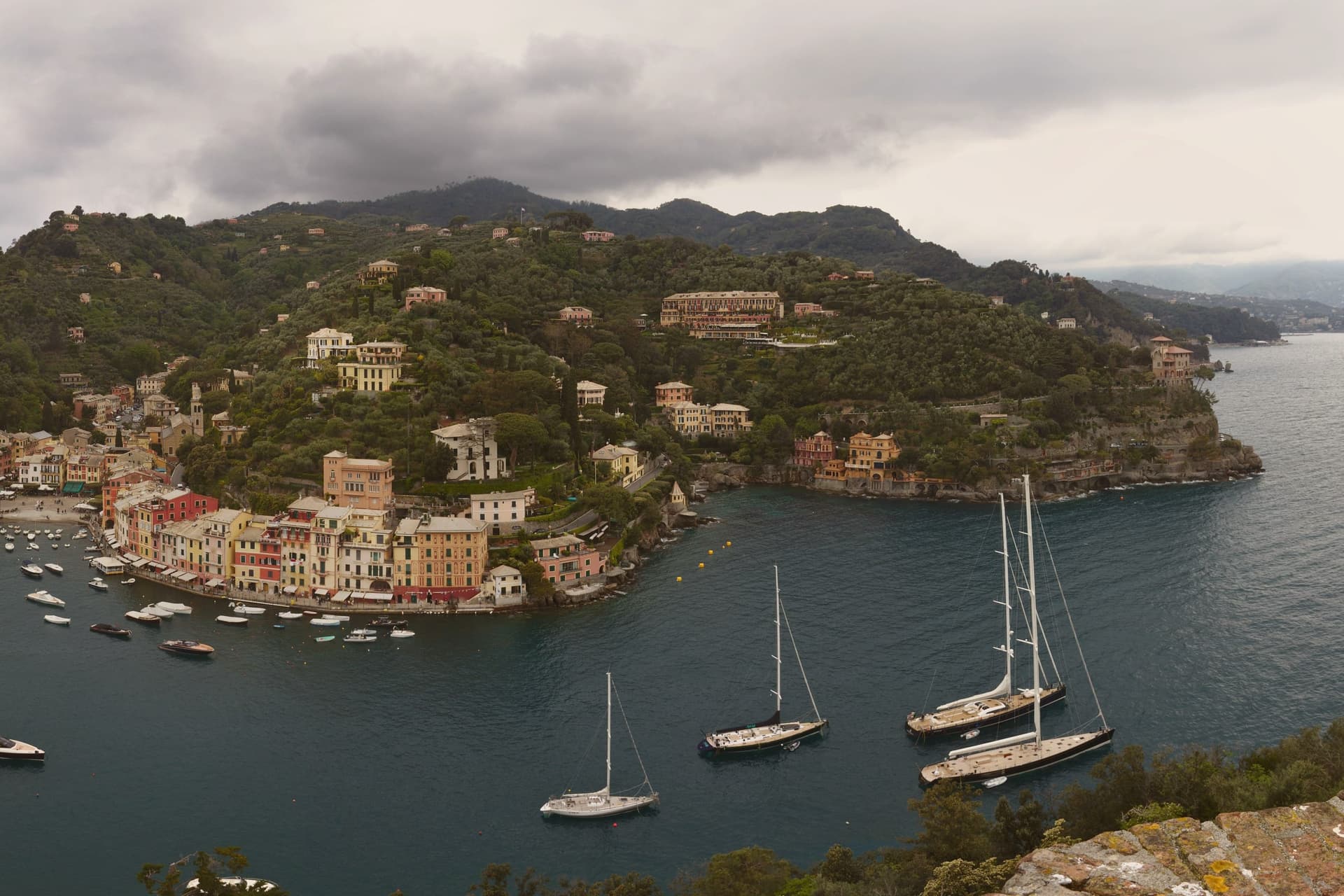
Portofino occupies the smallest municipal territory in the Metropolitan City of Genova, 355 residents on a horseshoe harbor on the southern tip of the Portofino headland. The whole commune sits inside the Portofino Regional Natural Park and the Portofino Protected Marine Area.
Roman fortification stood on the hill above the harbor; the medieval Genoese fort took the name Castello di San Giorgio, was later renamed Castello Brown after the British consul who bought it in 1867. British and then northern European aristocrats discovered the village in the late nineteenth century.
Aubrey Herbert and Elizabeth von Arnim were among the early regulars. By 1950 tourism had replaced fishing as the main industry.
The Chiesa di San Giorgio, first built in 1154 and destroyed by a wartime bomb, was rebuilt in 1950 on the 1760 plans. The painted facades around the harbor are the photograph everyone takes.
The footpaths into the park behind the village are the reason to stay longer than the cruise day-trippers.
What to see in Portofino
- Castello Brown. Genoese coastal fort raised over a Roman site, renamed in 1867 after British consul Montague Yeats Brown, now a historic house museum above the harbor.
- Chiesa di San Giorgio. Church first built in 1154, destroyed in Second World War bombing, rebuilt in 1950 on 1760 plans, on the path up to Castello Brown.
- Faro di Portofino. Lighthouse at the tip of the Portofino headland, walking distance from the harbor along the Punta del Capo coastal path.
How to get to Portofino
Genova is roughly 78 minutes away by road.
✷ We have written about Portofino
“A steep hill falls into the sea. The houses are crammed on the slope and painted in bright colors because they are old, packed tight, and need help. There is a small port if the cove allows it and a bigger port if the cove is generous. There is a small piazza around a small church, with maybe four restaurants, three bars, and a gelato place. There is no space for a grand square, because there is no space for grand anything in Liguria.”
Read our piece on Portofino →Tigullio Roadtrip | Four Versions of the Same Liguria
Our tip
May through June and September into October are the best months. The harbor is open, the park trails are dry, and the day-tripper rush from cruise ships is less intense than in midsummer. July and August fill the piazzetta from late morning to dusk, the ferry queues from Santa Margherita stretch to the seafront, and parking is closed to outside cars.
Camogli
Why visit Camogli
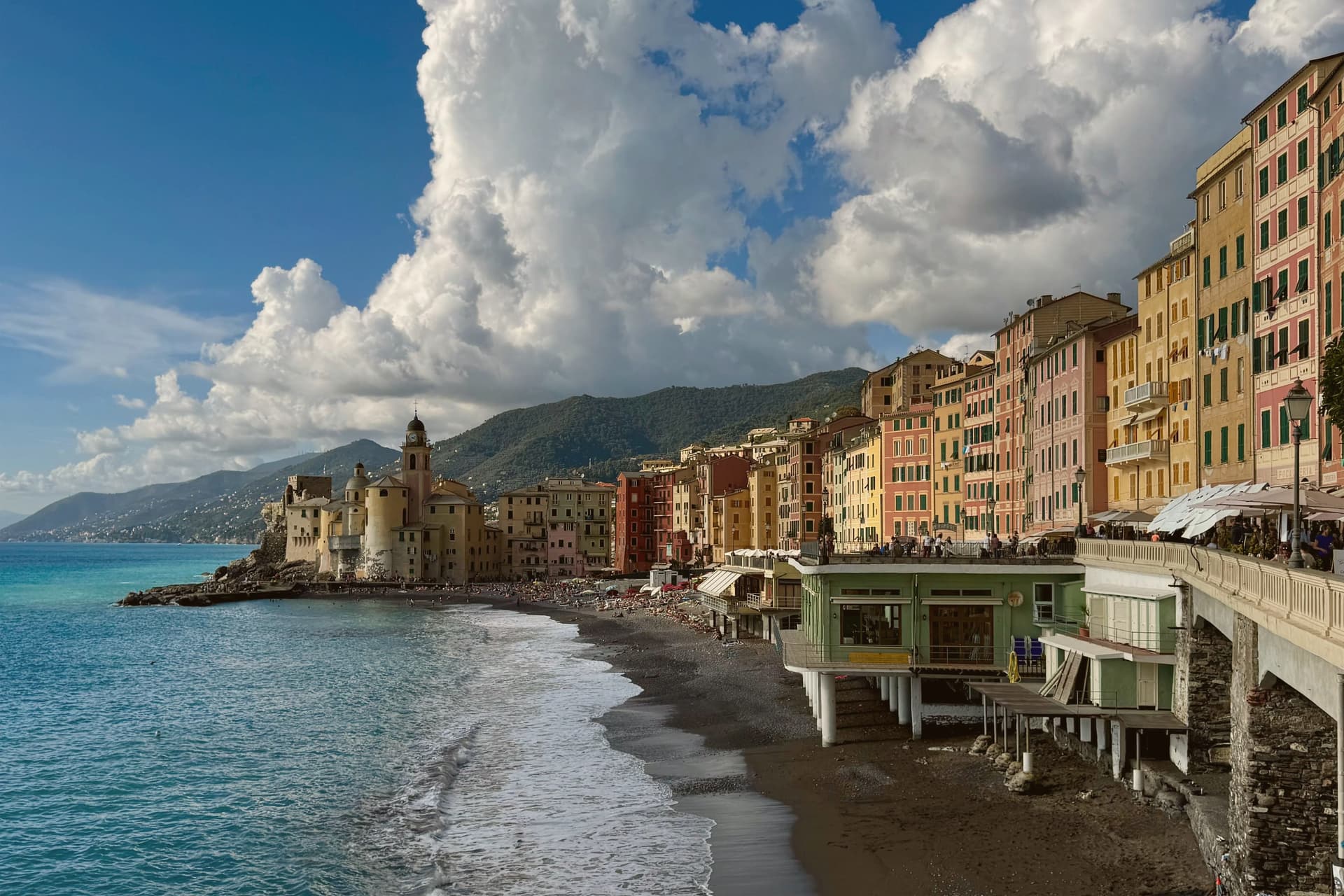
Camogli sits on the west side of the Portofino peninsula, twenty kilometers from Genova on the Golfo Paradiso. The earliest record dates to the tenth century, when it was already a tuna and shrimp fishing port.
By the nineteenth century, the town's fleet of merchant sailing ships ran to several hundred vessels and Camogli was called the city of a thousand white sails. After the naval defeat at Abukir against the British, the camogliesi shipowners reinvested in building merchant sailers under contract to the major European states.
The painted façades of the seafront houses, with their false windows and trompe-l'oeil cornices, served the returning sailors as recognition marks from sea. The Castello della Dragonara, built in the thirteenth century, still guards the harbor.
Every second Sunday of May, the Sagra del Pesce fries thirty thousand portions of fish in a single giant pan on the wharf, in honor of San Fortunato. San Fruttuoso, the eleventh-century abbey reachable by boat or trail, sits in the next cove.
What to see in Camogli
- Castello della Dragonara. Thirteenth-century fortress guarding the harbor, used as municipal seat and now a venue for exhibitions and cultural events.
- Basilica di Santa Maria Assunta. Parish basilica next to the castle on the harbor, baroque interior with marble inlays and seventeenth-century paintings.
- Abbazia di San Fruttuoso. Eleventh-century Benedictine abbey in the next cove, reachable by boat or by the coastal trail across the Portofino peninsula.
How to get to Camogli
There is a railway station in the town, so you can arrive without a car and never need one while you are here. Genova is roughly 33 minutes away by road.
Our tip
April through June and September into October are the strongest months for the Camogli seafront, with mild evenings and clean water before the Genova weekend traffic peaks. The Sagra del Pesce on the second Sunday of May is the date that fills the wharf. July and August are warm, often 28 to 30 degrees, and the painted-façade harbor fills with day-trippers off the Genova trains. Sagra Del Pesce falls in May.
Arenzano
Why visit Arenzano
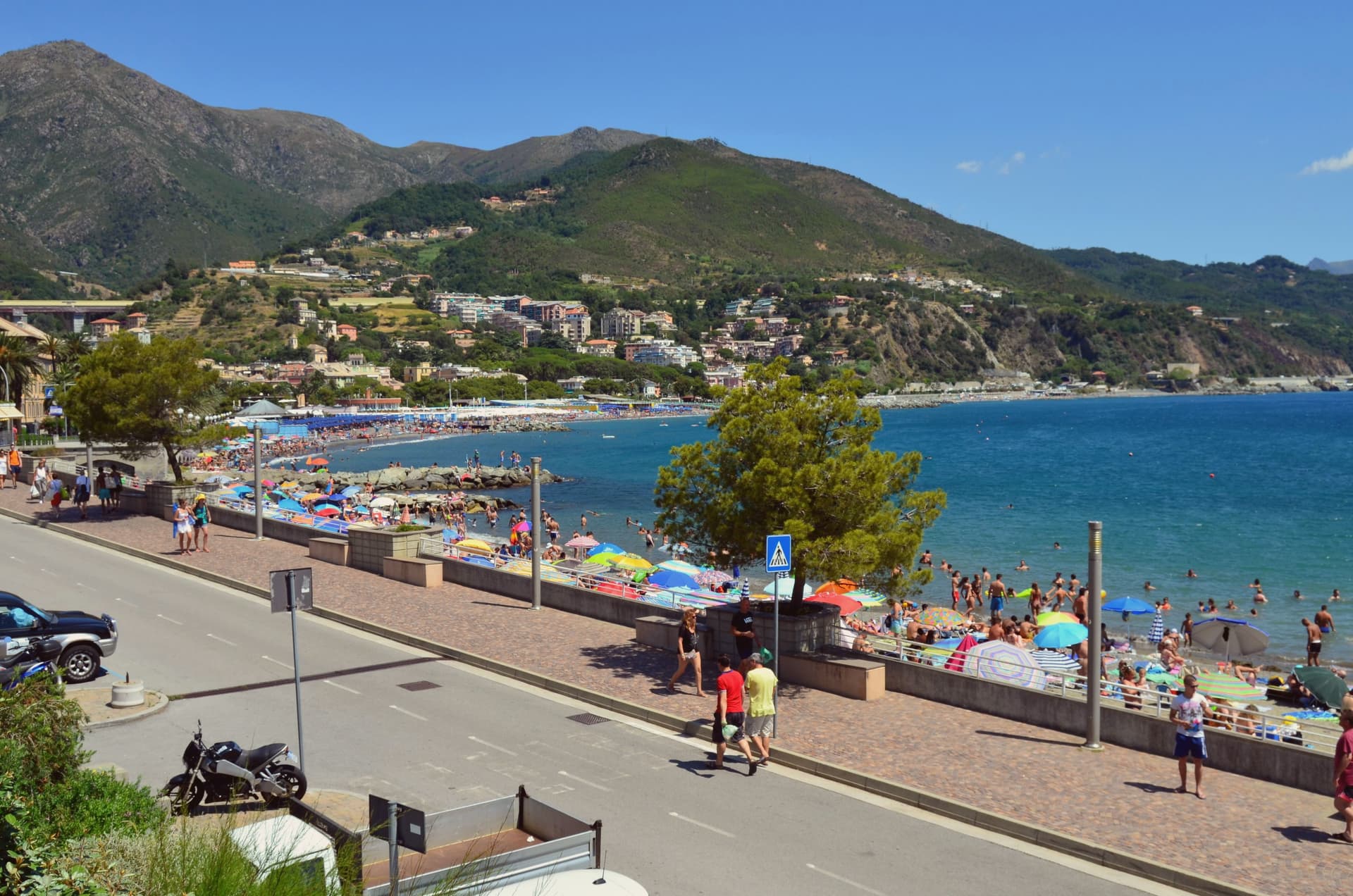
Arenzano sits in a bay at the foot of Capo San Martino on the Riviera di Ponente, twenty kilometers west of Genova. The name covers two different territories that share a boundary rather than a character: a strip of seafront and promenade at sea level, and behind it, rising fast, the two-thirds of the commune that belongs to the mountain park, climbing to peaks above a thousand meters within an hour of the shore.
The town itself gathers between the two, with the church and the villa a short walk apart near the water, and the trailhead sitting well above both, at 758 meters, as the point where the coastal town ends and the climb into the plateau begins. Arenzano reached the Borgo dei Borghi RAI final, which brought enough recognition to fill August weekends but not enough to make the rest of the year hard.
What holds the place together is that proximity: a pilgrimage site, a seat of government in a park, a sandy bay and an alpine plateau all sit within the same short walk of each other, so the town reads less as a single attraction than as a set of unrelated destinations that happen to share an address.
What to see in Arenzano
- Santuario di Gesù Bambino di Praga. The sanctuary draws pilgrims year-round; the interior holds the statue of the Infant of Prague at the center of the devotion it gave the town.
- Villa Negrotto Cambiaso. The villa's park holds palm and cedar groves, a small aviary and a glasshouse, alongside the offices it now houses.
- Parco naturale regionale del Beigua. Monte Reixa rises to 1,183 meters within the park, reached by a network of trails that begin at sea level.
How to get to Arenzano
There is a railway station in the town, so you can arrive without a car and never need one while you are here. Genova is roughly 49 minutes away by road.
Our tip
April through June is the cleanest stretch for combining the Beigua trails with sea swimming, before the heat. July and August fill the bay with Genovesi day-trippers and weekend cars on the via Aurelia; the centro storico can be hard to park. September empties out and stays warm enough to swim into October.
More from Anywhere Italy
- The best coastal towns inside a nature park in Liguria
 The best small towns inside a nature park in Liguria
- The best towns inside a nature park that eat well in Liguria
- The best small towns inside a nature park that eat well in Liguria
 The best hidden coastal towns in the province of Genova
- The best hidden towns that eat well in the province of Genova