Traditional Italian Cooking
From the Talisman of Happiness and beyond
Let’s talk about recipes and food. As winter approaches, my wife and I are cooking a bit more at home. We don’t cook Italian that much, because it’s just so easy to eat out here. But when we do cook Italian, we go full, almost Tea Party level conservative with it. We do cook some modern Italian dishes, like carbonara (so new, it only entered kitchens after WW2), and others. But we prefer the old ones, especially the very regional ones from where we live. Which means a lot of Tuscan, Umbrian, Roman and Piedmontese dishes (we are learning the latter, as we’ve just moved to Turin).
So, Anywhere Italy won’t become a recipe or cooking blog, God forbid, but I wanted to feature some of the home cooking we do. And I wanted to do it in a special series, because structurally, I want to preserve Anywhere Italy as an expat and travel publication. But I know many of you enter Italy through its food, which is totally understandable. I’ll die on this hill: it is the best cuisine in the entire world.
This is also a publication I do because I have fun with it. The entire point, call me an egoist, is to be able to have fun. This is why most of my articles are overwritten, funny, and have too many anecdotes. So if there are going to be recipes here, they should not be ordinary recipes, but recipes with stories and roots in history.
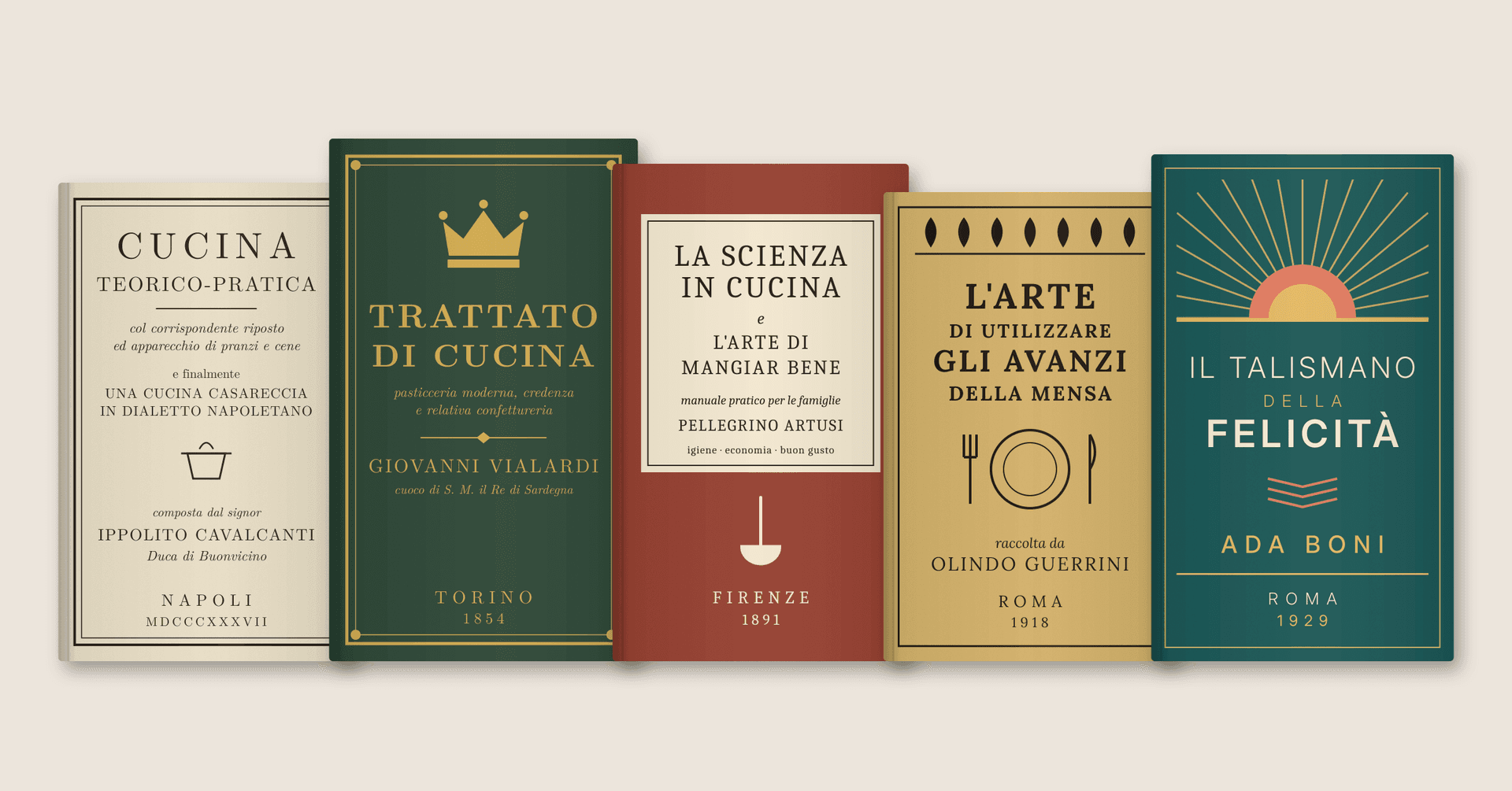
Because of this, I picked 5 books from which I will cook from time to time.
- Ippolito Cavalcanti | Cucina teorico-pratica, 1837
- Giovanni Valardi | Trattato di cucina, 1854
- Pellegrino Artusi | La scienza in cucina e l’arte di mangiar bene, 1891
- Olindo Guerrini | L’arte di utilizzare gli avanzi della mensa, 1918
- Ada Boni | Il talismano di felicitá, 1929
Apart from Artusi and Ada Boni’s super popular Talisman of Happiness, none of these are available in English. But it’s 2026, I use AI on a daily basis anyway, so I’ve got digital copies of all of them, gave them to my bot, and interpreting them should not be a problem.
Before I jump into introducing these five authors, I want to explain why them.
First, historic cooking is awesome, fun and traditional. Apart from Ada Boni, who is basically the Italian Julia Child and Martha Stewart, all of these books are more than a hundred years old.
Second, I wanted to cover many regions of Italy. I’m sure you’re bored of reading this by now, but there is no Italian cuisine. There is Tuscan, Roman, Umbrian, Neapolitan, Sicilian, and so on. There is upper-class cooking and there is poverty food. And there is the North and the South.
So these five names cover the North, the Centre and the South, the palace and the leftovers. In my humble opinion, that’s Italy.
The format, we will see. I’ll probably go to the grocery shop, buy a hero ingredient, and cook it different ways according to the books. Or I’ll just cook one flagship dish. Again, we will see. This is cooking, so it’s 200% experimentation and 500% fun.
So let’s see who these people are, so you’ll have a sense of what’s coming.
Ippolito Cavalcanti | Cucina teorico-pratica
It’s the oldest book on the list and the only one from the South, published in Naples in 1837. I have the second edition, from 1839, which adds a whole section on home cooking.
Cavalcanti was the Duke of Buonvicino, a small Calabrian town, beautiful, still exists. He was a well-off aristocrat in the Kingdom of Naples. And he was a bit bored, I guess. He explains in his own words why he wrote the book:
‘To amuse myself in idle moments I took up this pleasant occupation, and guided by simple principles learned through very long experience, I put together various precepts of gastronomy…”
A new town in your inbox. Free.
Get the next letter free, and read the rest of this one.
Already subscribed? Continue reading
Another letter