The best hill towns in the province of Imperia
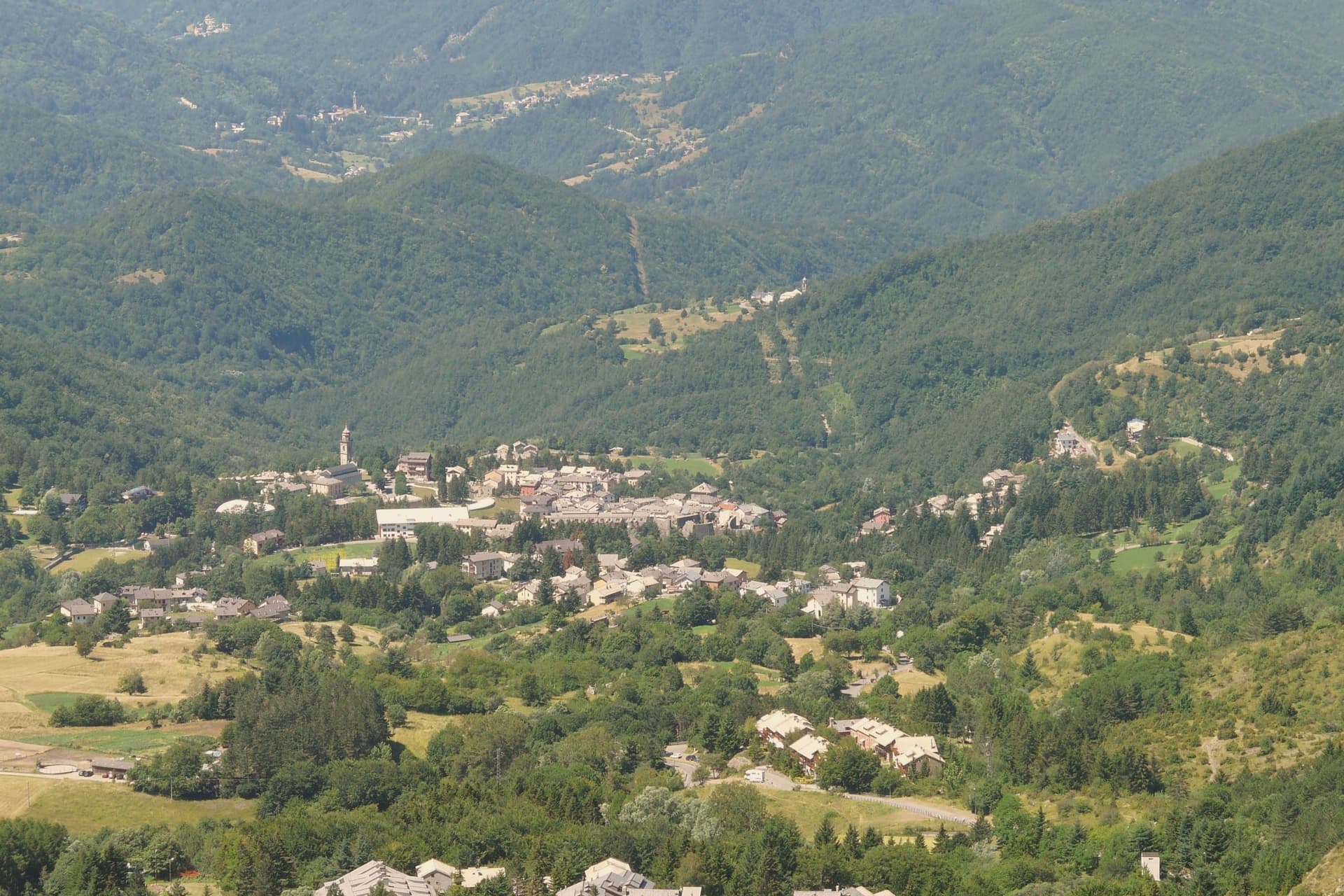
Behind the flower nurseries and the palm-lined seafront, the province of Imperia goes vertical fast. Valleys cut back from the coast into the Ligurian Alps, and the villages here are built of grey stone with slate roofs, stacked so tightly that streets run under the houses in vaulted passages. This is Taggiasca olive country, and the oil is mild, almost sweet, poured over stockfish, over rabbit cooked with pine nuts and olives, over the flat sardenaira bread of the western Riviera. Spring brings wild greens and artichokes to the market stalls; late autumn brings the olive harvest and nets spread under the terraces.
Almost everyone who reaches this province stops at the water. Sanremo takes the largest share, with its casino, its Ariston theatre and its long promenade on the old railway line, and in summer the coast road between Ventimiglia and Imperia moves at walking pace. Bordighera and Diano Marina fill their beaches from June onwards. It is a good coast, and the reason it is crowded is that the motorway and the trains deliver you straight to it.
The same olive terraces climb inland for miles, and the same cuisine gets older and plainer as you go up. Fewer people drive the valley roads of the Nervia, the Argentina and the Arroscia, which is where these towns are: settlements built on ground too steep to spread, so they grew upwards and inwards instead. They are close enough to the sea for a morning swim and far enough for a proper change of air. Worth a detour, and in some cases worth the night.
Of the 13 communes we have mapped in the province of Imperia, 6 qualify as hill towns: each is an inland hill settlement built on ground too steep to spread. The smallest, Seborga, has 276 residents.
If you are still choosing, we have also written The prettiest small villages in the province of Imperia and The best olive oil towns in the province of Imperia.
Seborga
Why visit Seborga
Seborga sits at 517 meters in the hills above Bordighera, 35 kilometers from Monaco. In 954 the counts of Ventimiglia ceded the territory to the Cistercian abbey of Lérins; in 1079 Gregory VII granted the abbots prince-abbot status and the right to mint coins.
The Principality of Seborga ran as a Cistercian state until 1729, when it was sold to Vittorio Amedeo II of Savoy. In 1963 Giorgio Carbone, head of the local flower-growers' cooperative, argued the sale had never been properly registered, declared the commune independent, and was elected prince.
The 200 registered voters now elect a sovereign every seven years. Princess Nina Menegatto took the title in 2019.
Seborga prints its own stamps and mints a currency called the luigino. Italy does not recognise any of it, but the town does carry a Bandiera Arancione and a Borghi più belli badge, and on a clear day the view stretches from the Esterel coast to Cap Ferrat.
What to see in Seborga
- Chiesa di San Martino. Seventeenth-century parish church, single nave, the seat of the former Cistercian abbey transformed after the principality lost ecclesiastical status.
- Palazzo dei Monaci. Former Cistercian abbots' residence on the main piazza, now used as the principality's symbolic government building.
- Zecca di Seborga. Old mint that produced the principality's coins from the eleventh century, restored as a small museum on Via Verdi.
How to get to Seborga
Genova is roughly 120 minutes away by road.
Our tip
April through June and September to October are the working months: clear afternoons, evenings cool enough for a jacket at 517 meters, the road up from Bordighera passable in any car. The principality holds its main festa in mid-August around Ferragosto, when the population doubles for a weekend and the prince makes a public appearance. July and August can hit 32 degrees on the coast below, but the hilltop stays five degrees cooler.
Apricale
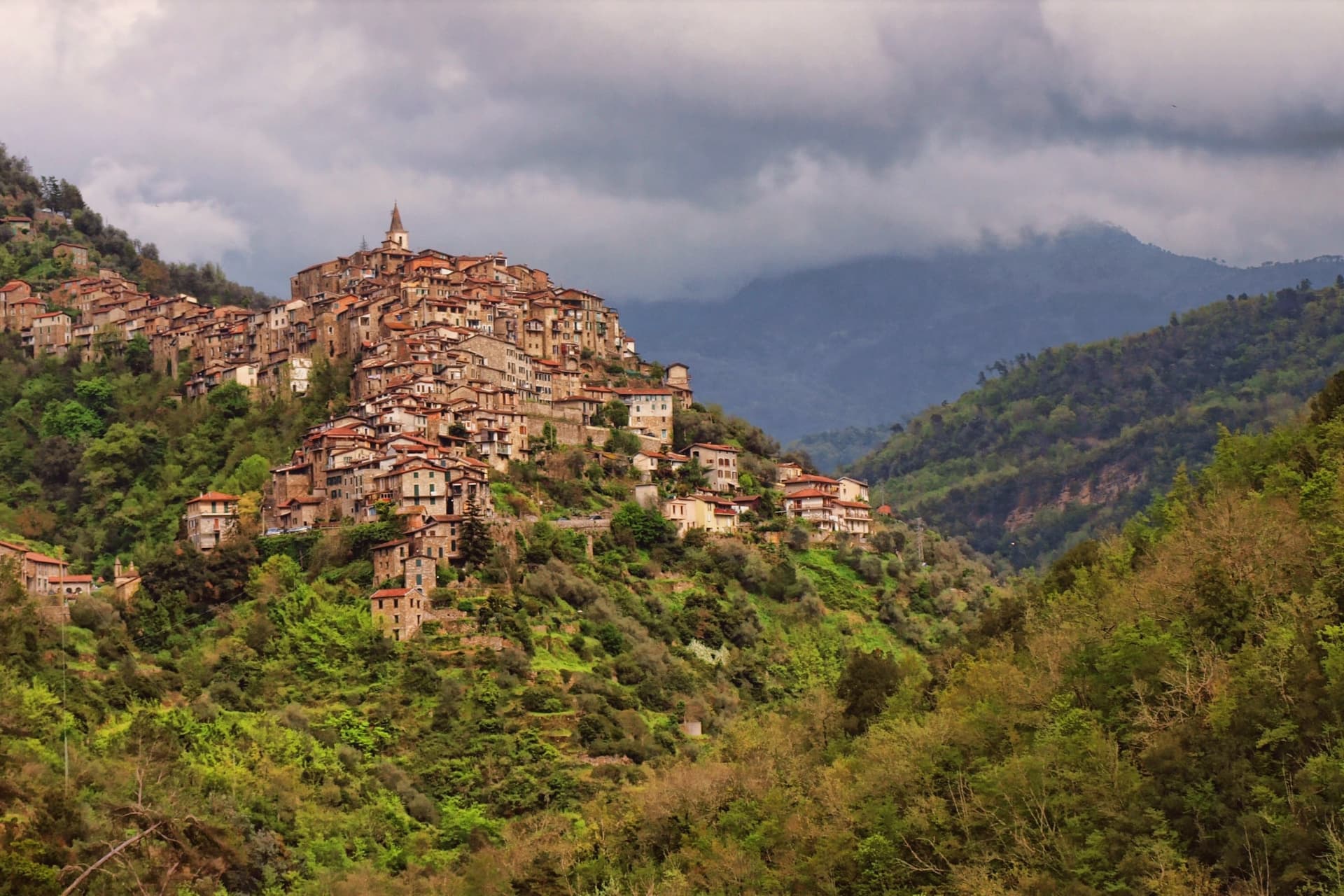
Why visit Apricale
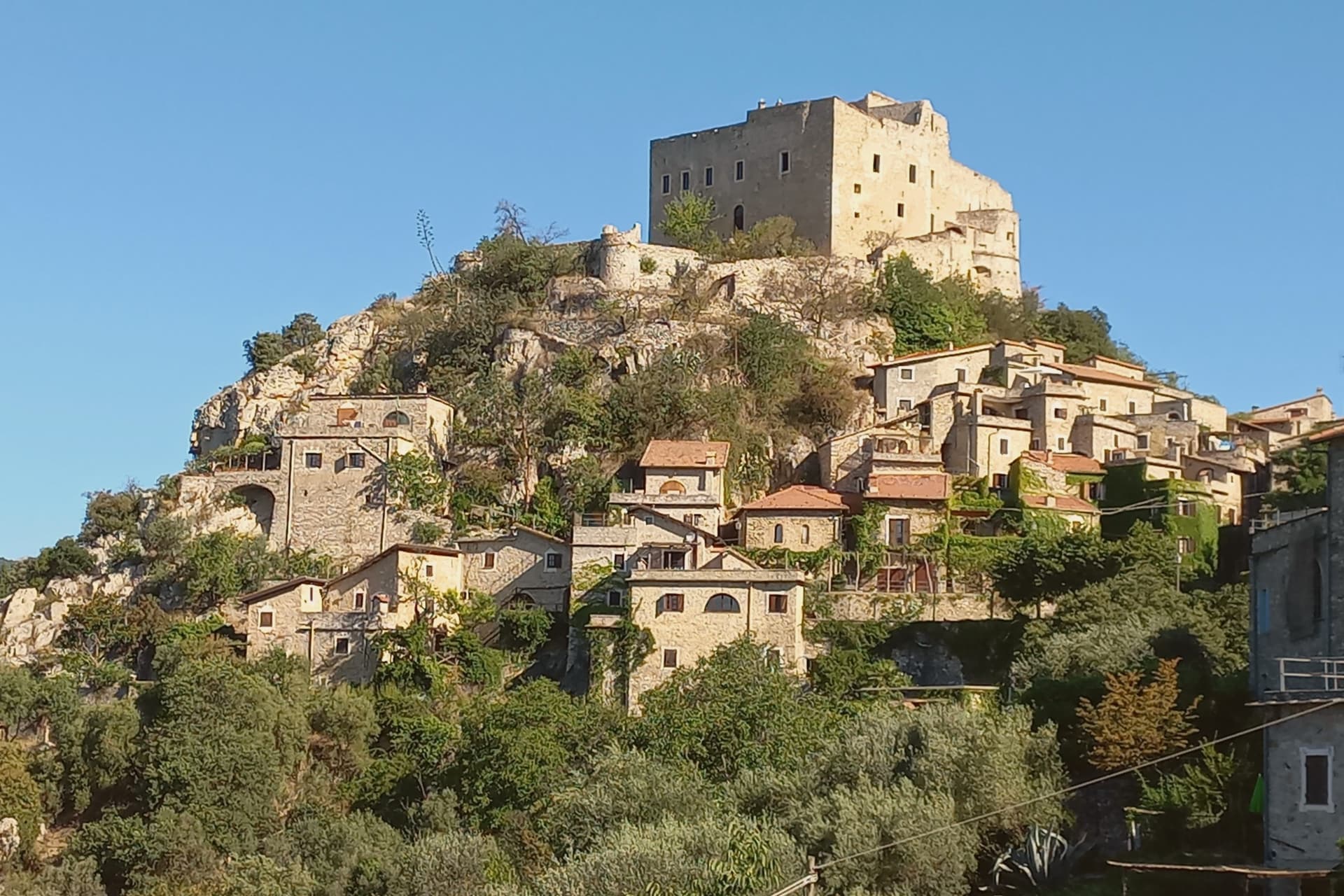
Apricale sits at 273 meters on a rocky spur in the Val Nervia, thirty kilometers west of Imperia and a few kilometers inland from the French border. The name comes from apricus, the Latin word for sunny: the village faces south on a ridge that catches light most of the day.
The Counts of Ventimiglia built the Castello della Lucertola here in the tenth century, called the Lizard Castle because its outline matches the silhouette of the village along the rock. From 1270 the borgo passed to the Doria of Dolceacqua.
The houses cascade down the slope in stone tiers, connected by alleys and stairs rather than streets. The village holds Borghi più belli, Bandiera Arancione, and Città dell'Olio.
Below the centro storico, the Chiesa di Santa Maria degli Angeli dates to the thirteenth century. The Sagra della Pansarola each September celebrates the local sweet fritter eaten with zabaglione.
What to see in Apricale
- Castello della Lucertola. Tenth-century castle of the Counts of Ventimiglia, named for its lizard-shaped outline on the rock, now housing the village museum.
- Chiesa di Santa Maria degli Angeli. Thirteenth-century church at the foot of the village, the oldest religious building in Apricale.
- Chiesa della Purificazione di Maria. Parish church on Piazza Torracca, with a neo-Romanesque façade rebuilt in the nineteenth century.
How to get to Apricale
Genova is roughly 144 minutes away by road.
Our tip
April through June and September into October are the right months. The terraces are green, the olive harvest runs from October into December, and the light on the south-facing rock matches the Latin name. July and August push into the low thirties; the stone holds heat and the village empties between two and five.
Perinaldo
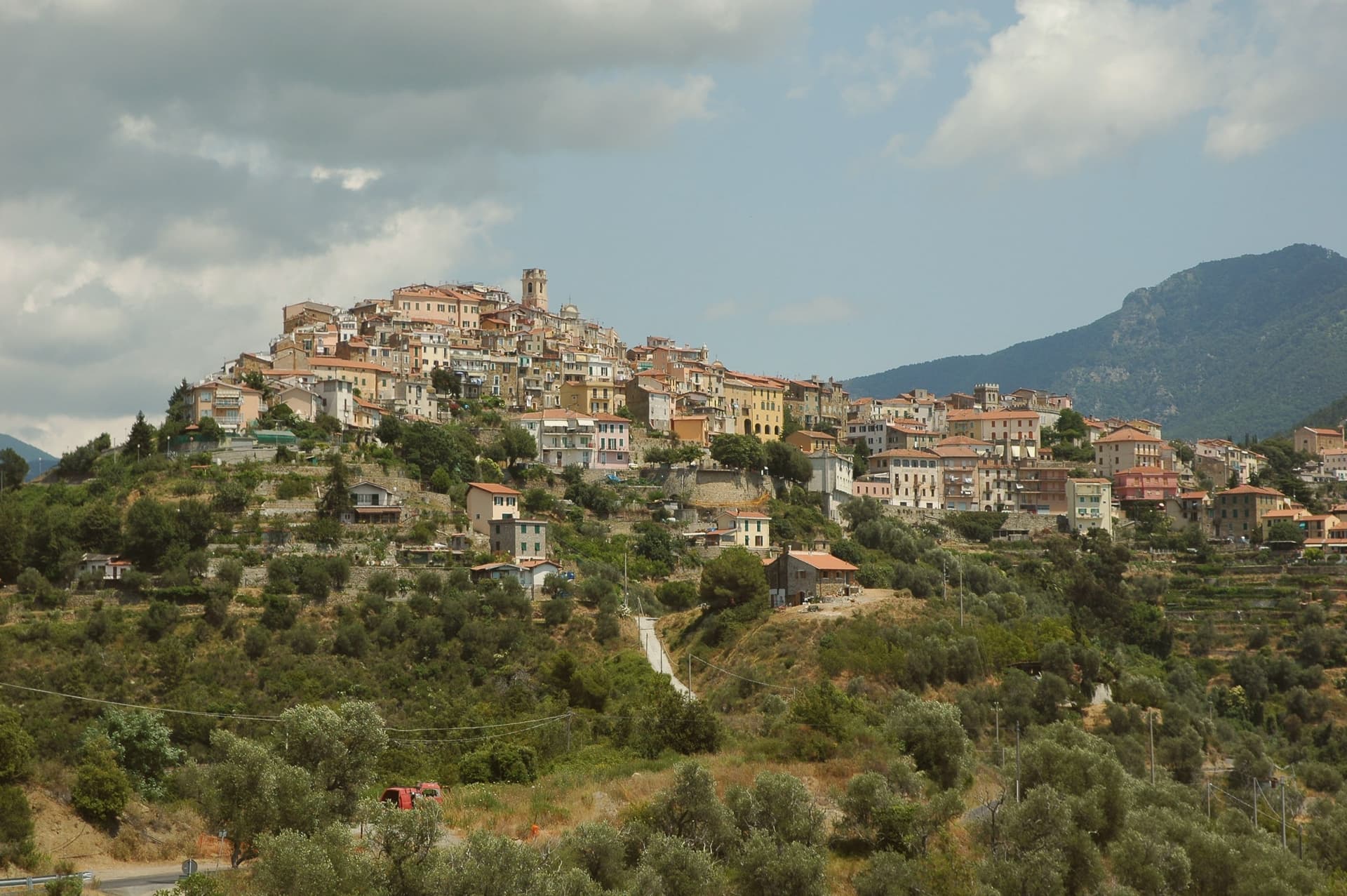
Why visit Perinaldo
Perinaldo sits seven kilometers inland from Bordighera and the French border, on a ridge above the Val Nervia. The medieval centro storico is built in concentric rings around the old castle, a compact plan that ties church, castle, and town hall together within a short walk of each other.
The astronomer left for Bologna and then for the court of Louis XIV in Paris, where he directed the new Royal Observatory. He did not return, but he sent a canvas back to the Suffragio altar of the parish church in 1672, and the meridian his calculations helped fix is still marked on the sundial of the smaller church on the ridge.
The terraces below the village grow Taggiasca olives, the basis of its Città dell'Olio standing. Perinaldo also holds Borghi più belli and Bandiera Arancione recognition.
The village's shape, ring upon ring around a single high point, mirrors the way its history keeps circling back to one native mind that left for Paris and never stopped sending word home.
What to see in Perinaldo
- Osservatorio Astronomico G. D. Cassini. A dome rises from the inner courtyard of the town hall. On observation evenings the working instrument inside is put to the same sky Cassini once charted from far greater distance, in Paris.
- Chiesa di San Nicola da Bari. Parish church built in 1489, holding a fifteenth-century wooden crucifix and, on the Suffragio altar, a canvas sent back from Paris by its most famous native son.
- Chiesa della Visitazione. Smaller church on the ridge, fitted with a meridian sundial calibrated using the astronomical methods developed by the town's native astronomer.
How to get to Perinaldo
Genova is roughly 132 minutes away by road.
Our tip
April through June and September into October are the right months on this ridge above the Val Nervia. The terraces green in spring, the olive harvest runs from October into December, and the sky at 572 meters clears most evenings. The observatory schedules its public sessions through spring, summer and early autumn.
Badalucco
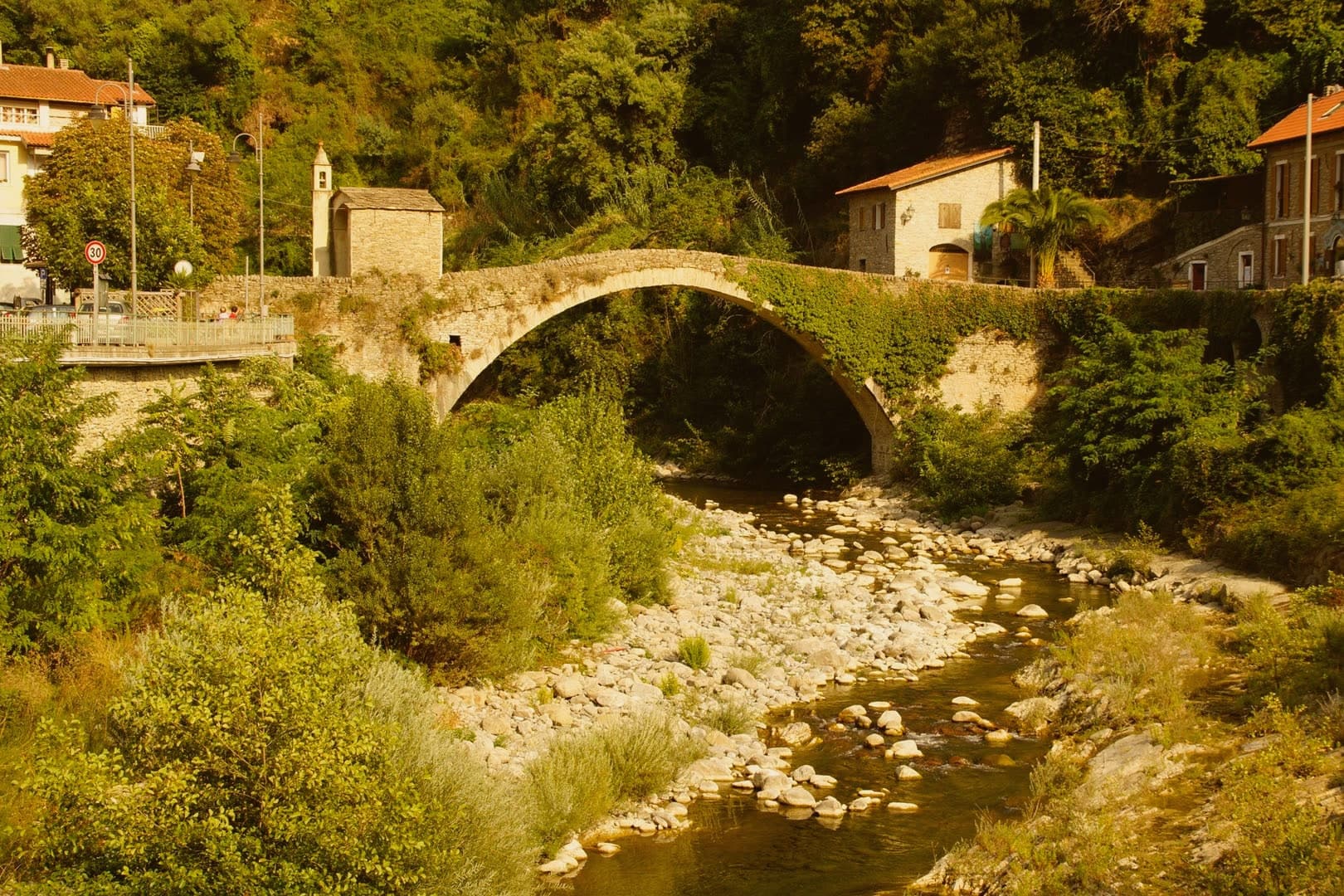
Why visit Badalucco
Badalucco sits at 179 meters in the middle Valle Argentina, fifteen kilometers north of Imperia. The torrent that gives the valley its name runs in a wide bend below the village.
The site changed hands between Ligures and Rome in 181 BC, became a fief of the Counts of Ventimiglia, and passed to the Republic of Genova in 1259. The seventeenth century rebuilt the parish Chiesa di Santa Maria Assunta e San Giorgio in full Baroque, with a square bell tower and a fifteenth-century polyptych attributed to Giovanni Canavesio.
The caruggi of stone houses are painted with contemporary murals and trompe-l'oeil, a more recent layer over the medieval shell. The Rundin bean, an indigenous variety grown on the terraces, is a Slow Food Presidium.
Stoccafisso alla badalucchese, stockfish stewed in tomato and olives, is the dish: the third Sunday of September brings the Stockfish Festival to the square.
What to see in Badalucco
- Chiesa di Santa Maria Assunta e San Giorgio. Seventeenth-century Baroque parish church with a square bell tower, holding a fifteenth-century polyptych attributed to Giovanni Canavesio and a seventeenth-century wooden crucifix.
- Chiesa di San Niccolò. Hilltop church above the old village, on the site of a former noble castle that served as a lookout over the valley.
- Ponte sull'Argentina. Stone bridge across the torrent that wraps the village, connecting the centro storico to the valley road.
How to get to Badalucco
Genova is roughly 122 minutes away by road.
Our tip
April through June and September into October are the dry months in the Argentina Valley. The terraces above the village hold olive groves, the Rundin bean, and pockets of grapevine. July and August push into the low thirties, but the valley keeps a few degrees cooler than the coast. Festival dello Stoccafisso falls in September.
Ceriana
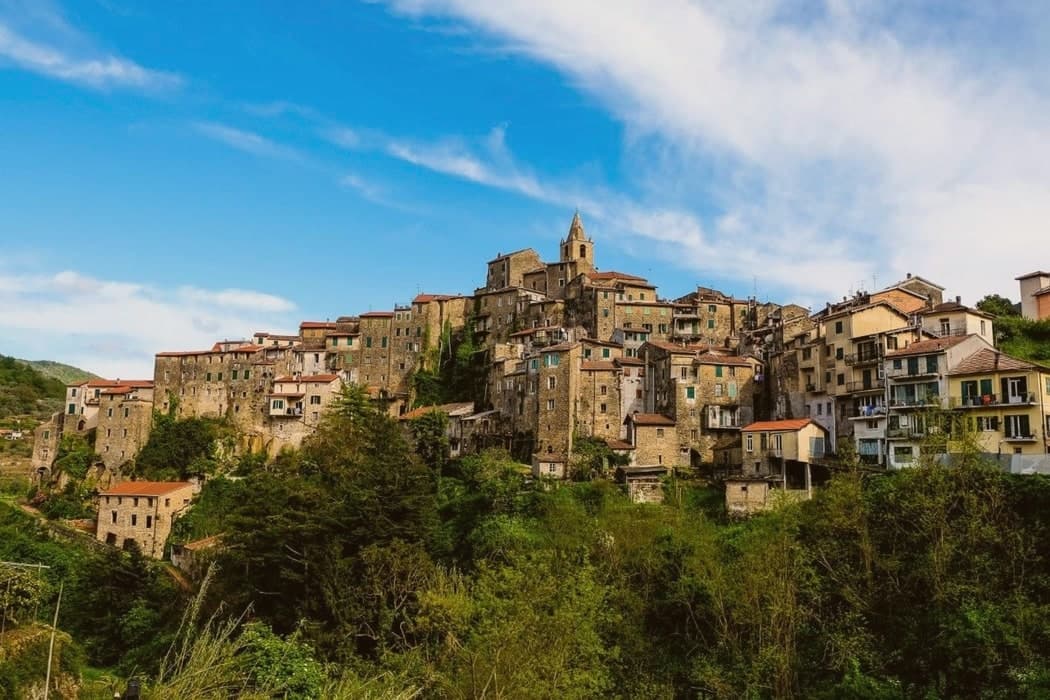
Why visit Ceriana
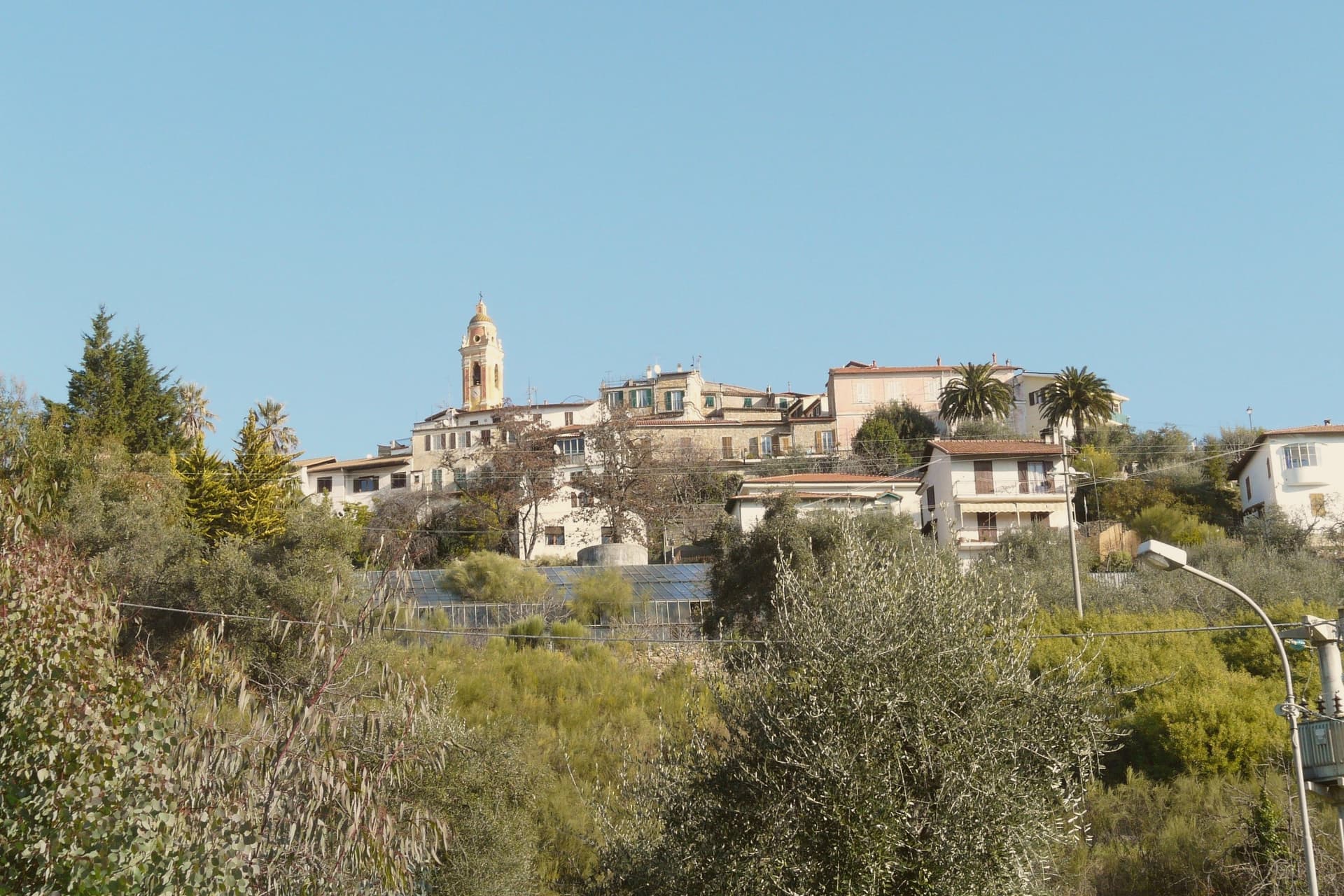
Ceriana sits at 369 meters in the Valle Armea, twenty kilometers west of Imperia and a short climb inland from Sanremo. The Romans built a garrison here called Castrum Coelianae, a watchtower with permanent quarters for legionaries; the name shortened to Ceriana over the centuries.
The town took its present shape in the eleventh and twelfth centuries, passing from the Counts of Ventimiglia to the Mari family in 1297 and to the Republic of Genoa in 1359. The parish church of Santi Pietro e Paolo is reached by climbing the caruggi, narrow Ligurian alleys roofed in places by overpassing houses; inside, an anonymous wooden Virgin from the thirteenth century and a 1526 polyptych of San Pietro in cattedra.
Three confraternities still keep their oratories in town: the Rossi at Santa Caterina, the Azzurri at the Visitazione, and the Neri at the Addolorata. Olive oil from the surrounding terraces carries the Città dell'Olio mark.
What to see in Ceriana
- Chiesa dei Santi Pietro e Paolo. Parish church at the top of the caruggi, with a thirteenth-century anonymous wooden Virgin and a 1526 polyptych of San Pietro in cattedra.
- Oratorio di Santa Caterina. Seventeenth-century oratory of the Confraternita dei Rossi, built under the protection of the Senate of Genoa.
- Oratorio della Visitazione. Seat of the Confraternita degli Azzurri, the second of three colour-coded brotherhoods that still organize the town's processions.
How to get to Ceriana
Genova is roughly 121 minutes away by road.
Our tip
April through June brings the olive flowering on the terraces below the village and warm afternoons that don't yet burn. September and October are the dry months, with the harvest ramping up and pressing beginning in November. Summer is hotter but the 369 meters of elevation keep nights cool enough to sleep; the caruggi stay shaded most of the day. Sagra Della Salsiccia Di Ceriana falls in August.
Pieve di Teco
Why visit Pieve di Teco
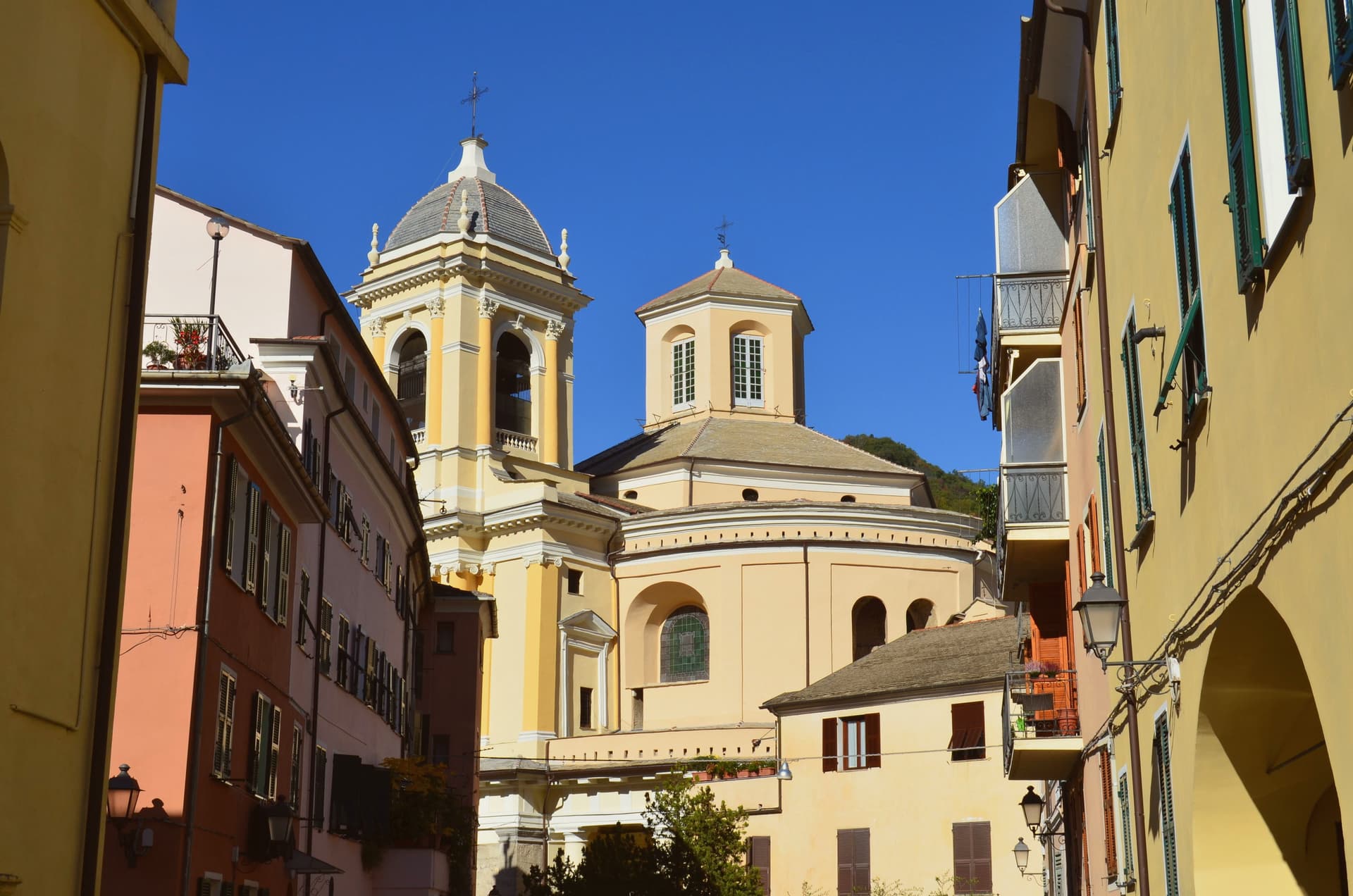
Pieve di Teco sits at 240 meters in the middle Arroscia valley, twenty kilometers northwest of Imperia. The town was not a slow medieval accretion: it was deliberately founded in 1233 around a parish church, a mill and a well, on a flat stretch where the main roads of the upper valley converged, with the explicit purpose of running a market.
Manufactures followed of paper, leather, soap, ropes, cloth and footwear. The Clavesana family held it until 1386, when it passed to Genoa, and it changed hands repeatedly through the wars that crossed the Ligurian Apennines.
The Corso Mario Ponzoni, porticoed since the sixteenth century, runs the length of the original market layout, and the eighteenth-century Collegiata di San Giovanni Battista anchors one of its squares. The Teatro Salvini, with around a hundred seats, is the second-smallest functioning theater in Italy.
The commune is the seat of the Unione dei Comuni della Valle Arroscia.
What to see in Pieve di Teco
- Corso Mario Ponzoni. Porticoed market street running the length of the original 1233 town plan, with two-storey houses above the sixteenth-century arcades.
- Collegiata di San Giovanni Battista. Eighteenth-century collegiate church overlooking one of the squares on the Corso, the religious anchor of the upper Arroscia valley.
- Teatro Salvini. Roughly one hundred seats, the second-smallest functioning theater in Italy, still in regular use for chamber-scale productions.
How to get to Pieve di Teco
Genova is roughly 94 minutes away by road.
Our tip
April through June and September through October work well for Pieve di Teco. The Arroscia valley at 240 meters runs cooler than the coast through summer; July and August are warm but tolerable, with the porticoed Corso providing continuous shade. The autumn harvest brings the Taggiasca olive picking and the first pressings. Expo Valle Arroscia falls in September.