
‘Nduja | The salami that wants to melt
The perfect marriage of spicy paprika and pig fat
A few months ago, before I moved to Turin, I was still living in Tuscany, in Pietrasanta. I took a train from Turin to Viareggio, close to Pietrasanta. It turned out that the train was a night train, going from Turin to Reggio Calabria. Turin is full of people from the South.
So, I took my seat among a group of Calabrians. Various ages: a young dude studying at Turin’s Politecnico, a middle-aged lady, an old grandpa, a young mom, a couple, really, it was everyone. Within minutes of the train leaving the station, as if it were a ritual, a sign, or a mandatory exercise, every Calabrian pulled out their sandwiches.
Tinfoil crackling, boxes opening up, bags out. And the entire cabin smells of ‘nduja. And then, as if this weren’t enough, they started to show their ‘ndujas to each other. Even more, they started sharing them, tasting them, and talking about them as if they were ‘nduja sommeliers.
From what I could understand, the main theme of the conversation was the meat-to-fat ratio, and where they hang it up to cure. Some families do it in the attic, others in the wine cellar. They argued about which one is better.
It was a hilarious scene, and it reminded me of my weeks in Calabria. The spiciest, warmest, and friendliest people I have met. And this is Italy, where the bar is already high. Maybe it’s because of something else. Maybe it’s because of the extreme consumption of ‘nduja.
So let’s start with the basics.
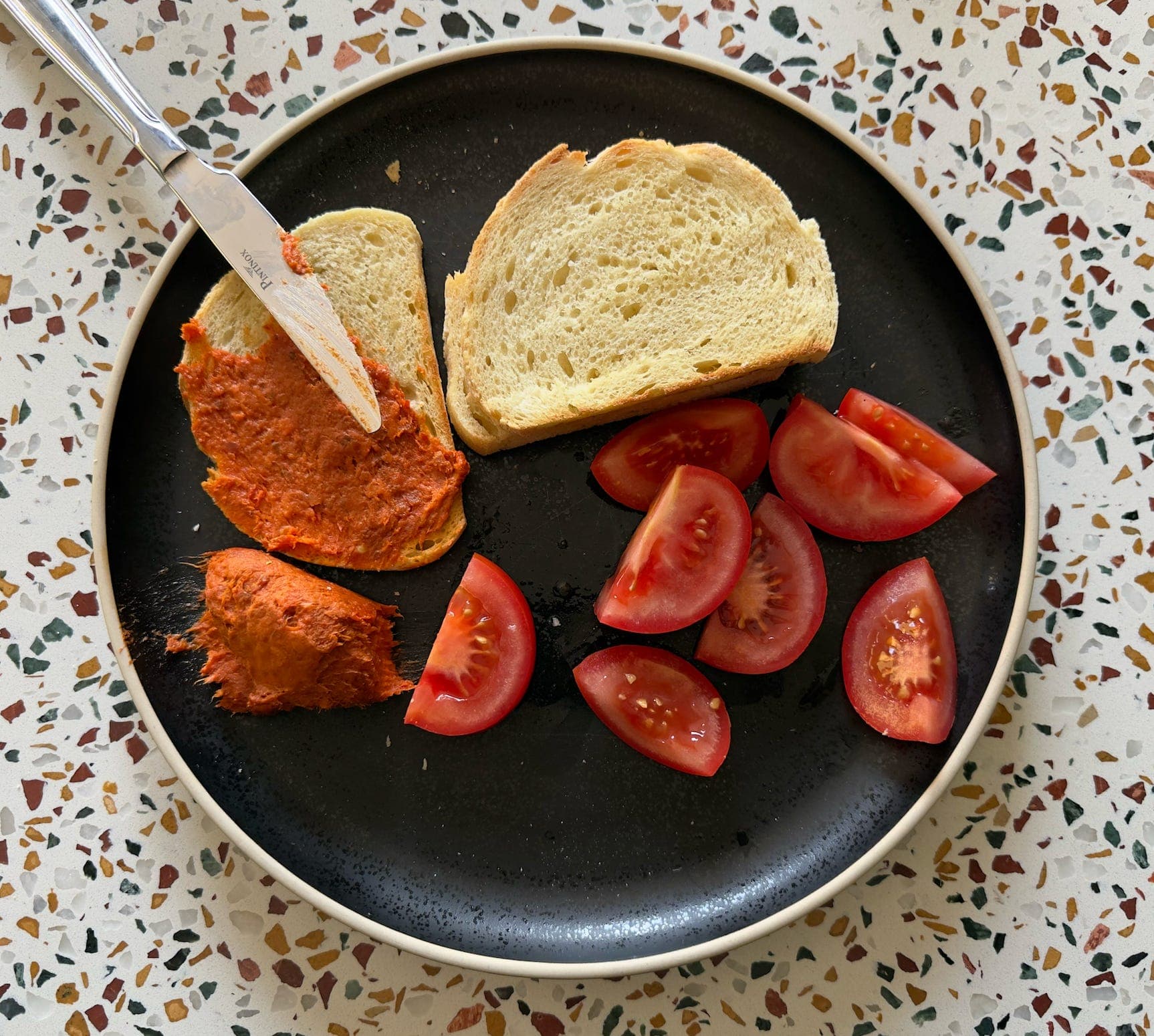
This is how I like to eat it. A very basic white bread that is not overpowering, with no extra cereals or anything fancy going on. It’s a carrier for the Main Thing. I sometimes toast it. If I toast it, I rub a garlic clove on it. Big, meaty tomatoes, the ones you would use to make sauce. Maybe onions from Tropea; they are red and very sweet. They should serve as a balance between the fat and the heat of the Main Thing. And then, the Main Thing, ‘nduja. Spread it generously. Another treat of mine is ‘nduja pasta. It’s also super simple: some pasta (the classic recipe calls for fileja), tomato sauce, garlic, oil, that’s it. Pecorino on top.
Calabrians eat it kind of the same way: fewer vegetables, more pecorino. A glass of local heavy red wine. There is also the scalda ‘nduja, or ‘nduja warmer, a terracotta dish. A small candle at the bottom, a small plate on top, and the ‘nduja melts into a salami sauce which you spread hot on your bread. The idea is that you sit around it with family or friends, and you’ll also see it in restaurants.
‘Nduja is in the long line of Italian foods which are connected to a town. I wrote about the Lardo of Colonnata, which is basically pig fat aged in marble basins, the Biroldo from Garfagnana, and there are many other examples, like the Porchetta from Ariccia or the Amatriciana pasta from Amatrice. ‘Nduja comes from Spilinga, a small town in Calabria. They have an annual festival celebrating it. Some state that ‘nduja is DOP/IGP protected, but nah, only the chilli in it has any sort of designation. And ‘nduja is made across the local area, in many other towns as well.
So there are three things that are interesting about ‘nduja, I think. Aside from the fact that it is awesome and I’m pretty much addicted to it.
A new town in your inbox. Free.
Get the next letter free, and read the rest of this one.
Already subscribed? Continue reading
Another letter
