Italian salaries are low, but should you care about that as a foreigner?
Introduction to basic economics in Italy
If you believe in market economics, you arrived to this article with curiosity, even with a smile.
If you’ve read more Marx in your uni than you've read Milton Friedman, you arrived here with a slightly higher blood pressure.
If you are Italian, even the title makes your eyes roll.
I get it all, but fear not: all of you will be disappointed here.
So let’s begin. FYI, this is a sister article of my previous one on politics in Italy:
Quickstart for Italian politics
In my politics article, I argued (among many things) on one key theme: should you care about Italian politics at all?
My argument was this: as a tourist, visitor, traveler, and even a slow traveler who spends months here, you should care zero about Italian politics. You come for a visit, and even if you care, you couldn’t do anything about it during a short stay.
Think about it. If you visit Paris in October-November, do you care that the streets are burning every year? Well, maybe, but mostly because you want to avoid the riots on your way to the Louvre.
But if you are an expat who lives here, you should absolutely care, because it shapes your daily life, and if you stay long enough to become a citizen, you will vote on it.
Same goes for basic economics. You should know the baseline metrics, and what they mean in terms of the zeitgeist of the society. It also helps you to negotiate better prices on anything.
The format will be a new one: I will give you 5 charts on the Italian economy, and explain what they mean for you (not for Italians).
If it is not clear to everyone by now, I’m saying this clearly: this is an article for those who are wishing to move to Italy as a foreigner.
Disclaimer: I earn abroad and spend here, so I’m writing from the comfortable side of every chart below. Italians didn’t choose these numbers. They live with them, and nothing below is a joke at their expense.
And before anyone comments “go back to your shopping mall, expat”: I’m from Hungary. We didn’t have shopping malls until the late-90s, and trust me, our salaries are lower than yours.
Budget for Italian salaries, not your home wages
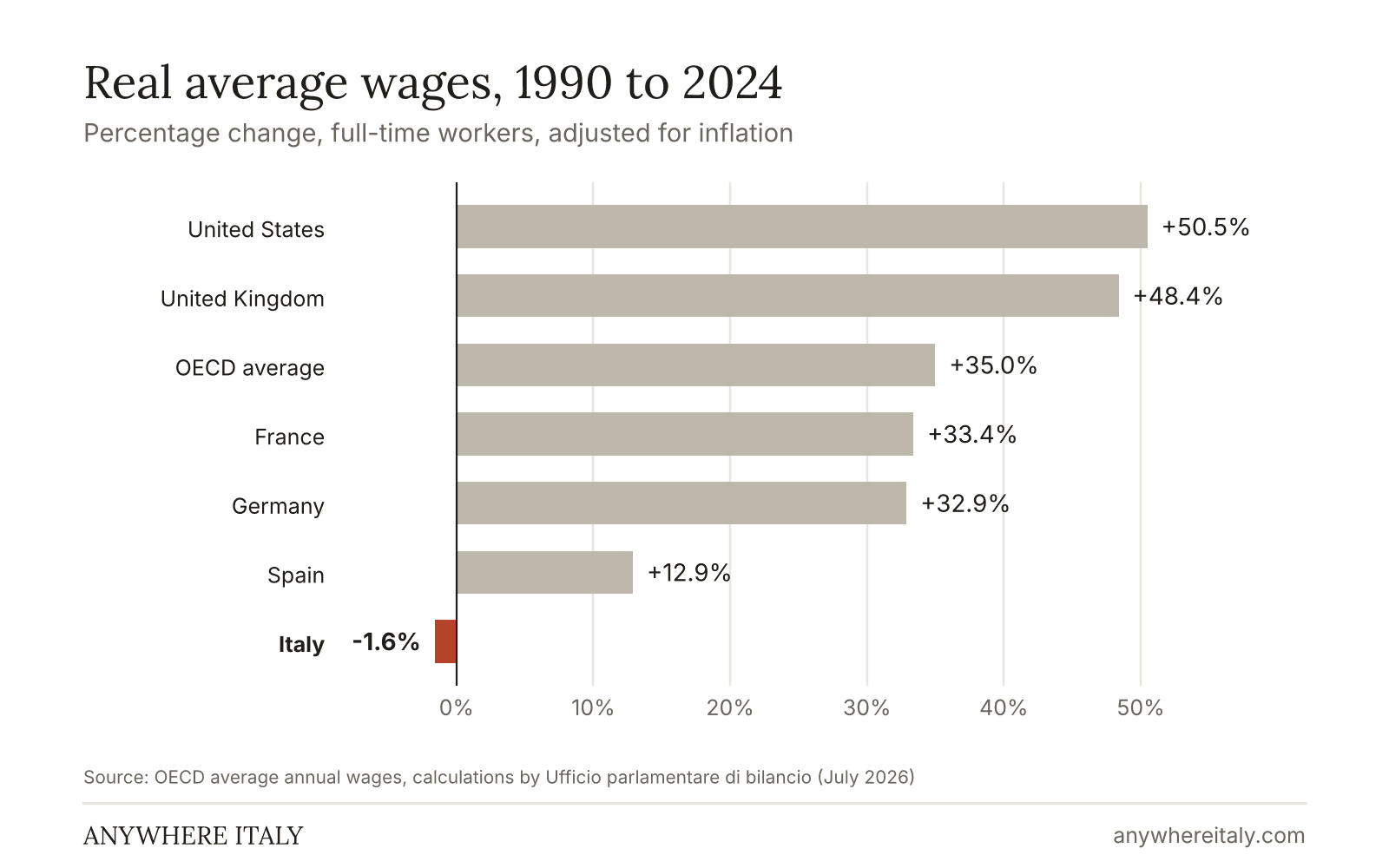
Gosh, where should we start. Let’s start with the wages as it is in the title anyway. This is probably the most descriptive chart:
If you watch any news nowadays, it is filled with one core theme across the Western world: salaries are crap, they are not growing, who do we blame? Boomers bought their homes for pennies. Young people are stuck in shitty rentals or pay-till-you-die mortgages. The European protests you see are filled with the angst of young people who can’t afford the things they see online.
And even in countries where these themes are widely discussed, salary growth has happened, at least to some extent. Meanwhile in Italy, salaries are flat or even less for an entire generation. Italy is the only large Western economy where you earn no more than your parents did at the same age.
The chart doesn’t show it, but it is getting even worse. Since COVID, while most economies have managed to rebound, Italian wages lost 8% of their buying power. Insane.
A typical salary is about 1,500 EUR after tax per month. Yeah, it’s one thousand and five hundred. I didn’t miss a zero. I wish.
The reason behind it? Many, not that you as an expat can do anything about it. But it is mostly how the economy is built up from the ground. In Germany, mid-sized businesses are the backbone of the economy. In the US, it’s giant corporations.
In Italy? Famiglia! Micro-companies, otherwise known as family businesses. And family businesses are always cheap on cash, low on investment, thin on margins, and therefore low on productivity. Add astonishingly high taxes that obviously create a grey economy.
A new town in your inbox. Free.
Get the next letter free, and read the rest of this one.
Already subscribed? Continue reading
Another letter