
Hill towns
Hill towns in Veneto
5 towns
The ridge and hilltop borghi, sitting around 400 metres. Vineyards below, one road up, walkable once you are there. Good in almost any season.
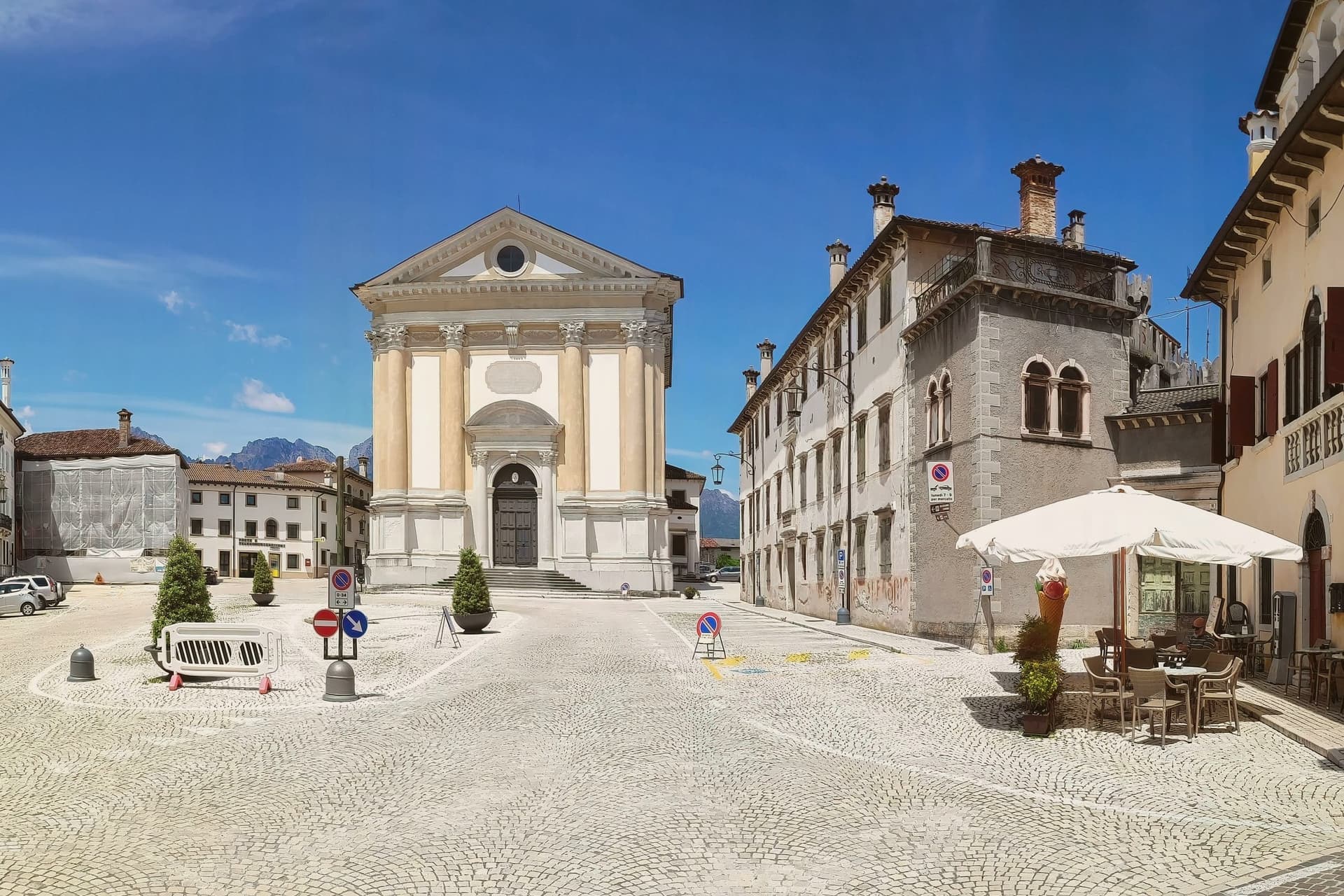
Borgo Valbelluna
Province: Belluno · 367 m
Veneto's youngest comune, a 13,410-resident fusion of three lower-Belluno towns formed in 2019, wrapped around an old borgo in the pre-Dolomite Piave valley.
Feltre
Province: Belluno · 325 m
A Renaissance city at 325 meters in the Belluno Prealps, rebuilt after 1510 as the vertical village it remains.
Cison di Valmarino
Province: Treviso · 261 m
A Prosecco hills borgo at 261 meters under the dolomite rock of CastelBrando, the largest inhabited castle complex in Europe.
Valdobbiadene
Province: Treviso · 253 m
The Prosecco Superiore capital at 253 meters in the Treviso Prealps, where Glera grown on Cartizze's 108 hectares produces the most expensive Italian sparkling wine.
Asolo
Province: Treviso · 205 m
A walled hill town at 205 meters that Caterina Cornaro ran as her court after trading Cyprus to Venice in 1489.
The slow-trip planner
Plan a slow trip across the towns travelers skip.
Answer five questions. We will shape a geographically coherent slow trip from the 1,000 Italian towns most travelers skip. Yours to save and share.
From elsewhere in Italy
Five more towns to discover
Visso
Province: Macerata
The northern Sibillini gate at 607 meters where the Nera meets the Ussita, holding one of two surviving manuscripts of Leopardi's L'Infinito.
Goriano Sicoli
Province: L'Aquila
At 720 meters in the Subequana valley, a medieval village drawn by M.C. Escher in 1929 keeps a May ritual folklorists trace to Demeter.
Ugento
Province: Lecce
A Messapian-Roman town five kilometers from the Ionian, where a Baroque castle sits on the walls of the ancient city of Ozan.
Fontanellato
Province: Parma
A Parma-plain town built around the Rocca Sanvitale, the moated fortress at its center.
Pescina
Province: L'Aquila
A Marsica town at 735 meters, on the rim of the drained Fucino basin, that lost five thousand of six thousand people in a single morning in 1915.