
The best wine towns within an hour of Turin
The hills south and north of Turin are wine country in the working sense: rows of Nebbiolo and Barbera combed across marl slopes, tractors on the ridge roads at dawn, cellars cut into the hillside below houses of soft red brick. Autumn is the season everything points towards, when the harvest is in, the fog sits in the valley bottoms until midday and the trattorie put tajarin, agnolotti del plin and brasato al Barolo back on the board. Further north, towards the Canavese, the grape changes to Erbaluce and the vines climb stone pergolas on glacial moraine. Spring brings a different pleasure, empty roads and the vines still bare, with the Alps sharp on the horizon behind every ridge.
The village of Barolo itself takes the weight of all this. It is small, it has the name every wine list in the world carries, and in October its car parks fill with coaches while the enoteca in the castle runs a queue down the steps. There is good reason for it, the wine is extraordinary and the setting close to perfect, but a tasting room shared with a tour group is not the best way to understand a place that lives on farm work.
The same hills, the same soils and largely the same producers continue for miles past the famous village, in towns that grow protected wines and see far fewer visitors doing it. Some sit deep in the Langhe, some on the Monferrato ridges towards Asti, some north of Turin where the wine is white and the castles are Savoyard. All are close enough to the city for a day, and better for a night.
Of the 11 communes we have mapped in a one-hour drive of Turin, 6 qualify as wine towns: each sits inside the production zone of a protected wine. The smallest, Verduno, has 567 residents.
Two more lists worth reading alongside this one: The best hill towns within an hour of Turin and The best towns that eat well within an hour of Turin.
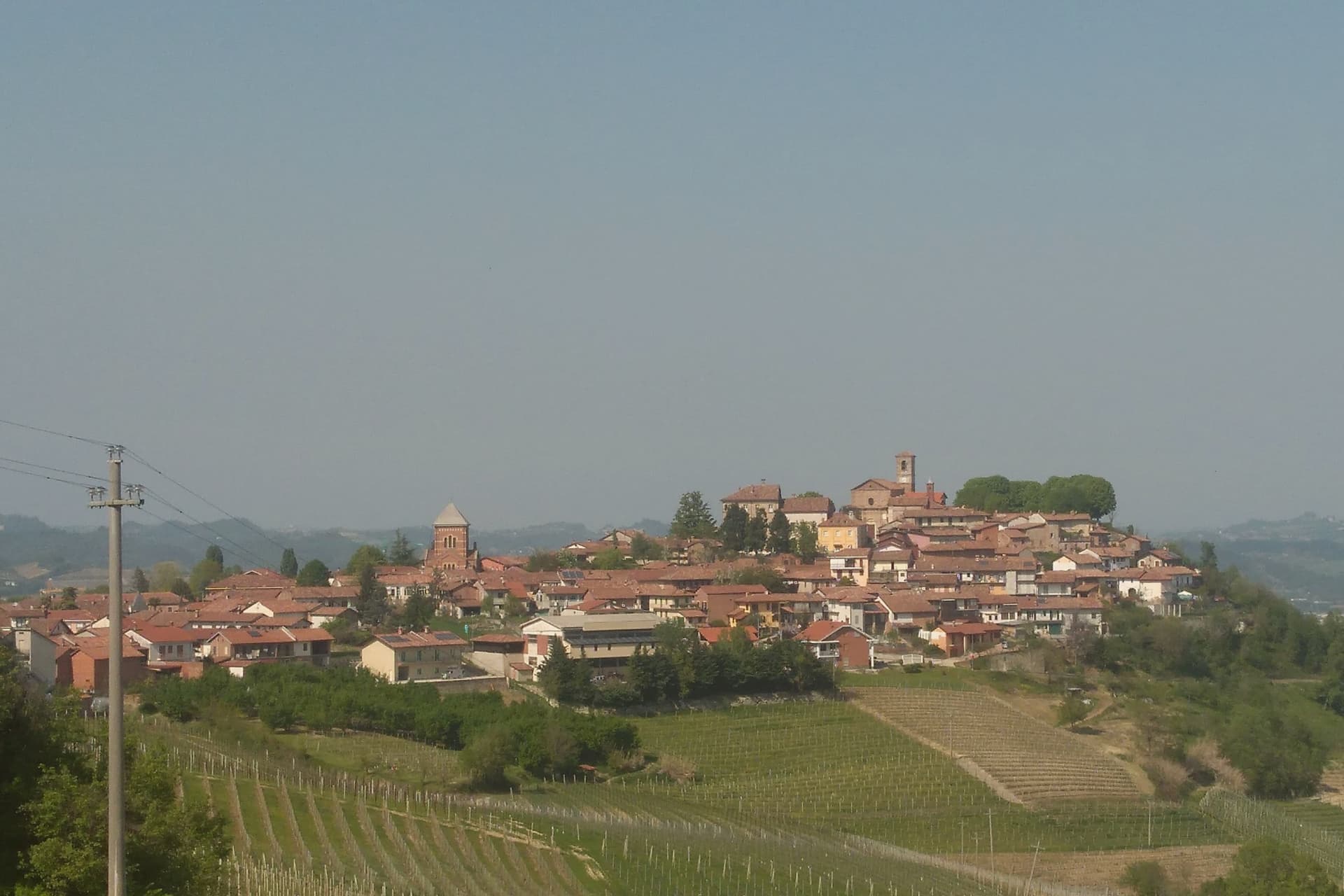
Verduno
Why visit Verduno
Verduno sits fifty kilometers south of Torino on a Langhe ridge above the Tanaro, its vineyards the only ones among the eleven Barolo communes to lean partly toward the river plain rather than folding back into the hills. That position, facing the water and the Alps beyond it, sets the village apart from the rest of the DOCG even before the wine is considered.
The other thing that sets it apart is Pelaverga Piccolo, a native black grape cultivated commercially in only three Langhe communes: Verduno, La Morra and Roddi. It yields a light ruby red with strawberry, rose and a distinct white-pepper finish, and the first single-variety Pelaverga vineyard on these slopes was planted in 1972.
Between the castle on the ridge and the vine on the plain-facing slope, Verduno holds two things most of its neighbors do not: a wine that is Barolo's own, structurally, and a wine that belongs to almost nowhere else.
La Sbornia a Verduno, Real Castello have been named by a guide.
What to see in Verduno
- Castello di Verduno. The castle stands on the Langhe ridge and passed to the Burlotto family in 1909, who still work it as a winery producing Barolo and Pelaverga.
- Centro storico. Small hilltop village arranged around the castle and the parish church, with views across the Tanaro and the northern Barolo vineyards.
- Vigneti di Pelaverga. Indigenous Pelaverga Piccolo plantings on the Verduno slopes, including the first single-variety Pelaverga vineyard planted in 1972.
How to get to Verduno
There is a railway station in the town, so you can arrive without a car and never need one while you are here. Torino is roughly 60 minutes away by road.
Our tip
April through June is the green window in the Langhe, hillsides striped between Nebbiolo and Pelaverga vines, mild evenings on the Verduno ridge. September and October are the harvest months: Pelaverga first, Nebbiolo last, with the surrounding cantine open for tastings and walking through the rows possible without crowds. July and August touch the low thirties on the hills; the centro storico thins after lunch and the cellar tastings move under stone vaults to stay cool.
Cocconato
Why visit Cocconato
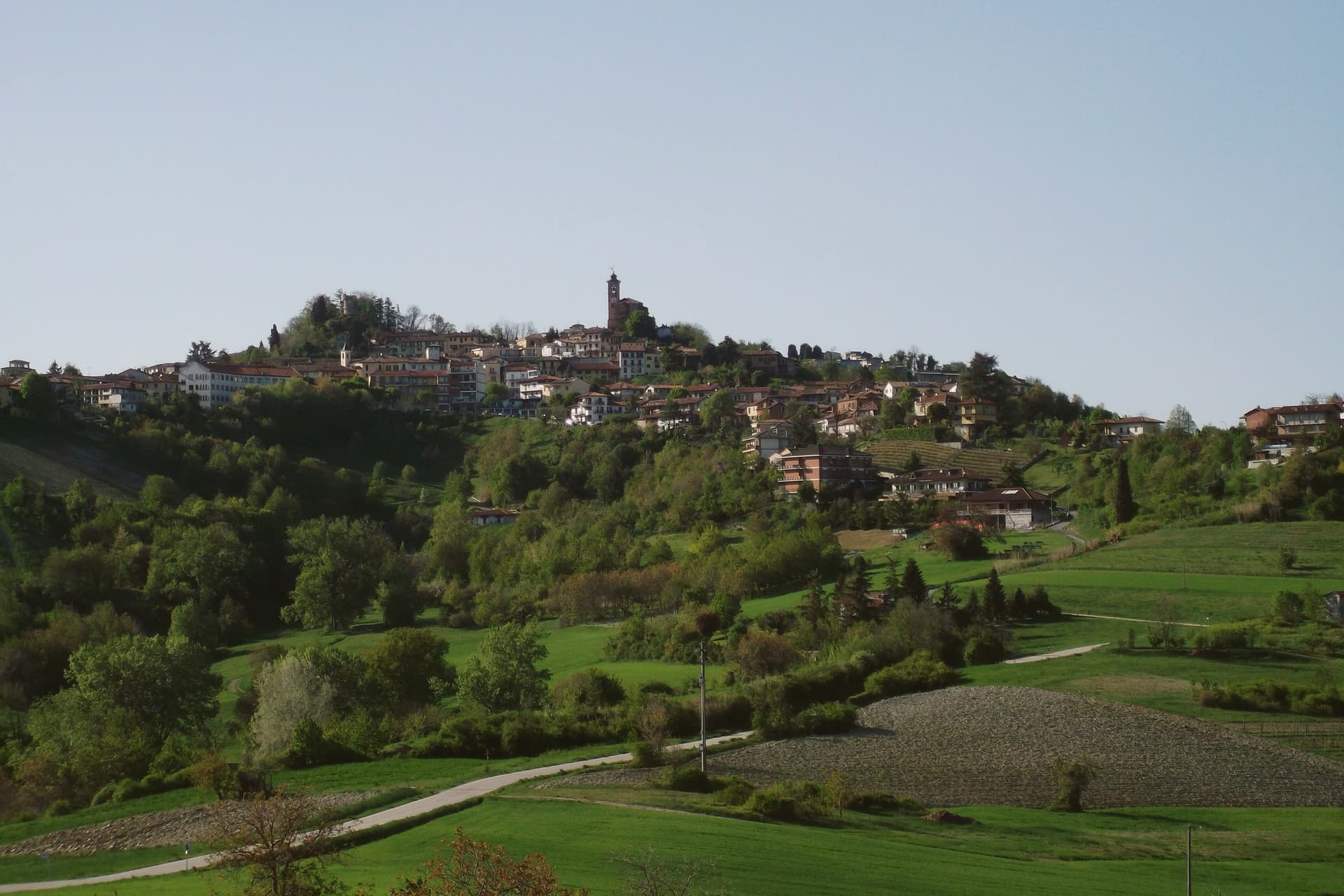
Cocconato sits thirty kilometers east of Torino, on a ridge whose south-facing slope catches enough sun to keep olives, palms and mimosas alive this far north, the reason locals call the area the Riviera del Monferrato. From the tenth century the ridge was held by the Radicati counts, a Manfredian family, as an imperial fief for four hundred years, until 1586: the centro storico that survives is their seat, not a later reconstruction.
The town's two anchors sit close together but answer to different authorities. The civic palace, built in the fifteenth century, faces the seventeenth-century parish church of Santa Maria della Consolazione across the upper piazza, government and religion holding opposite ends of the same small square.
Beyond the built center, the ridge opens onto a belvedere looking south across vineyards toward the Alta Langa and, on clear days, the Monviso massif. Since 1970 the six frazioni of Airali, Brina, Colline Magre, San Carlo, Torre and Tuffo have raced their donkeys in the Palio degli Asini, a modern rivalry laid over an old administrative one.
Cocconato is the only commune in the province of Asti to hold the Bandiera Arancione, a fitting distinction for a ridge that has been organizing the same handful of parts, fief, palace, church, frazioni, for centuries.
Cantina Nicola have been named by a guide.
What to see in Cocconato
- Palazzo Comunale. Pointed-arch porticoes and terracotta-framed windows on the Late Gothic facade, still the building the ridge town organizes itself around.
- Chiesa di Santa Maria della Consolazione. Seventeenth-century parish church anchoring the upper piazza, the religious counterweight to the medieval civic palace below it.
- Centro storico. Medieval ridge town that was the seat of the Radicati counts from the tenth century until 1586, well preserved on the south-facing slope.
How to get to Cocconato
There is a railway station in the town, so you can arrive without a car and never need one while you are here. Torino is roughly 57 minutes away by road.
Our tip
April through June and September through October are the months that earn Cocconato its Riviera nickname: dry warm days on the ridge, vineyards in green or gold, and the palms in the lower gardens visibly out of season. July and August are warm and busy, with Cocco Wine at the end of summer drawing crowds into the centro storico. November through March is the quiet half of the year.
Agliè
Why visit Agliè
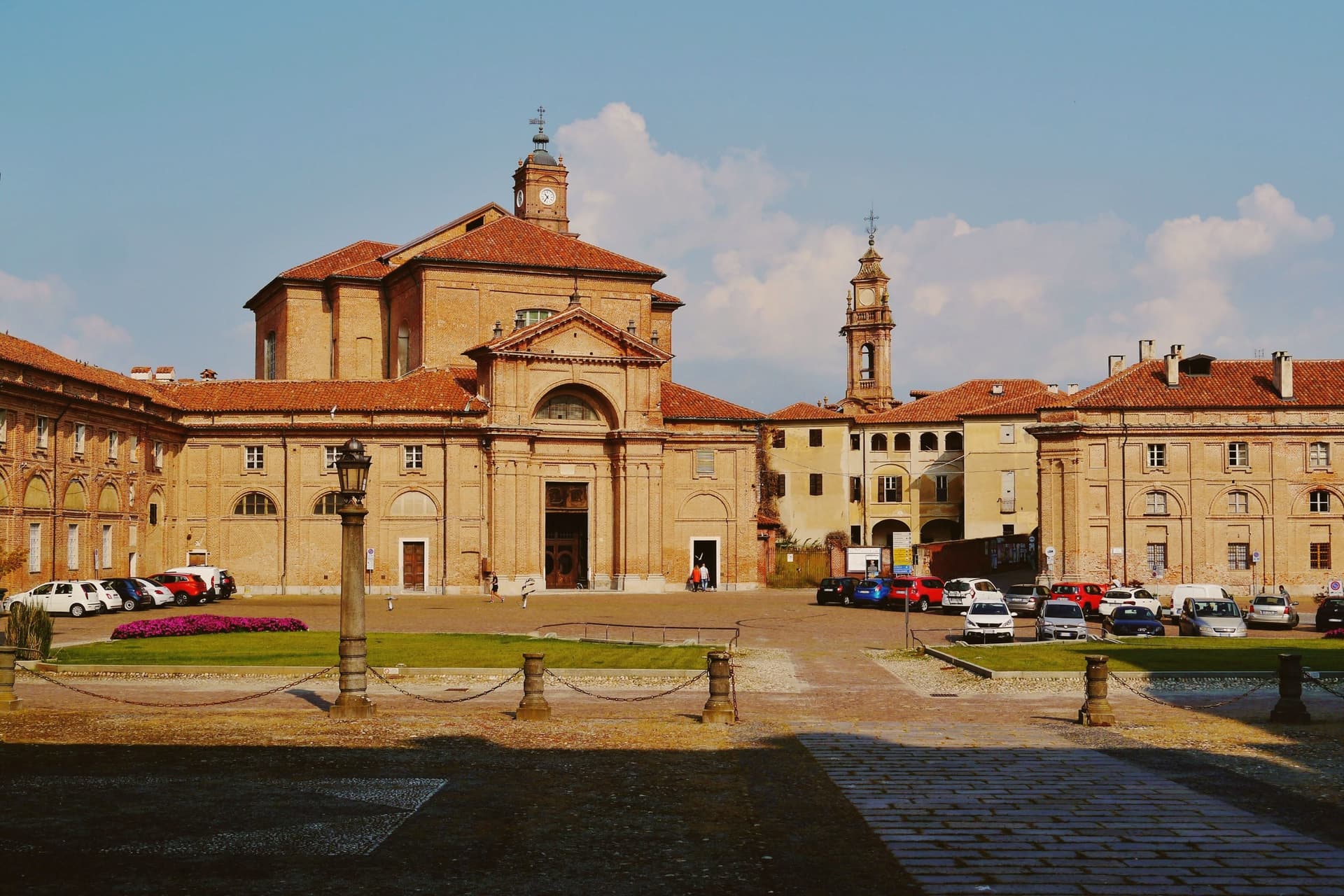
Agliè sits at 330 meters in the Canavese, thirty-five kilometers north of Torino on the foothills above the Po plain. The d'Agliè family held the fortified core from 1259, and the conversion to a Sabauda residence began in the mid-1600s under Count Filippo San Martino d'Agliè, favourite of the Regent Christine of France.
The castle later entered the UNESCO list of Savoy Residences, one of fourteen royal sites recognised together as a single serial property, and its gardens grew alongside it, enlarged in the nineteenth century with terraced Italian and English layouts. The town's other center of gravity lies apart from the castle, at a country house on the edge of the commune where a Crepuscolar poet kept his own quiet ground.
The centro storico adds a third note, a confraternity church faced in glazed terracotta from nearby Castellamonte. The town carries the Bandiera Arancione of the Touring Club, a place where a Savoy court seat, a poet's retreat, and a working parish church occupy the same small radius without competing for it.
What to see in Agliè
- Castello Ducale. The two parallel galleries framing the courtyard and the internal Chapel of San Massimo are the work Amedeo di Castellamonte added for Count Filippo San Martino, the piece that turned a fortified seat into a residence fit for the Savoy court.
- Giardini e Parco del Castello. The eighteenth-century basin stages an allegory in stone: the Dora Baltea meeting the Po, set among the terraced beds where Italian and English styles sit side by side.
- Chiesa di Santa Marta. Confraternity church in the centro storico, decorated with polychrome glazed terracottas from nearby Castellamonte.
How to get to Agliè
Torino is roughly 45 minutes away by road.
Our tip
April through June is the green window for the Canavese hills, when the castle gardens are in full leaf and the morning light works well on the long west façade. July and August are hot in the valley below and the gardens carry the heat; Agliè empties between two and five in the afternoon. September and October are the second peak, with vineyards in the surrounding frazioni turning over for harvest.
La Morra
Why visit La Morra
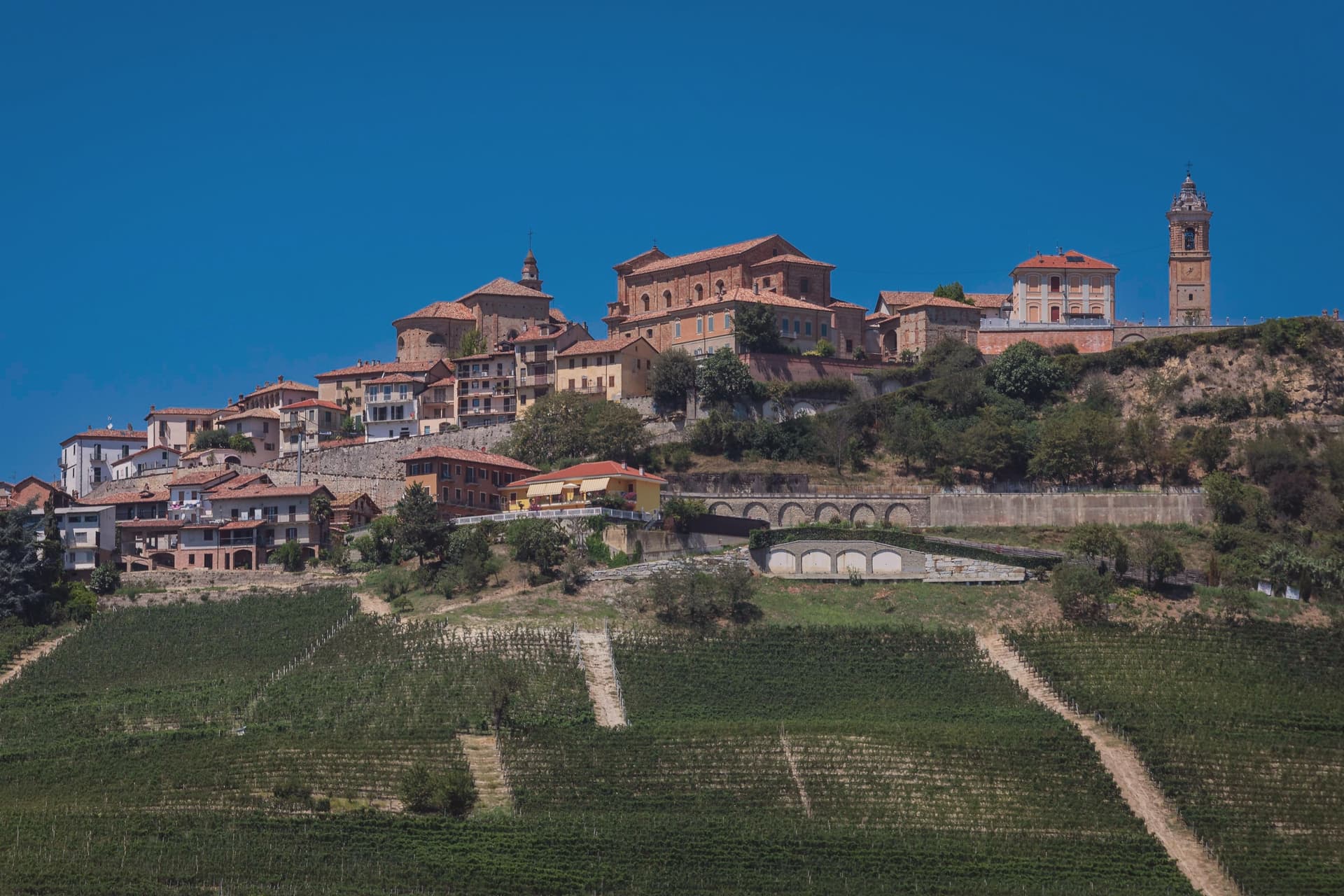
La Morra sits at 513 meters on the western edge of the Barolo zone, fifty kilometers southeast of Torino, the highest of the eleven communes and the one with the widest view over the rest of them. The village itself gathers around the square and the tower; the working part of it, the crus, spreads downhill and outward, Brunate and Cerequio among them, with the Cantina Comunale pouring producers from across that spread under one roof in the old Marchesi di Barolo cellars.
A kilometer outside the centro, below the village, the former abbey sits in the Marcenasco cru with its wine museum, and Renato Ratti bought his first parcel near it in 1965, drawing the first cru map of the zone a decade later. The village is compact and fixed in place; the vineyards around it are what the whole zone is measured against.
Osteria Veglio, Coltivare, Osteria Arborina and 5 more have been named by a guide.
What to see in La Morra
- Belvedere di Piazza Castello. The highest point of the village, with the 18th-century bell tower rising above the terrace.
- Cappella del Barolo (Cappella delle Brunate). A small vineyard chapel among the vine rows of the cru, its two faces given over entirely to the artists' repainting, interior and exterior alike.
- Cantina Comunale di La Morra. Municipal wine cellar founded 1973 in the 18th-century palace of the Marchesi di Barolo, pouring 70+ local producers.
How to get to La Morra
Torino is roughly 59 minutes away by road.
Our tip
April through June bring green vines, mild evenings and the long views the Belvedere is built for. September and October are harvest, when the cellars open and the hills turn copper. July and August push past thirty degrees and the centro thins between two and six, though the elevation keeps nights cooler than Alba.
Ivrea
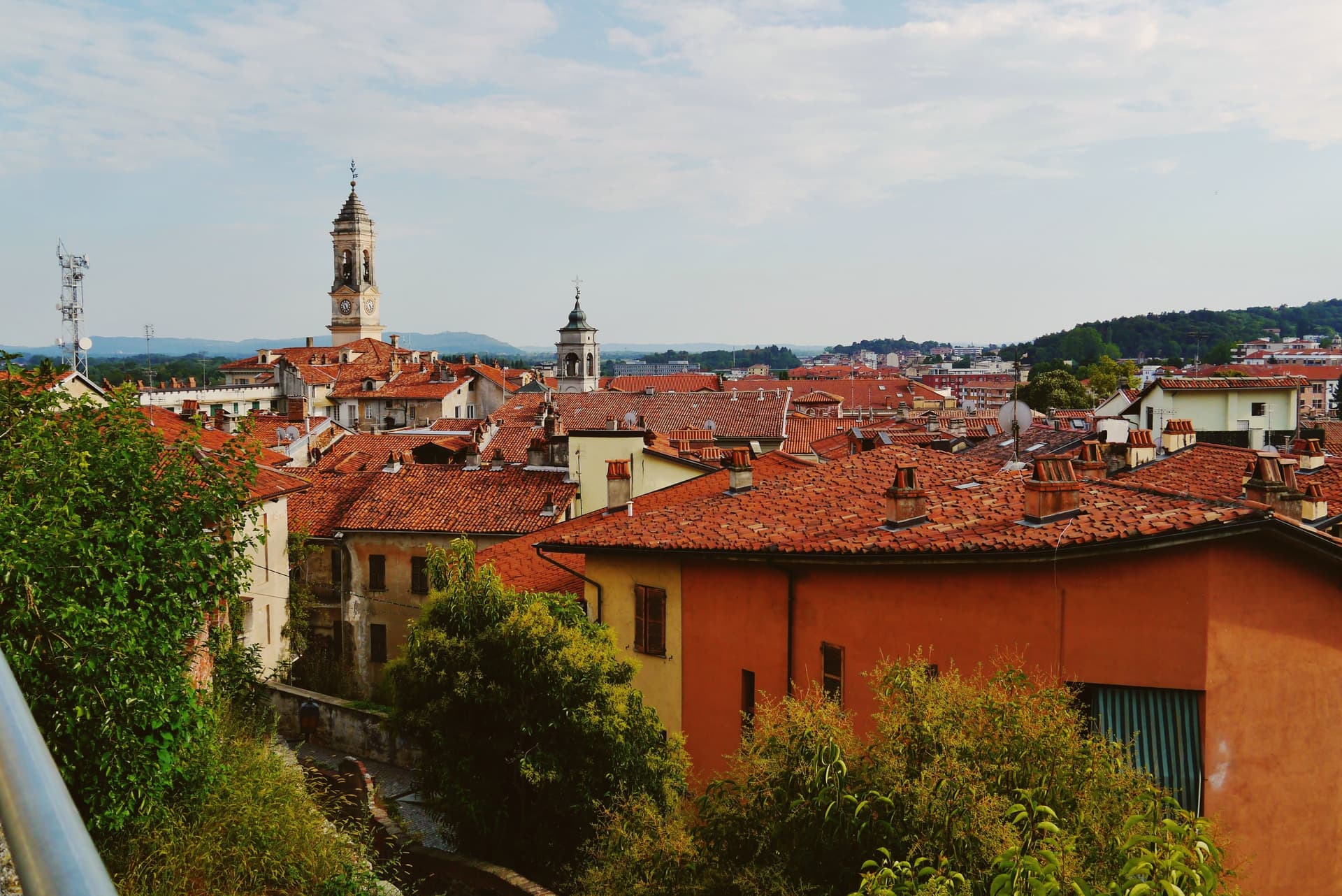
Why visit Ivrea
Ivrea sits at 267 meters where the town meets the river that drains the Aosta valley before it reaches the Po, the Dora Baltea, guarding the Alpine routes into Gaul that made the site worth fortifying in the first place. The medieval town grew upward from that Roman garrison into a seat of regional power, and centuries later the same streets became the frame for an industrial experiment: Camillo Olivetti opened a typewriter factory here in 1908, and his son Adriano rebuilt the town around its workers, threading glass-walled plants, housing, schools, libraries, and cultural centers into the landscape rather than beside it.
The Cinque Laghi lie north of the center, five small lakes left by the Balteo glacier, a different register of water from the Dora Baltea that carried the Roman and industrial town below. The layers do not so much replace each other as sit stacked: a Roman garrison town, a medieval capital, and a twentieth-century factory city occupy the same ground on the same river, and the carnival each February, with its reenacted revolt, is the one moment the town stages its own long memory in public.
La Mugnaia have been named by a guide.
What to see in Ivrea
- Castello di Ivrea. Fourteenth-century red-brick castle of the Savoy on the hill above the centro storico, with four towers and views over the Dora Baltea.
- Duomo di Santa Maria Assunta. Ninth-century cathedral on the site of a Roman temple, with Romanesque crypt and bell tower, the religious anchor of medieval Ivrea.
- MAAM - Museo a Cielo Aperto dell'Architettura Moderna. Open-air museum of the ICO factories and the Talponia underground housing, walkable ground for tracing how the glass-walled plants and worker facilities sit against the town.
How to get to Ivrea
There is a railway station in the town, so you can arrive without a car and never need one while you are here. Torino is roughly 56 minutes away by road.
Our tip
April through October is the open season. May and June green the morainic hills around the Cinque Laghi and the Olivetti factory tours run on full schedule. September and October are dry and quiet, the time to walk the UNESCO industrial route without summer heat.
Alba
Why visit Alba
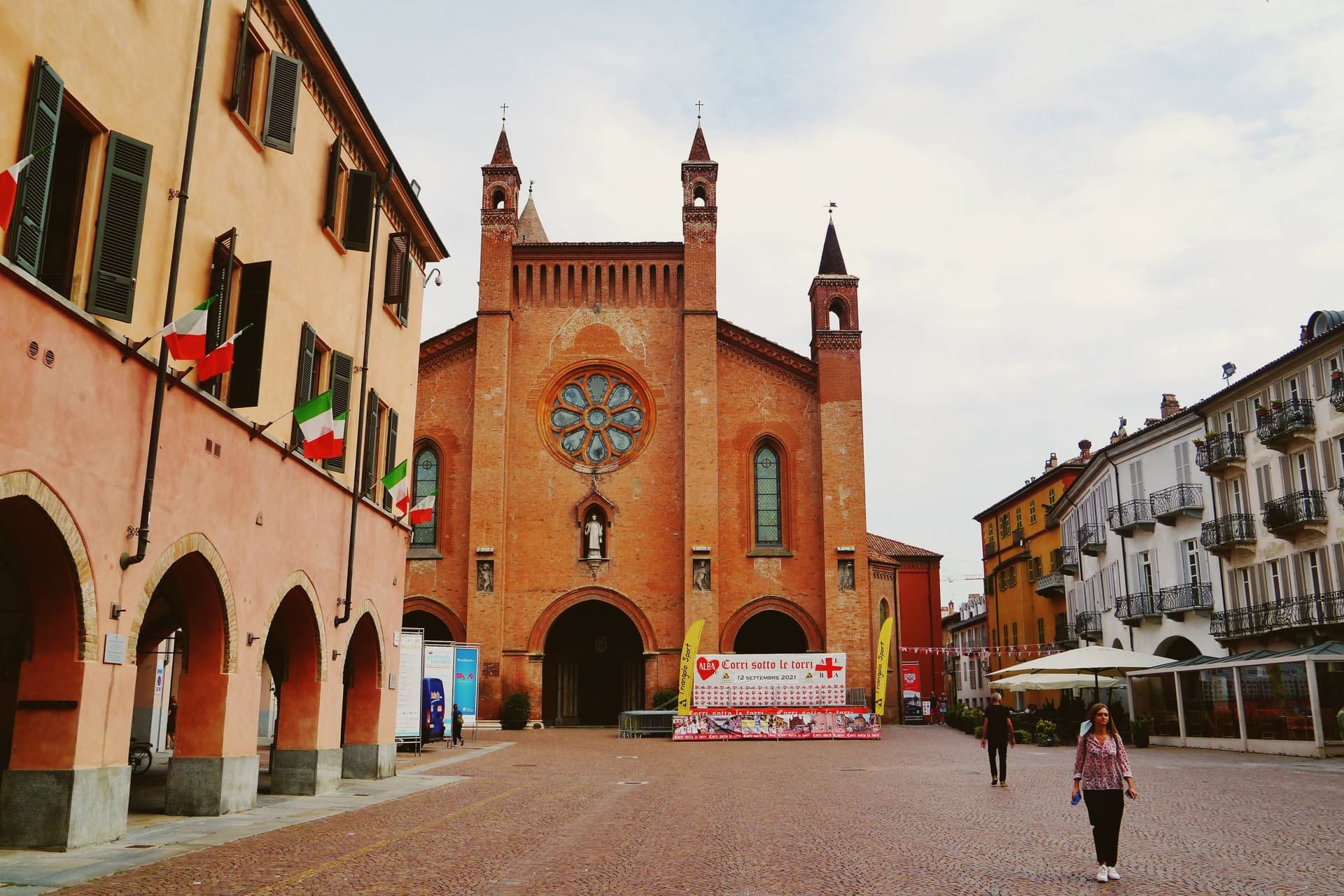
Alba sits at 172 meters on the right bank of the Tanaro, the regional capital of the Langhe and the centre of one of Italy's most concentrated wine and food economies. The Roman city of Alba Pompeia stood on the same site, and the Piazza Risorgimento, locally called Piazza Duomo, is laid out on the line of the old Roman forum.
The Duomo di San Lorenzo dates to the twelfth century and carries a late Gothic red-brick façade and a vaulted nave. In the medieval centuries the town was known as the city of a hundred towers; a few dozen survive, the tallest along Via Cavour.
The Fiera Internazionale del Tartufo Bianco runs across October and November, the oldest white truffle fair in the country. The Palio degli Asini on the first Sunday of October recalls a 1275 dispute with Asti.
The town is the headquarters of Ferrero, the family company that invented Nutella, and the home of Beppe Fenoglio, whose Partisan novels are set in these same hills.
Piazza Duomo, Locanda del Pilone, Ventuno.1 and 10 more have been named by a guide.
What to see in Alba
- Duomo di San Lorenzo. Twelfth-century cathedral with a late Gothic red-brick façade, vaulted nave and 16th-century inlaid wooden choir, on the line of the Roman forum.
- Piazza Risorgimento. Central square on the site of the Roman forum, framed by the Duomo, the Palazzo Comunale and the surviving medieval brick towers.
- Torri medievali. Roughly forty of the original hundred or more brick towers still rise above the rooftops, most clustered along Via Cavour and Via Vittorio Emanuele.
How to get to Alba
There is a railway station in the town, so you can arrive without a car and never need one while you are here. Torino is roughly 58 minutes away by road.
Our tip
April through June are the green months in the Langhe hills, with mild evenings and vineyards in full leaf. July and August touch the mid-thirties; the centro storico empties between two and five in the afternoon. September and October are the heart of the year: harvest in the surrounding cantine, the Palio degli Asini on the first Sunday of October, and the opening weekends of the white truffle fair. Festa Patronale Madonna della Moretta falls in September.
More from Anywhere Italy
- The best hill towns within an hour of Turin
- The best towns that eat well within an hour of Turin
- The best towns you can reach by train within an hour of Turin
 The 10 best hidden wine towns that eat well within 90 minutes of Torino
- The best small wine towns within 90 minutes of Torino
- The best wine towns in the province of Cuneo