
The best small towns with a serious restaurant in the province of Siena
The province of Siena feeds people seriously, and it does it in small places. Cinta senese pork, pici rolled by hand and dragged through garlic and breadcrumbs, pecorino from Pienza's pastures, olive oil pressed in November and poured green over bread still warm. The towns are built of the same materials as the meals, travertine and hot brick and stone the colour of dry earth, ringed by walls and looking out over vines or clay or oak woods. In autumn the white truffle comes down from the Val di Chiana and the Crete, and the dining rooms fill with people who have driven a long way for a table.
Most visitors eat in Siena itself, or in Montalcino between tastings, and the reasons are obvious: the Campo, the Duomo, the cellars, the ease of walking from a hotel to dinner. Those restaurants are good and they are booked out weeks ahead, particularly around the Palio and through the Brunello season. Prices rise with the coach traffic, service runs at a clip, and the tables near the window go to whoever asked first. It works, but it is the version of Sienese eating that everyone else has already ordered.
The vines, the clay hills and the sulphur springs carry on well past the ring road, and so do the kitchens. In the villages below, along the Chianti ridge, out on the Val d'Orcia stone roads, up in the wooded hills toward Monte Cetona, there are dining rooms that answer to the most demanding of the dining guides, in towns where the passeggiata takes a few minutes. Fewer people go. Booking is still wise, but you are more likely to be the only foreign table in the room.
Of the 20 communes we have mapped in the province of Siena, 14 qualify as towns with a serious restaurant: each holds a restaurant listed by the most demanding of the dining guides. This list is the small ones, 6 in all, ordered smallest first. The smallest, Trequanda, has 1,166 residents.
If you are still choosing, we have also written The best small olive oil towns with a serious restaurant in Toscana and The best small olive oil towns in the province of Siena.
Trequanda
Why visit Trequanda
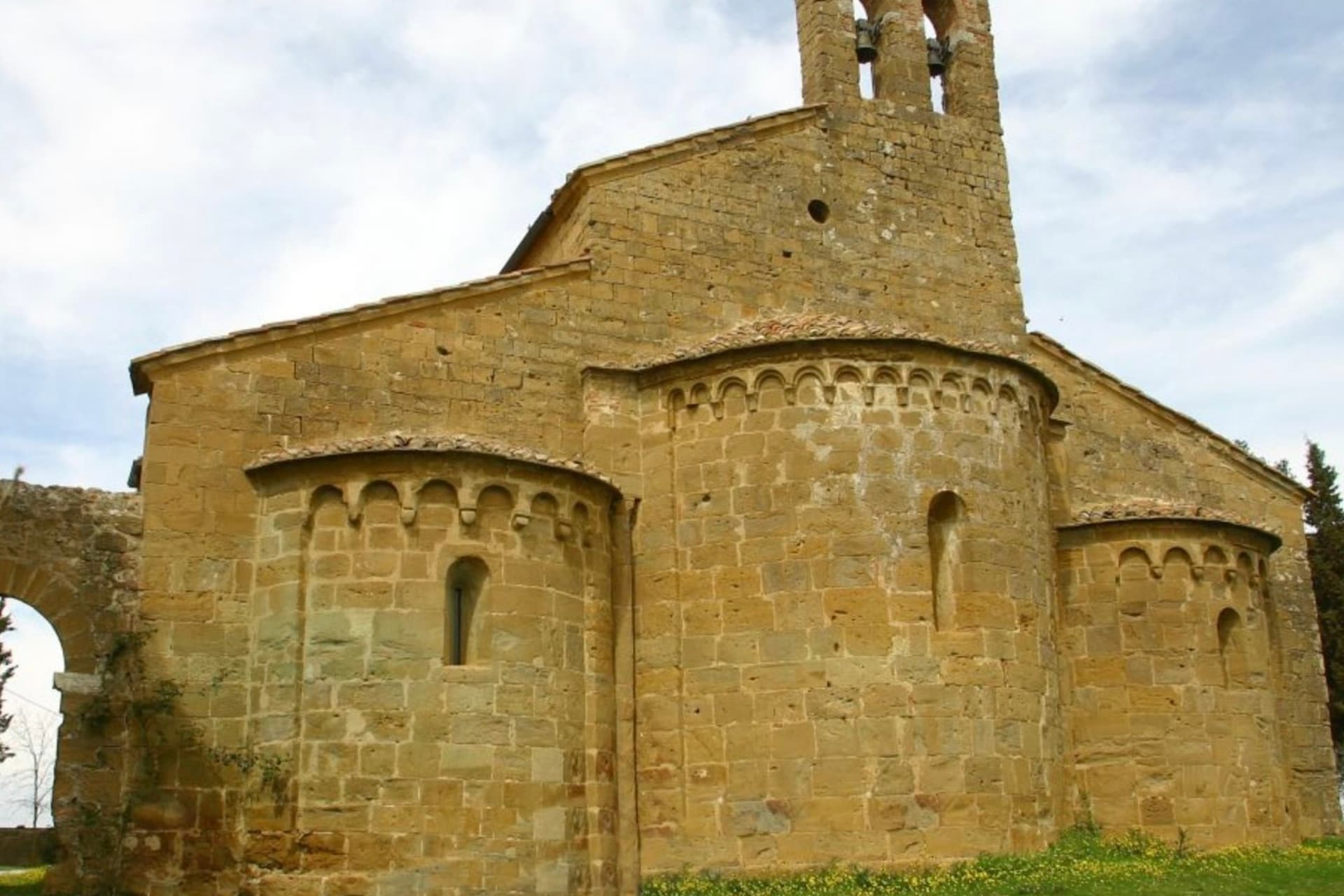
Trequanda is three villages in one comune: Trequanda itself at 453 meters, Castelmuzio, and Petroio at 486 meters, scattered across the hills southeast of Siena. The first written record dates to 1198, when the Cacciaconti of Scialenga held it as fief; in 1211 Emperor Otto IV gave them the right to collect tolls.
In 1553 the village was among the first to be annexed to the Grand Duchy of Tuscany. The Cacciaconti castle still anchors the centro storico, the Pieve dei Santi Pietro e Andrea next to it, built from 1327 in a Gothic-Romanesque mix and renovated in the Renaissance.
Petroio has produced fine ornamental terracotta since the early sixteenth century: lions and dogs and pineapples and chimney pots, the surface of half the gardens in central Tuscany. The municipality holds the Orange Flag from the Italian Touring Club and was inscribed in 2018 in the national register of historic rural landscapes.
Il Conte Matto, Fattoria del Colle have been named by a guide.
What to see in Trequanda
- Castello dei Cacciaconti. Medieval fortress at the center of Trequanda, seat of the Cacciaconti di Scialenga from the twelfth century.
- Pieve dei Santi Pietro e Andrea. Gothic-Romanesque parish church begun in 1327, expanded in the Renaissance, holding a fresco attributed to Sodoma.
- Castelmuzio. Walled hilltop frazione between Trequanda and Pienza, on the rural landscape register, the smallest of the three borghi.
How to get to Trequanda
There is a railway station in the town, so you can arrive without a car and never need one while you are here. Perugia is roughly 70 minutes away by road.
Our tip
April through June brings the green months across the Crete Senesi, the clay hills holding their color before the summer burn. September and October are dry and gold, the olive harvest running through November in the Petroio and Castelmuzio frantoi. July and August touch thirty-six degrees and the three borghi go quiet between four and seven in the afternoon.
San Casciano dei Bagni
Why visit San Casciano dei Bagni
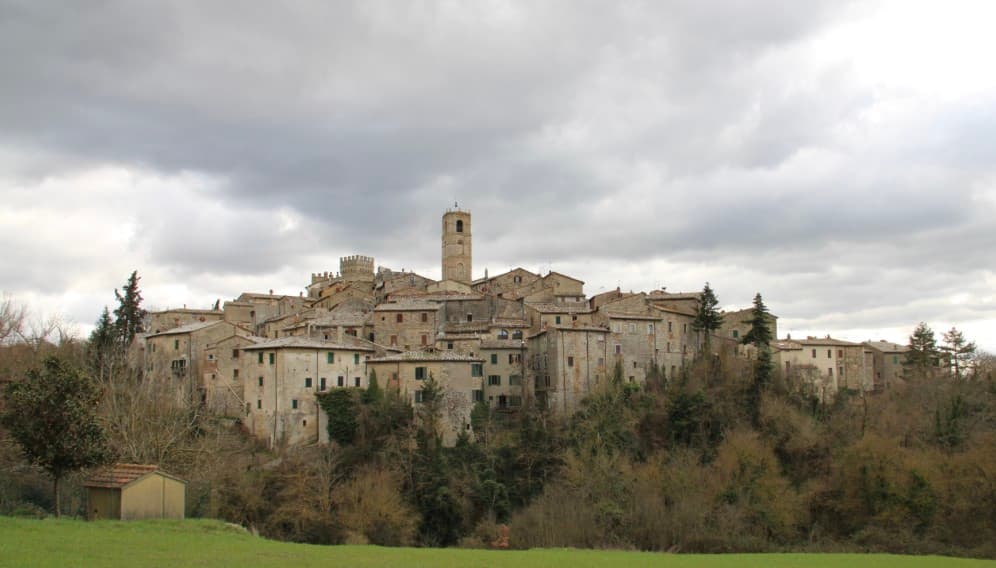
San Casciano dei Bagni sits at 582 meters at the southern edge of the province of Siena, above 42 hot springs that average 42 degrees Celsius. The baths were used continuously from Etruscan through Roman times and again from the Renaissance, when visitors came from across Europe.
In 2022, an excavation that began in 2019 at the ancient sanctuary turned up 24 bronze votive statues protected by mud, with around 6,000 coins in gold, silver and bronze. The find was the largest of its kind in fifty years; most surviving Etruscan votive material is terracotta.
The 1,500 residents live on a basalt outcrop above the Roman thermal complex, in a centro storico of stone houses and three small churches. The borgo joined the Borghi più belli network in 2014 and remains one of the smallest communes in Toscana to carry both that label and Bandiera Arancione.
Daniela, Castello di Fighine have been named by a guide.
What to see in San Casciano dei Bagni
- Santuario Ritrovato. Etruscan-Roman thermal sanctuary excavated since 2019, where 24 bronze votives and around 6,000 coins were recovered in 2022.
- Bagno Grande. The principal natural pool of the 42 hot springs, used from the second century BC through the Renaissance and reopened to the public.
- Collegiata di San Leonardo. Romanesque parish church in the centro storico, restored in the seventeenth century, with a baptismal font carved from local travertine.
How to get to San Casciano dei Bagni
Perugia is roughly 68 minutes away by road.
Our tip
The thermal pools make the calendar different here. Winter is the season many visitors prefer, when the 42-degree water steams against cold air and snow occasionally dusts the basalt outcrop. April through June and September into October are the most balanced months: warm hill light, the dry-stone walls of the borgo at their best, the sanctuary excavations open to guided tours. Sagra del Ciaffagnone di San Casciano dei Bagni falls in June.
Chiusdino
Why visit Chiusdino
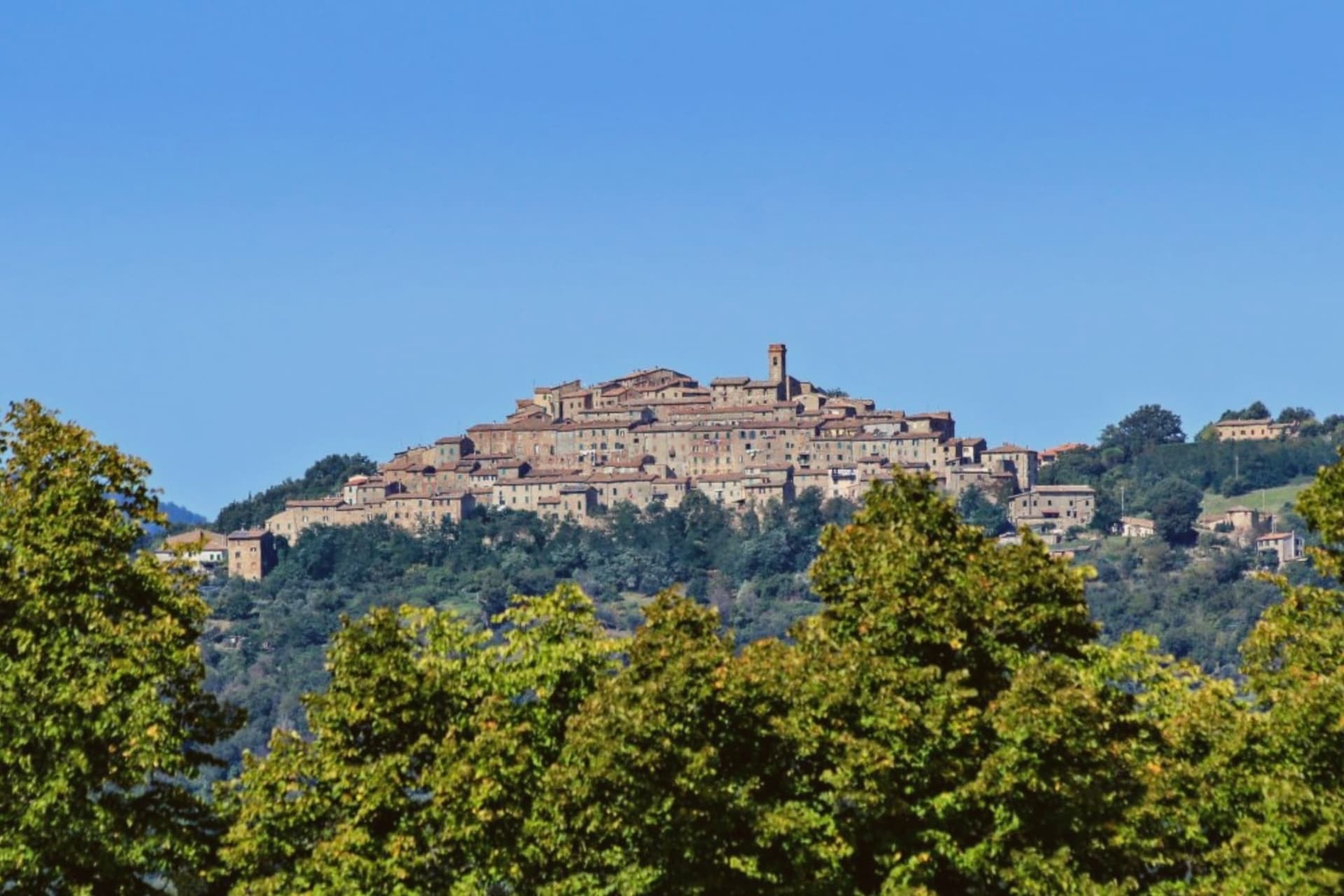
Chiusdino was founded under Lombard rule between 568 and 569, on a metalliferous hill between the Val di Farma and the upper Merse. The village sits at 564 meters; five kilometers below it, on the floor of the Merse valley, the ground opens into flatter pasture where the Cistercians later built.
The two sites read as a pair: the hill town where a wealthy knight was born around 1148, and the valley floor where, a century later, an entire abbey rose to mark what he had done above it on Monte Siepi. Galgano climbed that hill on Christmas Day 1180, drove his sword into a rock as a cross, and lived as a hermit until he died the following year.
Pope Lucius III canonized him in 1185. Metallurgical analysis has dated the blade still fixed in the stone to the late twelfth century, which places the object itself in the period the story claims for it.
The Cistercians who built below, between the 1220s and 1280s, worked in the French Gothic style at the scale of a cathedral; when the roof came down in 1786 it was never replaced, and the church has stood open to the weather since. A hill settlement, a hermit's rock above it, and an unroofed church on the valley floor below: three sites at different elevations, each holding a different stage of the same account.
Saporium have been named by a guide.
What to see in Chiusdino
- Abbazia di San Galgano. Built 1220s-1280s in French Gothic, the largest open-air church in Italy: a nave and side aisles standing without a roof, arches framing sky instead of vaulting.
- Cappella di Montesiepi. A round chapel raised over the stone where Galgano's sword is still lodged, the blade visible through a case set into the rock.
- Centro storico di Chiusdino. A hill village with the house where Galgano was born and the Pieve di San Michele Arcangelo standing at the highest point.
How to get to Chiusdino
Firenze is roughly 112 minutes away by road.
Our tip
April through June and September through October are the months the Merse valley shows best: green or gold depending on the season, the abbey light coming in at low angle through the empty windows. Concerts and theater are staged inside the roofless church in summer evenings. July and August touch thirty-five degrees; the centro storico empties between four and seven in the afternoon.
San Quirico d'Orcia
Why visit San Quirico d'Orcia
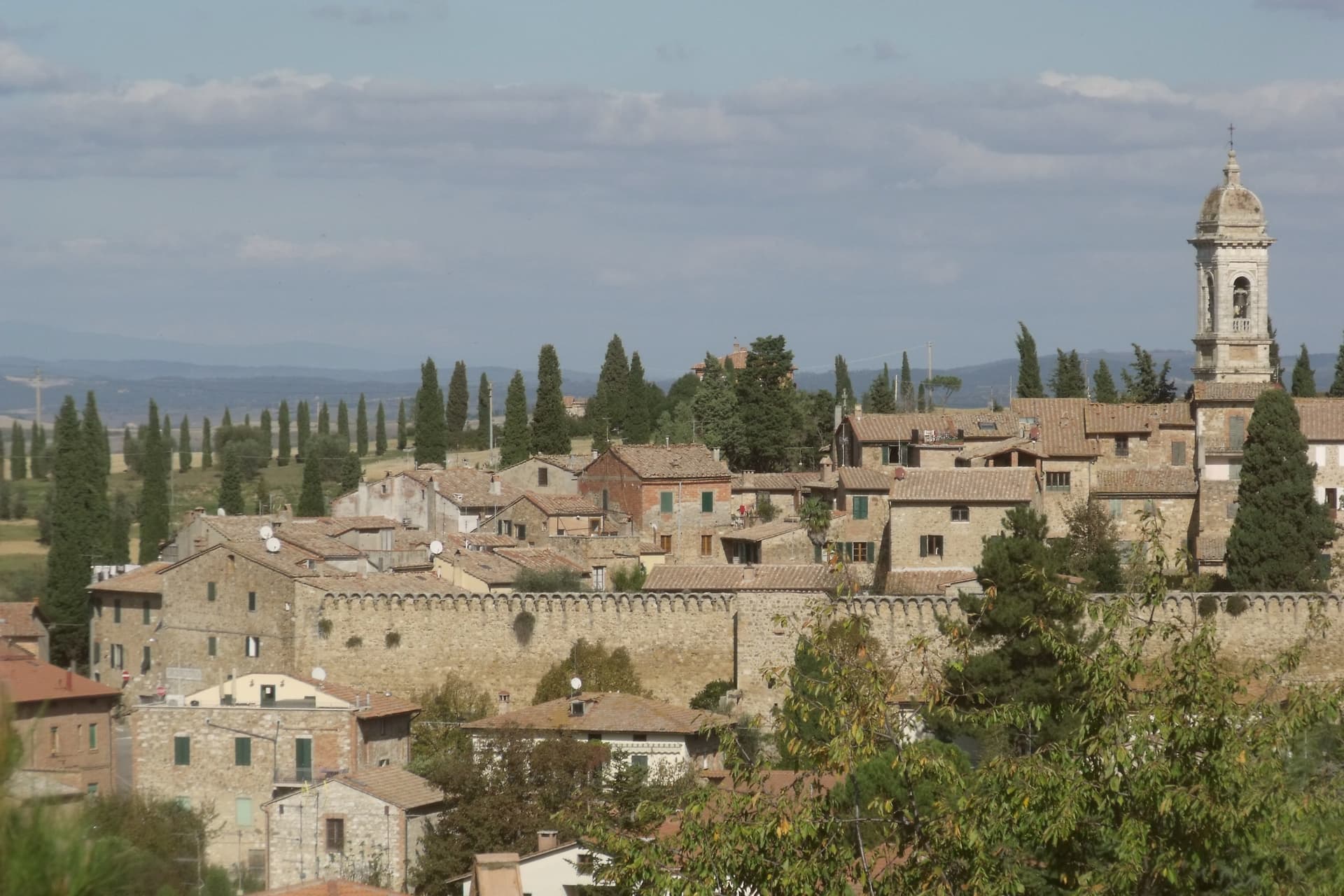
San Quirico d'Orcia sits at 409 meters on a low rise in the Val d'Orcia, the rolling clay-and-tufa landscape inscribed by UNESCO in 2004 as a cultural landscape shaped by fourteenth and fifteenth-century Sienese governance. The town was a stage on Sigeric the Serious's tenth-century Via Francigena from Canterbury to Rome and has remained a working stop on the route ever since.
The Collegiata dei Santi Quirico e Giulitta was built at the end of the twelfth century over an eighth-century baptistery; the lateral portal added in 1288 is attributed to Giovanni Pisano, then working on the Siena cathedral. The Horti Leonini, the geometric boxwood garden laid out by Diomede Leoni around 1580 inside the town walls, hosts the Forme nel Verde sculpture exhibition every summer since 1971.
Bagno Vignoni, the frazione five kilometers down the road, has a thermal pool at the center of its piazza, used since Etruscan times. Few comuni this small carry UNESCO, thermal and Francigena signals at once.
Trattoria Toscana al Vecchio Forno, Da Ciacco have been named by a guide.
What to see in San Quirico d'Orcia
- Collegiata dei Santi Quirico e Giulitta. Romanesque parish church built late twelfth century over an eighth-century baptistery, with the 1288 lateral portal attributed to Giovanni Pisano.
- Horti Leonini. Italianate boxwood garden laid out by Diomede Leoni around 1580 inside the town walls, hosting the Forme nel Verde sculpture exhibition since 1971.
- Bagno Vignoni. Frazione five kilometers south, with a sixteenth-century thermal pool at the center of its piazza, fed by springs used since Etruscan times.
How to get to San Quirico d'Orcia
Perugia is roughly 96 minutes away by road.
✷ We have written about San Quirico d'Orcia
“When the film industry needed a picture of heaven, of the fields a dead hero walks home to, they came and shot it here, and that is the truest thing anyone has ever said about the Val d'Orcia. It is not a place. It is the afterlife as imagined by people who lived in cities. It is how the country looks to men who never spent an hour in it, dreamed up by Florentine bankers five hundred years ago and maintained, beautifully, ever since.”
Read our piece on San Quirico d'Orcia →Val d'Orcia | The Postcard Is Constructed
Our tip
April through June and September into October are the gold months in the Val d'Orcia: green wheat in spring, ochre stubble by autumn, low light that defines the cypress ridges. The Festa del Barbarossa runs the third Sunday of June with archery, jousts and crossbow contests between the town quarters. July and August are hot and busy; the centro storico fills with day-trippers from Pienza and Montalcino. Festa del Barbarossa a San Quirico d'Orcia falls in June.
Castellina in Chianti
Why visit Castellina in Chianti
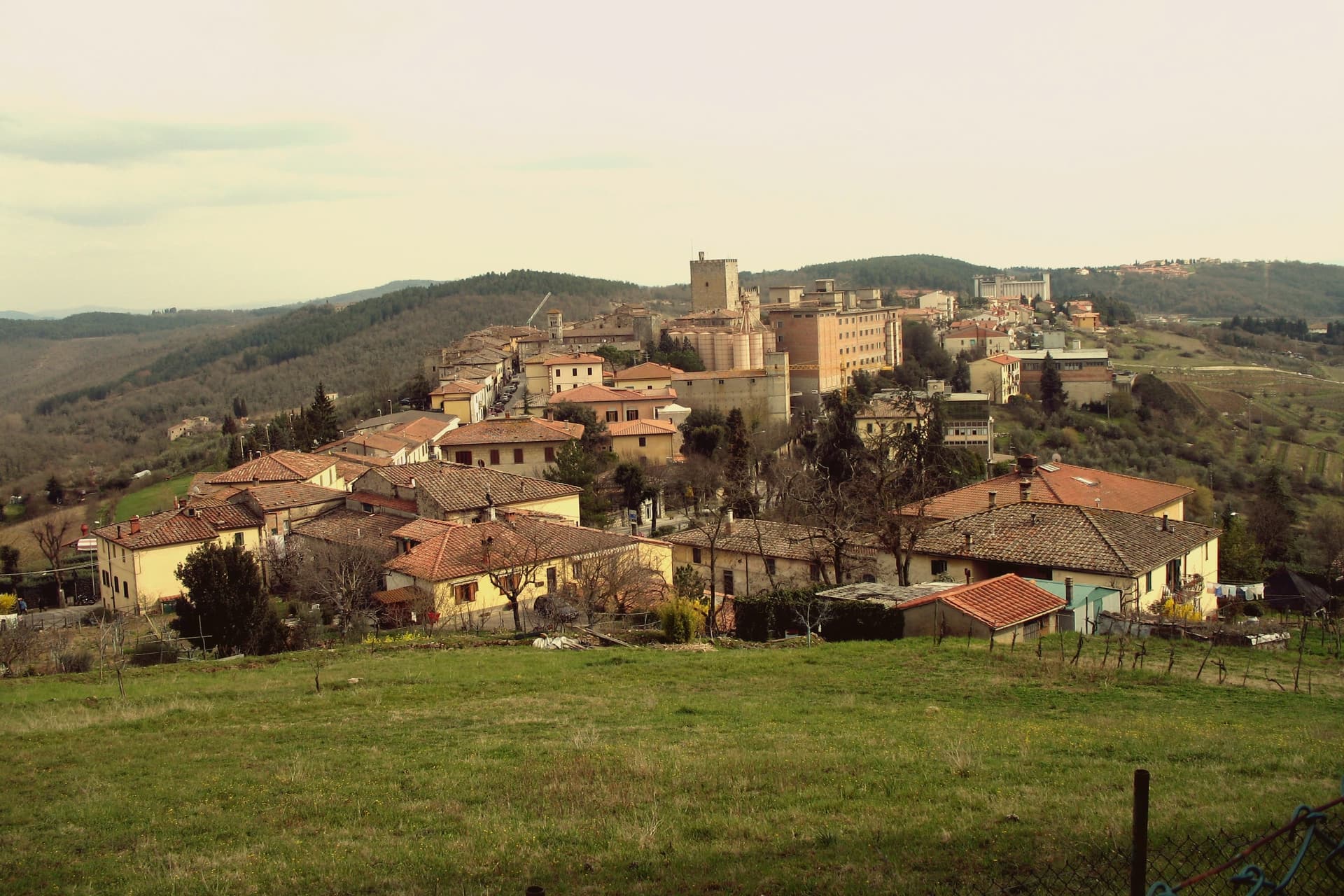
Castellina in Chianti sits at 578 meters on the watershed between the Arno and Ombrone basins, fifteen kilometers northwest of Siena and thirty-five south of Florence. Its position on the historic frontier between the two republics shaped the town: it was a Sienese border fortification reinforced in the fifteenth century by Filippo Brunelleschi and Giuliano da Sangallo against firearm warfare.
The Rocca with its fifteenth-century tower dominates the centro storico and now houses the Museo Archeologico del Chianti Senese, opened in 2006. The Via delle Volte runs the length of the eastern wall: an original ancient pomerium, once open to the sky, gradually built over by private houses against the wall and now a covered arcaded passage lined with workshops and trattorie.
The Tumulo Etrusco di Montecalvario, a sixth-century BC tomb with four burial chambers carved on the cardinal axes, sits a kilometer from the centro storico. The Gallo Nero of Chianti Classico DOCG is grown on the slopes below.
Albergaccio di Castellina, Osteria di Fonterutoli, Passo dopo Passo Osteria have been named by a guide.
What to see in Castellina in Chianti
- Rocca di Castellina. Fifteenth-century fortification with imposing keep, now housing the Museo Archeologico del Chianti Senese, opened in 2006.
- Via delle Volte. Covered arcaded walkway along the eastern wall, once an open pomerium, built over by houses pressing against the fortifications and now lined with workshops.
- Tumulo di Montecalvario. Sixth-century BC Etruscan tomb a kilometer from town, with four burial chambers carved on the cardinal compass points, excavated in the early 1900s.
How to get to Castellina in Chianti
Firenze is roughly 63 minutes away by road.
✷ We have written about Castellina in Chianti
“The wine is the whole economy of these hills, every village with its own, the region’s name stamped on the most famous red in Italy. Tuscan food runs to cured and roasted meat, so the wine ran red to meet it, lighter than you expect, almost fruity, easy, made to sit beside a steak and not to be lectured about. Here is the only wine knowledge you need on this road: it is all good.”
Read our piece on Castellina in Chianti →Road to Siena | The Long Way Is the Better Way
Our tip
April through June and September into October are the working months on the Chianti watershed: vine work, harvest from mid-September, mild days at 578 meters. The Festa del Vino in the second half of September fills the centro storico for a long weekend. July and August are warmer but stay below the inland Maremma heat, and the Via delle Volte is reliably cool.
Cetona
Why visit Cetona
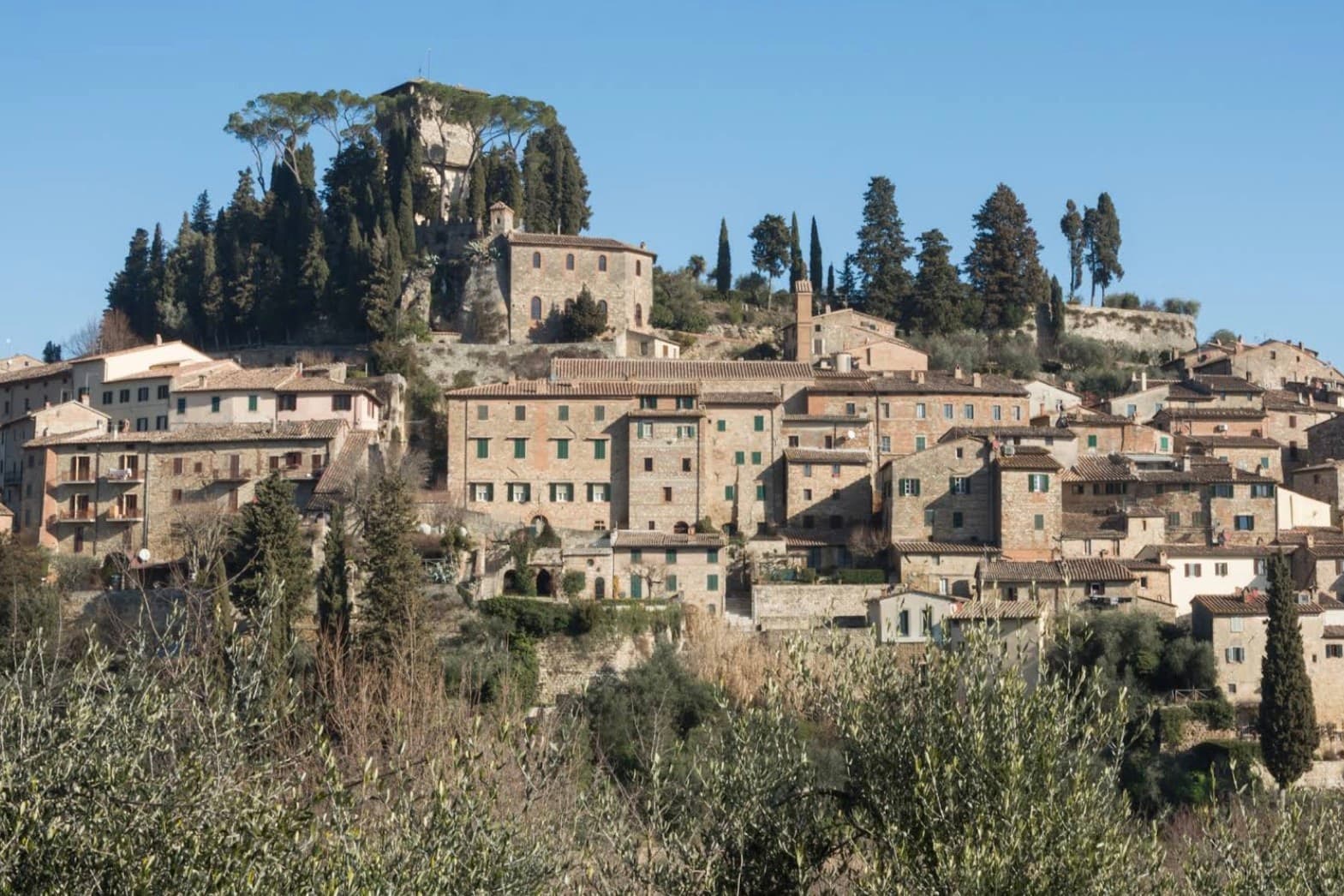
The town sits on the western flank of a ridge at the meeting point of Toscana, Umbria and Lazio, where the mountain divides the Val d'Orcia from the Val di Chiana. The medieval comune passed between Siena, Orvieto and Perugia before falling to Siena in the late fourteenth century, and it was Cosimo I who later sold it whole to a marchese.
The fortress at the top of the grid and the square laid out below it are two halves of the same Renaissance move: a private residence replacing a garrison at the summit, a flat civic stage opened up at the base. Above the town, in the woods, the hermitage and the caves belong to a much older layer, human use of the mountain reaching back to the Mesolithic, long before any comune or marchese laid claim to it.
What the town adds up to is a settlement built in tiers: a prehistoric mountain, a contested medieval center, and a Renaissance overlay that reorganized the base of the hill without touching what stood above it.
Da Nilo, Il Tiglio di Piazza da Nilo have been named by a guide.
What to see in Cetona
- Piazza Garibaldi. Elliptical square at the foot of the medieval grid, flat and open where the streets above it climb steeply. The civic stage of the borgo, still the first thing that orients a visitor.
- Rocca di Cetona. Fortress at the top of the centro storico, its walls and keep still standing though the interior became a private residence rather than a garrison.
- Convento di San Francesco. Franciscan convent below the borgo, founded in 1212, with a single-nave church and a small cloister still in religious use.
How to get to Cetona
Perugia is roughly 78 minutes away by road.
Our tip
April through June and September into October are the months Cetona keeps its calmest pace, the wooded slopes of Monte Cetona green or rust depending on the half. July and August are hot in the centro storico but the mountain trails above 800 meters stay cool. The Mostra del Tartufo, dedicated to the local white truffles, runs the second weekend of November in Piazza Garibaldi. Sagra del Bico di Cetona falls in June.
More from Anywhere Italy
- The best small olive oil towns with a serious restaurant in Toscana
- The best small olive oil towns in the province of Siena
- The best small hill towns with a serious restaurant in Toscana
- The 10 best small hill towns in the province of Siena
- The best hidden towns with a food festival that have a serious restaurant in Toscana
- The best hidden towns with a medieval festival in the province of Siena